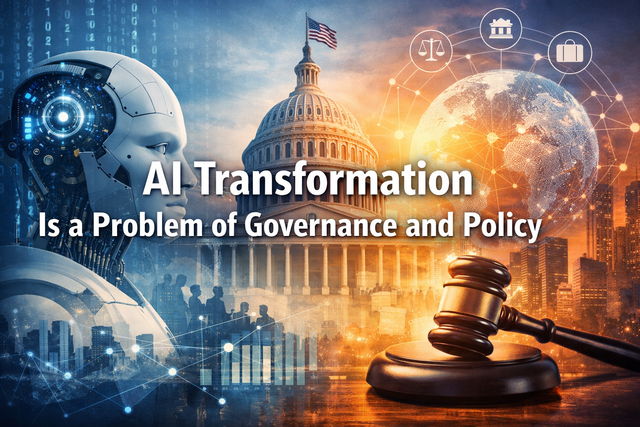
AI Transformation Is a Problem of Governance and Policy
AI Transformation Is a Problem of Governance before it is a problem of code, computation, or even capability. That may sound counterintuitive in a world obsessed with algorithms, neural networks, and exponential progress. Yet the deeper challenge is not whether artificial intelligence can perform tasks faster or more accurately than humans. The real question is who decides how it is deployed, who benefits from it, who bears its risks, and who is accountable when things go wrong.
Technological revolutions have always disrupted societies. The steam engine reshaped labor. Electricity transformed production. The internet rewired communication. But artificial intelligence is different in both scope and speed. It penetrates every sector—healthcare, education, finance, defense, media, transportation—simultaneously. It amplifies human decision-making, replaces routine tasks, and even shapes perception through recommendation systems and generative tools.
And that is precisely why AI Transformation Is a Problem of Governance. It forces governments, institutions, corporations, and civil societies to rethink regulation, oversight, ethical frameworks, global coordination, and democratic accountability at a scale never before experienced.
AI Transformation Is a Problem of Governance, Not Just Innovation
At first glance, AI appears to be an innovation challenge. Companies race to build better models. Startups compete for funding. Nations invest in research labs and chip manufacturing. But innovation alone cannot determine how AI integrates into society.
Governance answers different questions:
- What standards define safe deployment?
- How do we prevent systemic bias?
- Who owns the data that trains AI systems?
- How do we protect privacy?
- What happens when autonomous systems cause harm?
- How do we prevent AI from destabilizing democratic institutions?
When left purely to market forces, technology often evolves faster than safeguards. History offers sobering lessons. Social media platforms scaled globally before policymakers fully grasped their influence on elections, mental health, and misinformation. The result was reactive regulation rather than proactive governance.
With AI, reactive governance could prove far more dangerous.
Why AI Transformation Is a Problem of Governance in Democracies
Democratic societies face a delicate balance: encouraging innovation while protecting citizens’ rights. AI systems influence hiring decisions, loan approvals, predictive policing, medical diagnostics, and content moderation. When algorithms shape opportunities, they indirectly shape equality.
In democracies, governance must address:
- Transparency – Citizens deserve to know when AI systems affect them.
- Accountability – There must be mechanisms for redress when harm occurs.
- Public Oversight – Regulatory frameworks should involve stakeholders beyond corporations.
- Ethical Alignment – Systems must reflect societal values, not just efficiency metrics.
Without strong governance, AI can quietly entrench inequality. Biased training data can perpetuate discrimination. Automated systems can obscure responsibility. Decisions may become “black boxes” that even developers struggle to explain.
Governance, therefore, becomes a safeguard for democratic legitimacy.
AI Transformation Is a Problem of Governance in Authoritarian Contexts
In non-democratic systems, AI governance takes a different trajectory. Instead of emphasizing rights and transparency, governments may prioritize surveillance, social control, or centralized data management.
AI-powered facial recognition, predictive analytics, and social scoring systems can consolidate state power. In such contexts, governance still exists—but it may serve control rather than accountability.
This divergence creates a geopolitical challenge. If different political systems adopt radically different AI governance models, global norms become fragmented. Competing standards can create friction in trade, diplomacy, and digital cooperation.
Thus, AI governance is not merely a domestic issue; it is a global political question.
AI Transformation Is a Problem of Governance in the Labor Market
One of the most visible impacts of AI is automation. From manufacturing robots to AI-generated content, machines increasingly perform tasks once considered uniquely human.
But automation is not new. The industrial revolution also displaced workers. What is different today is the speed and breadth of transformation. White-collar jobs—law, journalism, software development, accounting—are no longer immune.
Governance must address:
- Workforce retraining and reskilling programs.
- Social safety nets for displaced workers.
- Policies that encourage inclusive growth.
- Tax structures that adapt to automation-driven productivity.
If AI-driven productivity increases profits while shrinking middle-class opportunities, social unrest may follow. Economic inequality could widen, undermining political stability.
AI Transformation Is a Problem of Governance because it demands structural adaptation—not just technological adoption.
Data Governance: The Foundation of AI Transformation
AI systems rely on vast datasets. These datasets contain personal information, behavioral patterns, biometric data, and proprietary insights. Data is the fuel of AI.
Without robust data governance:
- Privacy violations proliferate.
- Surveillance becomes normalized.
- Consent becomes ambiguous.
- Cross-border data flows create jurisdictional conflicts.
Data governance requires clarity on ownership, usage rights, storage security, and transfer protocols. It also demands global cooperation, since digital data flows do not respect national boundaries.
Policies like data localization laws, privacy regulations, and digital trade agreements are now central to AI governance debates. The challenge is crafting rules that protect individuals without stifling innovation.
AI Transformation Is a Problem of Governance in National Security
Artificial intelligence increasingly influences military strategy, cyber defense, and geopolitical competition. Autonomous weapons, predictive threat analysis, and AI-enhanced surveillance systems alter the nature of conflict.
Governance questions include:
- Should lethal autonomous weapons be banned?
- How do nations prevent AI arms races?
- What international treaties are needed?
- How can cyberattacks using AI be deterred?
The risk is escalation without adequate oversight. Just as nuclear technology required global treaties, AI may demand international agreements to prevent misuse.
Without governance, strategic competition could spiral into destabilizing arms races.
The Ethical Dimension: Values Embedded in Code
AI systems do not exist in moral vacuums. Developers encode objectives. Companies define optimization goals. Policymakers set regulatory boundaries.
Ethical concerns include:
- Bias and discrimination.
- Algorithmic transparency.
- Consent and autonomy.
- Human oversight.
- The potential erosion of human agency.
When AI systems make decisions that affect lives, ethical governance becomes essential. Self-regulation by corporations is insufficient if profit incentives conflict with public welfare.
Therefore, AI Transformation Is a Problem of Governance because ethics cannot be outsourced to algorithms alone.
Corporate Governance and AI Responsibility
Private companies lead much of AI innovation. Tech giants invest billions in research and deployment. Startups experiment rapidly, often scaling before regulators respond.
Corporate governance must evolve to include:
- AI risk committees at the board level.
- Ethical review processes.
- Transparent reporting standards.
- Independent audits of AI systems.
- Clear accountability structures.
Shareholders increasingly demand responsible innovation. Investors recognize that reputational damage, regulatory penalties, or public backlash can undermine long-term value.
AI governance, therefore, is not only a public policy issue—it is also a corporate governance imperative.
Global Coordination: The Fragmentation Risk
AI does not stop at borders. Cloud computing, global supply chains, and digital services operate transnationally. Yet governance frameworks remain largely national.
If each country creates incompatible AI regulations, businesses face compliance chaos. Smaller nations may struggle to influence standards set by technological superpowers.
Global governance mechanisms could include:
- International AI safety standards.
- Multilateral forums for AI ethics.
- Cross-border data agreements.
- Shared research on AI risk mitigation.
Without coordination, regulatory fragmentation could hinder innovation while failing to mitigate global risks.
AI Transformation Is a Problem of Governance in Public Services
Governments themselves use AI for public services—tax fraud detection, welfare eligibility assessments, predictive policing, and healthcare resource allocation.
While AI can improve efficiency, it also risks amplifying bias or eroding due process. Automated welfare denials, for instance, may lack transparency. Predictive policing tools can disproportionately target marginalized communities.
Public-sector AI governance requires:
- Clear oversight mechanisms.
- Transparent procurement processes.
- Impact assessments before deployment.
- Citizen engagement and consultation.
Governments must hold themselves to higher standards than private firms.
Education Policy and AI Literacy
AI literacy is becoming as essential as digital literacy once was. Students must understand not only how to use AI tools but also how to critically evaluate their outputs.
Education governance should consider:
- Integrating AI ethics into curricula.
- Training teachers in AI-enabled tools.
- Preventing academic dishonesty while embracing innovation.
- Ensuring equitable access to AI technologies.
If education systems fail to adapt, inequality could widen between those who can leverage AI and those who cannot.
Environmental Governance and AI
AI consumes substantial computational resources. Large-scale models require immense energy, data centers, and cooling systems.
Environmental governance must examine:
- Carbon footprints of AI training.
- Sustainable data center practices.
- Renewable energy integration.
- Lifecycle management of hardware.
AI may also contribute positively—optimizing energy grids, climate modeling, and sustainable agriculture. Governance must ensure that environmental benefits outweigh ecological costs.
Human Rights and AI Transformation
AI systems intersect with fundamental rights: privacy, freedom of expression, non-discrimination, and due process.
Surveillance technologies can chill free speech. Content moderation algorithms may inadvertently suppress marginalized voices. Biometric systems can threaten bodily autonomy.
Human rights frameworks must evolve to address algorithmic impacts. Courts and lawmakers will increasingly grapple with AI-related cases, shaping precedents for decades.
AI Transformation Is a Problem of Governance because rights must remain central in technological progress.
The Role of Civil Society
Governance is not solely a government function. Civil society organizations, academic institutions, and independent researchers play crucial roles in monitoring AI deployment.
They:
- Conduct independent audits.
- Advocate for marginalized communities.
- Raise awareness of emerging risks.
- Contribute to ethical frameworks.
Public participation ensures that AI governance reflects collective values rather than narrow interests.
Innovation vs. Regulation: The False Dichotomy
Some argue that strict regulation stifles innovation. Others warn that unchecked innovation creates harm. The debate often frames governance and progress as opposing forces.
But this is a false dichotomy.
Well-designed governance can:
- Build public trust.
- Reduce systemic risk.
- Provide clear compliance pathways.
- Encourage responsible experimentation.
Clear rules often enable sustainable innovation by reducing uncertainty.
AI Transformation Is a Problem of Governance precisely because balanced frameworks are necessary to harmonize progress and protection.
The Pace Problem: Governance Lag
Technology evolves faster than legislation. Policymaking is deliberative by design, involving consultation, debate, and compromise.
This creates a “governance lag.” By the time laws pass, AI systems may already have evolved.
Adaptive governance models are needed:
- Regulatory sandboxes for experimentation.
- Iterative policy updates.
- Real-time oversight mechanisms.
- Cross-disciplinary advisory councils.
Governance must become more agile without sacrificing democratic deliberation.
Long-Term Risks and Existential Debates
Some researchers warn about advanced AI systems surpassing human control. While such scenarios remain speculative, they influence governance discussions.
Long-term governance must address:
- AI alignment research.
- Safety protocols for advanced systems.
- International cooperation on high-risk AI.
- Transparency in frontier model development.
Ignoring long-term risks could be shortsighted. Overreacting could stifle beneficial research. Balanced governance requires sober assessment rather than sensationalism.
AI Transformation Is a Problem of Governance in Developing Economies
Developing countries face unique challenges. They may lack regulatory infrastructure, technical expertise, or bargaining power in global AI markets.
Yet AI offers opportunities:
- Precision agriculture.
- Telemedicine.
- Financial inclusion.
- Disaster prediction.
Governance must ensure that AI reduces rather than exacerbates global inequality. International aid and knowledge-sharing initiatives can support equitable AI adoption.
Cultural Dimensions of AI Governance
Different societies prioritize different values—privacy, security, economic growth, social harmony. AI governance frameworks inevitably reflect cultural norms.
A universal governance model may be unrealistic. Instead, interoperable standards that respect diversity may be more achievable.
Understanding cultural context is crucial. Otherwise, governance frameworks may lack legitimacy.
The Future of Work and Social Contracts
As AI reshapes productivity, societies may need to reconsider social contracts. Ideas such as universal basic income, shorter workweeks, or new taxation models emerge in policy debates.
Governance must anticipate structural shifts rather than react to crisis.
AI Transformation Is a Problem of Governance because it challenges foundational assumptions about labor, value, and economic participation.
Frequently Asked Questions (FAQs)
Why is AI Transformation Is a Problem of Governance rather than just technology?
Because AI affects rights, labor markets, security, and democracy. Governance determines accountability, transparency, and fairness beyond technical performance.
How can governments regulate AI without stifling innovation?
Through adaptive regulation, regulatory sandboxes, stakeholder consultation, and clear compliance standards that balance risk management with innovation incentives.
What role do corporations play in AI governance?
Corporations must implement internal oversight, ethical review processes, transparency reporting, and independent audits to ensure responsible deployment.
Is global AI governance realistic?
While challenging, international coordination on safety standards, data flows, and ethical principles is increasingly necessary due to AI’s borderless nature.
How does AI governance affect everyday citizens?
It shapes privacy protections, job opportunities, access to services, exposure to misinformation, and protection from discrimination.
Can AI governance keep up with rapid technological change?
It requires adaptive, iterative policymaking, cross-sector collaboration, and ongoing research to remain effective.
What happens if AI governance fails?
Failures could lead to systemic bias, economic inequality, social unrest, geopolitical instability, or erosion of democratic norms.
Why is AI Transformation Is a Problem of Governance in developing countries?
Because regulatory gaps, limited resources, and unequal access can widen global disparities if AI deployment is not managed carefully.
Conclusion: Governance as the Decisive Factor
AI Transformation Is a Problem of Governance at its core. Algorithms may power the systems, but institutions shape their impact. Code can optimize decisions, but only governance can determine whose interests those decisions serve.
The future of AI will not be decided solely in laboratories or boardrooms. It will be shaped in parliaments, courts, international forums, classrooms, and civil society movements. Governance frameworks will determine whether AI amplifies inequality or promotes shared prosperity; whether it undermines democracy or strengthens accountability; whether it fuels conflict or fosters cooperation.
The stakes are immense. AI is not just another tool. It is a general-purpose technology capable of redefining power structures across the globe.
Ultimately, the question is not whether AI will transform society—it already is. The question is whether governance will rise to meet the transformation with foresight, inclusivity, and responsibility.