
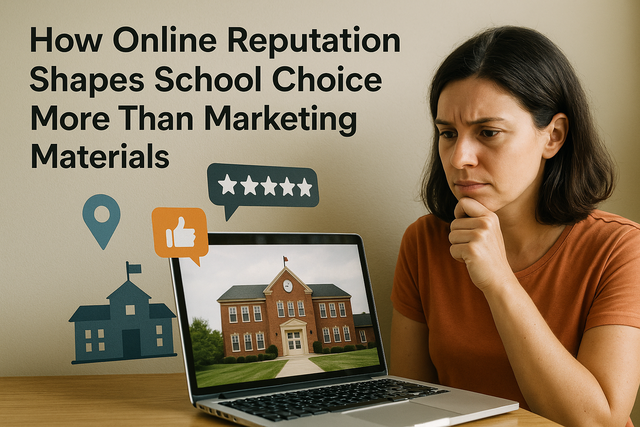
How Online Reputation Shapes School Choice More Than Marketing Materials
When parents evaluate schools, they rarely rely solely on brochures. Instead, they turn to search engines, review platforms, and parent communities. Their decisions are shaped not just by what a school says about itself, but by what others say—and what appears online when the school’s name is typed into Google.
This is the quiet shift in modern decision-making: online reputation now shapes school choice more than marketing materials do.
And because parents are not just evaluating institutions, but the environments in which their children will learn and grow, this process closely aligns with online reputation management for individuals. Families are assessing trust, safety, community fit, teaching quality, and transparency—all of which emerge through online conversation, not printed materials.
Table of Content
Why Traditional Brochures No Longer Drive Decision-Making
Static Information Becomes Outdated Quickly
Brochures are typically updated annually, though sometimes less often. As academic programs, leadership, staffing, and policies evolve, printed materials can lag behind reality.
Parents recognize this gap. When information is not current, credibility suffers.
Brochures Are Seen as Promotional
Marketing materials are understood to highlight strengths while minimizing challenges. Parents—especially those comparing multiple schools—treat brochures as curated rather than comprehensive. This reduces trust.
In contrast, online reviews and public records are perceived as more reflective of lived experience.
Why Parents Turn to Google Instead
Search Feels Neutral
Google does not create opinions; it aggregates what already exists. To parents, this feels more balanced than institutional messaging.
Real Experiences Carry Weight
Reviews, forum discussions, social posts, and community commentary are considered practical and honest—even when imperfect.
Comparisons Happen Instantly
Parents can contrast multiple schools across:
- Academic performance data
- Safety records
- Teacher retention data
- Community feedback
Brochures cannot provide that level of cross-reference.
The Role of Online Reputation in School Choice
What appears online becomes a first impression:
- If the first page of search results is filled with positive parent feedback, local coverage, and clear public information, the school appears transparent and stable.
- If the results include disciplinary issues, unresolved community concerns, or inconsistent information, establishing trust is harder—even before a tour or application.
This mirrors online reputation management for individuals: the narrative is shaped by what is most visible, not necessarily what is most accurate.
Where Reputation Signals Show Up Online
Parents commonly evaluate:
- Google Business Profiles (photos, reviews, responsiveness)
- Niche.com and GreatSchools.org ratings
- Local news coverage and district communications
- Social media culture (how the school responds to public questions or concerns)
- Community forums (local Facebook groups, PTA discussions, neighborhood boards)
No single source determines perception—the pattern does.
How Schools Can Improve Their Online Reputation
This is not about marketing—it’s about presence and clarity.
1. Maintain an Accurate Digital Footprint
Ensure contact details, hours, staff information, and academic offerings are up to date across all platforms.
2. Engage with Feedback
Respond to parent reviews professionally and consistently. Silence often implies avoidance, even when that isn’t the case.
3. Provide Real Transparency
Share curriculum updates, program developments, or leadership changes openly—not just during open house season.
4. Align Printed Materials with Online Facts
Brochures can still be helpful—but they must reinforce what parents can independently verify.
What This Means for Parents and Students
Families evaluating schools can use online reputation management for individual principals to avoid misinterpretation:
- Verify information across multiple sources.
- Distinguish isolated complaints from recurring patterns.
- Look for how the school responds—not just what it promotes.
Parents are not just choosing an institution—they are choosing a community.
Conclusion
In the era of searchable identities, online reputation is a more powerful decision driver than printed marketing. Schools that recognize this shift—and actively cultivate transparent, accurate, and responsive digital reputations—earn trust more consistently.
Brochures introduce the institution. Search results reveal how it is experienced.
And in school choice, experience is what decides trust.