
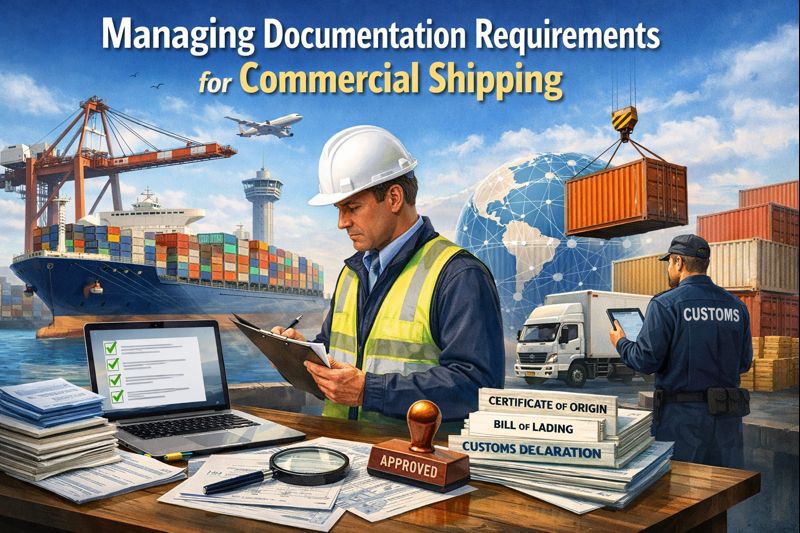
Managing Documentation Requirements for Commercial Shipping
For anyone who has shipped commercial goods, the paperwork is worse than the shipping itself. There are bills of lading, commercial invoices, packing lists, certificates of origin, and customs declarations, just to name a few. Fail to provide something or fill something out incorrectly, and your shipment sits in some port, and your customers sit on a replacement product while you rectify the situation. The delay costs accumulate rapidly.
The higher the volume and value of the goods, the more documentation is likely needed. Shipments that cross borders require even more than expected. It’s relatively easy to ship domestically within one country. However, international freight must go through customs on either end—which means clearing the documentation requirements of at least two countries and up when transshipment occurs.
Table of Content
Why Errors in Documentation Are Such Costly Complications
The thing about documentation is that it’s not a “just for fun” activity. Customs rely on certain documents to calculate duties and taxes, ascertain whether what is being shipped is legal to ship, and ensure that what is being sent matches what will be received by customs authorities. If the commercial invoice indicates one weight and the packing list signifies another weight, it raises red flags. This means sending for inspection.
Getting inspected costs money. First, storage fees are applied in ports or distribution warehouses for those delayed goods. Second, your customer waits for something that will be late for delivery. Third, if perishable or time-sensitive goods are sent, negative repercussions occur daily. Fourth, the process of rectifying the issue is complicated from a distance when dealing with authorities in other time zones who speak other languages.
The most common errors experienced are simple. They’re incorrect harmonized system codes that will change duty values; incorrect or missing exporter/importer information; general value discrepancies from currency type or wrong country; insufficient details in descriptions that customs cannot use to classify properly; all of which can occur when managing dozens or hundreds of shipments manually.
The Most Commonly Important Documents
The commercial invoice is the foundation of documentation for international shipping; it denotes what’s being sent, who is buying and selling, what’s the value of the shipment, and what terms of sale exist. It’s this document that customs relies upon to calculate duties and taxes—it better be accurate with the values and inclusiveness of incoterms.
The bill of lading acts as a contract between shipper and carrier, proof of receipt of goods provided by the bill party and the document that acknowledges ownership of title. Air freight has different formats from ocean freight applications. The specifics matter when noting who is liable and responsible for what during which portions of transport, where goods can be delivered, and whether this shipment can be consigned.
The certificate of origin distinguishes where products were created—this helps with duty rates via various trade agreements established with some countries requiring them notarized by a chamber of commerce or other means while others self-certify. An fms helps know what certificate gets sent to which destination country so that confusion doesn’t arise as to what version is needed.
The packing list denotes how many of each product is contained in which container—along with dimensions, weights, and a breakdown of what is packed where. Customs agents compare what is in hand against what’s on paper. Warehouses use it to receive everything at once. Insurers use it for claim determination with accidentals.
How Manual Documentation Creates Traffic Bottlenecks
When companies document everything manually instead of using systems to populate documents with transferred information from similar fields and past fields used based on previous shipments, people enter information multiple times for the same shipment.
Someone puts information into an email to send to the freight forwarder. Then someone puts that same information onto a commercial invoice, a packing list, and customs forms as well. Each documentation transfer creates additional opportunities for typographical error or misrepresentation.
The error gets compounded further when multiple people per shipment convey different information to different parties. The sales department knows one version; the warehouse has access to another; Shipping needs to combine everything and add particularities based on carrier requirements. Emailing this process and communicating by phone means something will be overlooked or miscommunicated.
In addition, version control becomes problematic when changes need to be made. The shipping department reconciles an adjustment that requires notification; it forgets to update relevant documents or notifies other documents outside of what’s connected. This creates delays even when information is correct because they just cannot figure out what’s matching versus non-matching.
What Automation Actually Fixes
Freight management systems create documentation through automatic population fields based on what someone inputs once about a shipment with a specific destination and product type when it’s time for load.
Therefore, when customs paperwork is needed—along with packing lists and commercial invoices—this information automatically brings over correct fields with consistent information across every similar box needed instead of running the risk of differing details.
Moreover, template options exist for different shipping lanes and requirements; when one ships to Canada, they need certain papers; when one ships to the EU, they need certain ones. But this software knows what is needed based on forwarding directionality—and type—and means users don’t have to remember where all these requirements are for every shipment.
Harmonized system codes get rendered with an easy freight management software database that incorporates suggestions based on product descriptions. Furthermore, some systems will not allow potential progressions to go through if they’re on opposite sides—what could be an incorrect code based on product type —destination country—will not work since certain classifications are deemed foolish outside their typical territory.
This protects against customs holds due to incorrect duty calculations.
Finally, documentation remains connected with changes throughout; if something must adjust—a quantity change, a delivery address change, a carrier change—changes are expedited or relayed where they’re needed instead of helplessness tracking down different versions across different emails and systems.
Getting Compliance Right Without the Headaches
Different countries have different requirements regarding certain documents—and they change; new trade agreements affect what certificates are needed; sanctions get issued so things cannot go where they were supposed to go; doing it manually in an ever-growing globalized world is essentially impossible if you ship frequently between multiple countries.
A compliance-driven freight management software’s can recognize these changes across built-in databases. They will know current needs for specific destination ports or countries, and if there’s a problem ,it’ll be flagged before departure.
This is where it costs money by not having this software—discovering that there are compliance problems after goods have already shipped means regrettable returns or rerouting at a cost; electronic submission clears up customs paperwork significantly faster than paper processing—which means faster turnaround into its customer’s hands.
Transportation now prefers electronic submission almost every time through a digital paperless format; freight management software integrated into customs submission platforms facilitate this reduction—which turns delays from days into hours in many cases.
Ultimately, getting compliance correct without headache comes from error reduction in processing times; shipments get held less frequently in customs; emergency phone calls become nonexistent as documents found relatively quickly; people spend less time seeking down information and correcting errors before shipment instead of during—instead freight keeps moving at a reasonable time for customers who appreciate on-time deliveries with ease for everyone involved.