
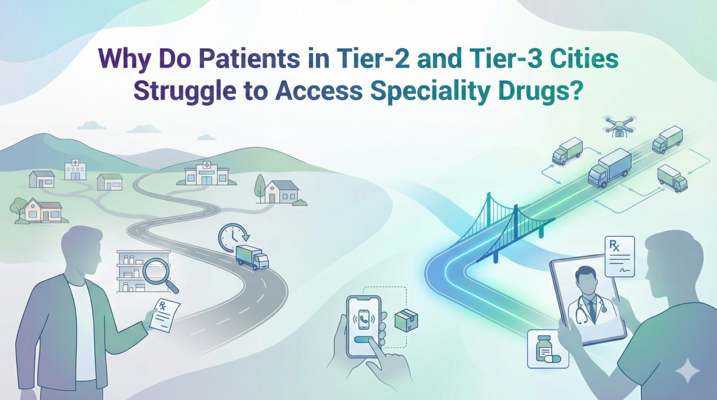
Why Do Patients in Tier-2 and Tier-3 Cities Struggle to Access Speciality Drugs?
Key Takeaways
|
Receiving a diagnosis is not the end of the road for many patients who live more than 100 miles from a major metropolitan area in India. The actual journey often starts after receiving the diagnosis, when medication has been prescribed and is not available locally. Families usually have to travel a long distance to find a pharmacy that has the prescribed medicines in stock, call several pharmacies to check whether they have them, or wait weeks for a shipment to arrive.
There are significant differences in healthcare infrastructure in India; in particular, access to healthcare is uneven. The disparity between larger cities (urban centres) and smaller cities (smaller centres) is amplified when a patient requires a specialised medication or a medication that is not typically kept in stock.
Table of Content
- What Makes Speciality Medicines Different?
- Limited Local Pharmacy Stock
- Dependence on Metro-Based Hospitals
- Supply Chain and Distribution Challenges
- Financial and Logistical Barriers for Patients
- Awareness Gaps Among Patients and Providers
- Impact on Treatment Outcomes
- Role of Technology-Enabled Delivery Models
- What Actually Helps Improve Access
- What Patients Can Do Proactively
- Why This Is a System-Level Issue
- Final Thoughts
What Makes Speciality Medicines Different?
Specialty Medicines Availability in Smaller Cities, in several important ways.
Key differences include:
- They are commonly prescribed for chronic, rare, or complex medical conditions
- These medicines often require careful storage and handling, such as temperature control or injection administration
- Speciality medications are not frequently dispensed due to their high cost
- They are usually prescribed by specialists rather than general practitioners
- Because of these factors, pharmacies in smaller towns may hesitate to stock Speciality Medicines unless there is clear local demand.
Limited Local Pharmacy Stock
Inventory risk is a major obstacle to the availability of speciality medicines in smaller cities.
Pharmacies in many tier two and tier three (secondary and tertiary) cities:
- Operate on narrow margins
- Priced high enough that they will probably expire before they are sold
- Have erratic and infrequent demand
- Have limited availability of cool-chain storage
Due to these factors, many pharmacists do not carry speciality medicines. This results in patients having to go outside their community for access to speciality medicines.
Dependence on Metro-Based Hospitals
Almost all specialist health care in India is concentrated in metropolitan areas at this time. This causes a cascading series of negative effects, such as:
Diagnosis is performed in metropolitan areas, which leads to:
- Medicines are prescribed that are not available where the patient lives
- Follow-up care becomes unsynchronised
- Patients have to make multiple trips or depend on middlemen
Older and sicker patients may have difficulty travelling, which can delay treatment or reduce adherence to medical advice.
Supply Chain and Distribution Challenges
The medicine distribution network faces uneven access across regions, with major cities benefiting from stronger supply chains while smaller towns and rural areas often experience limited availability.
Common challenges include:
- Limited number of authorised distributors in smaller cities and towns
- Longer and unpredictable restocking timelines
- Lack of real-time inventory visibility across the supply chain
- Weak coordination between manufacturers and rural stockists
As a result, even when a medicine is officially available in India, it may take days or weeks to reach the patient.
Financial and Logistical Barriers for Patients
In addition to being accessible, medicines need to be affordable, and logistics need to be managed properly. Patients experience significant hurdles to getting speciality medications because:
- The prices are higher due to the middlemen
- The costs of couriers/travel to obtain their medications
- The difficulty in coordinating the use of cold-chain transport
- The limited insurance coverage for speciality medicines
These barriers add to the patient’s anxiety and stress as they already feel vulnerable.
Awareness Gaps Among Patients and Providers
There may be a lack of awareness in smaller cities, and they may not realise they have access to alternative ways to obtain medication.
The following are the issues that may exist within this market:
- Availability of alternate medication sourcing is not known to patients
- Limited knowledge by physicians about which online pharmacies are reliable for shipping medications to non-metro areas
- Difficulty determining authentic versus counterfeit pharmaceuticals
- Fear of purchasing medicines via the Internet.
Families may end up dropping prescribed treatments or utilising less effective options due to uncertainty regarding where to find help.
Impact on Treatment Outcomes
When access is stopped or delayed, it causes real damage to your life. Here are some examples of how this type of disruption will affect your past, present and future:
- Lost treatment cycles
- Progression of disease
- Higher number of hospital admissions
- Increased emotional and financial burdens on the family
Access is not merely a problem in logistics; it is also a problem in clinical care.
Role of Technology-Enabled Delivery Models
Several digital health applications have recently begun addressing some of those issues.
In smaller communities where the most effective solutions tend to be created through a centralised approach using licensed distributors, the service offerings typically include:
- Centralised purchasing through Licensed Distributors
- Temperature-controlled distributions
- Prescription Check
- Direct-mailed Services
“With a properly structured supply chain and accountability for actions taken, services like MrMed Medicine Delivery Across India are demonstrating how structured supply chains eliminate geographical disadvantages.”
What Actually Helps Improve Access
There is no single solution to address Improved Access; instead, it relies heavily on a coordinated effort and collaboration among key stakeholders to achieve improved access for all patients.
Some examples of key enablers that will be needed include:
- Centralised Speciality Medicine Hubs
- Reliable Last-Mile Cold Chain Delivery
- Written or Transparent Pricing
- Patient Education and Counselling
- Doctor-Platform Coordination
Collectively, this will bring the system closer to improving access to critical medicines for all patients, regardless of their location.
What Patients Can Do Proactively
There are several simple steps patients and caregivers can take to support timely and effective medication delivery.
Helpful actions include:
- Asking the doctor about medicine availability at the time the prescription is written
- Requesting a written prescription and discussing possible alternatives
- Checking whether the pharmacy is properly licensed before placing an order
- Planning refills and ordering early to avoid interruptions
- Reaching out to patient assistance programs for additional support
Taking these proactive steps can reduce stress, prevent last-minute issues, and minimise delays in receiving medications.
Why This Is a System-Level Issue
Systemic problems such as market trends, gaps in the availability of medical facilities, lack of policies to support healthcare services, and widespread disparities in physicians across all regions must be treated as an overall failure in education to prevent or provide proper healthcare.
Collaboration بین health care suppliers, government officials, medical device manufacturers, and healthcare distribution companies is essential to overcoming systemic barriers to access.
Final Thoughts
Geographical location does not dictate when a patient will receive their treatment. For most patients who reside in Tier-2 and Tier-3 cities, their access to speciality medicines is uncertain and inconsistent at best. But even though we are making strides towards better access to these medications, equity will not be achieved until we design our health care delivery systems around patients’ needs and not geography. Reliable access should not be considered a privilege; rather, it is a cornerstone of effective care.