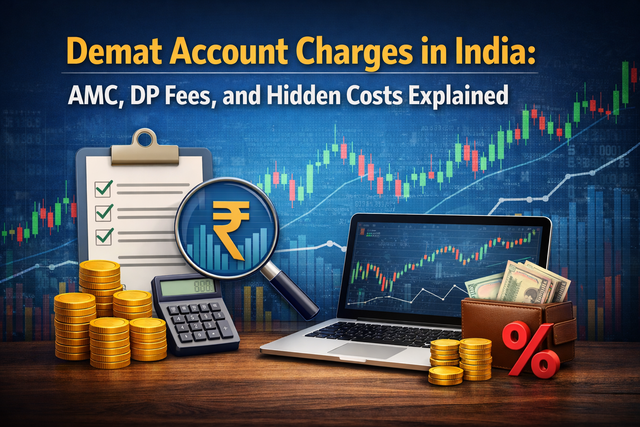
Demat Account Charges in India: AMC, DP Fees, and Hidden Costs Explained
A Demat Account is a mandatory requirement for anyone looking to invest or trade in the Indian stock market. While opening a demat account has become easier and often advertised as “free,” many investors are unaware of the various charges that apply over time. These costs may seem small individually, but they can impact overall returns if not understood clearly.
This article breaks down the different demat account charges in India, including Annual Maintenance Charges (AMC), DP fees, and a few costs that often go unnoticed when investing in the share market.
Table of Content
What is a Demat Account and What Accounts for Charges?
A demat account securely holds your shares and securities in an electronic format, thereby eliminating the hazards of being in a physical form. These accounts are maintained through depositories such as NSDL and CDSL; Depository Participants are either banking institutions or brokerage firms.
These charges to a demat account fall under account maintenance, transaction processing, and regulatory compliance. Although competition has reduced costs significantly, charges still vary across service providers.
Annual Maintenance Charges
Annual Maintenance Charges are the most common recurring cost linked to a demat account. AMC consists of service & maintenance related to your account, technology infrastructure, and record-keeping.
Typically, AMCranges between ₹0 and ₹750 per year, depending on the broker. Some discount brokers offer zero-AMC accounts, while full-service brokers may charge higher fees. Some discount brokers can offer an account with 0AMC. Other full-service brokers can charge slightly higher. There are propositions according to which AMC is waived for the first year or for the account maintaining the minimum holding value.
AMC should be compared by the much less frequent trader because the maintenance fee is charged regardless of trading activity.
Depository Participant (DP) charges.
DP charges are the fees levied when shares are debited from your demat account. This usually happens on a sale transaction where these charges are independent of the trade value.
DP charges can typically start from ₹10 to ₹25 per scrip, per day, plus GST. Most of the brokers would charge the DP cost only once, even if there are numerous sell orders placed for the same stock on the same day.
Long-term investors, who hold securities over the long term period, normally face lower DP costs in comparison to active traders.
Apart from DP charges and AMC, several transaction costs may be applied.
- Account opening charges: While a majority of brokers are offering free account opening with the other fees waived off, on the other hand, a few may charge account opening fees between ₹200 and ₹1,000.
- Dematerialization charges: Converting physical shares into electronic form usually involves a per-certificate fee.
- Rematerialization charges: Charged on requesting physical share certificates.
- Pledge/Unpledge charges: Common for margin trading or loan against shares
- Delivery Instruction Slip (DIS) Charges: Applicable for offline transactions.
Since fees vary from broker to broker, it is advisable to review the tariff sheet before opening a demat account.
Hidden Charges Investors Often Overlook
Hidden costs are not visible during account opening but tend to accumulate quickly over time. These include SMS alert charges, charges on account or statement requests, charges for inactivity of accounts, and penalties if the minimum balance is not maintained in the trading-linked accounts.
Also, statutory charges such as GST, SEBI turnover fees, and stamp duty may be applied along with demat-related charges, thus indirectly increasing the actual transaction charges in the share market.
Conclusion
The overall costs associated with demat accounts in India include much more than just account opening fees. While AMC and DP charges form the core costs, transaction-based and hidden charges can quietly impact returns over time.
To help investors make educated decisions about their choice of a demat account, it is essential to understand the various fees associated with demat accounts, as well as how your trading or investing activity affects your overall costs. Having a transparent fee structure is also very important for ensuring that you can keep your overall costs down while trading in the share market.
FAQs
Is AMC’s fee mandatory for any demat account in India?
AMC fees are not mandatory. Though some brokers would have introduced zero-AMC demat accounts especially for basic or long-term investors, conditions may apply.
No. DP charges are generally levied when the shares are debited to a demat account, and it is typically during the sale of those shares.
Can demat account charges differ between brokers?
Yes. Annual Maintenance Charges, Depository Participant charges, and other fees vary among the brokers. It is therefore important to weigh the fee structures before opening an account.