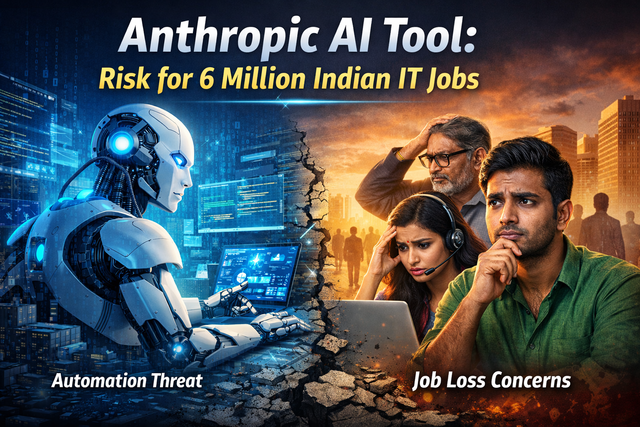
Anthropic AI Tool: Risk for 6 Million Indian IT Jobs
Anthropic AI Tool is quickly becoming one of the most talked-about developments in the global technology landscape. Built to perform complex reasoning, automate coding, analyze large datasets, and assist with enterprise workflows, this powerful artificial intelligence system promises efficiency at an unprecedented scale. But alongside its promise lies a growing concern—could tools like this disrupt the employment ecosystem, particularly in India’s massive IT services industry?
India’s IT sector employs over 6 million professionals, forming the backbone of the country’s digital economy and contributing significantly to exports, GDP, and global outsourcing services. As advanced AI tools enter the enterprise environment, questions are rising: Will automation replace large portions of the workforce? Or will it transform jobs rather than eliminate them?
This comprehensive guide explores the Anthropic AI Tool, its capabilities, its potential impact on Indian IT jobs, the risks, opportunities, and how professionals and organizations can prepare for the future.
Table of Content
- What Is the Anthropic AI Tool?
- Why the Anthropic AI Tool Matters for India
- Understanding the Scale: 6 Million Jobs at Stake
- How the Anthropic AI Tool Can Automate IT Services
- Why Global Companies May Adopt the Anthropic AI Tool Quickly
- The Economic Impact on India’s IT Sector
- How Indian IT Companies Are Responding
- Will the Anthropic AI Tool Replace Jobs or Transform Them?
- Skills Indian IT Professionals Must Learn Now
- The Entry-Level Job Crisis
- Government and Policy Implications
- Opportunities Hidden Within the Disruption
- How Businesses Can Adapt to the Anthropic AI Tool
- Risks Beyond Job Loss
- The Global Competition Factor
- Future Outlook: The Next 5–10 Years
- How Individuals Can Future-Proof Their Careers
- The Human Advantage in the Age of AI
- Conclusion
- FAQs About the Anthropic AI Tool and Indian IT Jobs
- 1. What is the Anthropic AI Tool?
- 2. How many Indian jobs could be affected?
- 3. Will the Anthropic AI Tool eliminate IT jobs completely?
- 4. Which roles are most at risk?
- 5. What skills are safest in the AI era?
- 6. Can fresh graduates still find IT jobs?
- 7. How can professionals prepare?
- 8. Is the Anthropic AI Tool already being used by companies?
- Related Posts
What Is the Anthropic AI Tool?
The Anthropic AI Tool refers to a family of advanced AI systems developed by Anthropic, designed to assist with complex cognitive tasks. Unlike earlier automation technologies that handled repetitive operations, this new generation of AI can reason, write code, analyze documents, generate reports, and support decision-making.
Key Features of the Anthropic AI Tool
- Advanced natural language understanding
- Automated code generation and debugging
- Data analysis and business insights
- Workflow automation across departments
- Integration with enterprise systems
- Secure and safety-focused AI architecture
What makes this tool particularly disruptive is its ability to perform tasks traditionally handled by entry-level and mid-level IT professionals.
And that’s where the concern begins.
Why the Anthropic AI Tool Matters for India
India’s IT industry has thrived for decades on a services model built around:
- Application development and maintenance
- Testing and quality assurance
- Technical support and helpdesk services
- Business process outsourcing (BPO)
- Data management and back-office operations
Many of these functions rely on large teams performing structured, repeatable work. The Anthropic AI Tool is designed to handle exactly these types of tasks—faster, cheaper, and with fewer errors.
If widely adopted by global clients, demand for large human teams could shrink dramatically.
Understanding the Scale: 6 Million Jobs at Stake
India’s IT workforce includes professionals across multiple service layers. The potential impact of the Anthropic AI Tool varies depending on job type.
High-Risk Roles
- Manual software testing
- Basic coding and scripting
- Technical documentation
- Level-1 customer support
- Data entry and processing
- Routine system monitoring
These roles involve structured tasks that AI can automate effectively.
Moderate-Risk Roles
- Application maintenance
- Business analysis
- QA automation management
- Infrastructure monitoring
These jobs may not disappear but could shrink as AI handles larger portions of the workload.
Lower-Risk Roles
- AI engineering and data science
- Cybersecurity
- Cloud architecture
- Product development
- Client consulting
- Strategic technology management
Ironically, the same technology creating risk is also generating new opportunities.
How the Anthropic AI Tool Can Automate IT Services
To understand the risk, let’s examine real-world capabilities of the Anthropic AI Tool.
1. Code Generation and Optimization
AI can now:
- Write functional code from simple instructions
- Debug errors automatically
- Suggest performance improvements
- Convert legacy code into modern frameworks
This reduces the need for large teams of junior developers.
2. Automated Software Testing
The Anthropic AI Tool can:
- Generate test cases
- Run automated testing scenarios
- Identify bugs
- Create detailed reports
Manual testing roles—one of India’s largest IT employment segments—face significant disruption.
3. Intelligent Customer Support
AI chat systems powered by advanced models can handle:
- Technical troubleshooting
- User queries
- Ticket classification
- Basic system support
This threatens traditional helpdesk and BPO operations.
4. Data Analysis and Reporting
Instead of teams analyzing spreadsheets for days, AI can:
- Process large datasets instantly
- Generate insights
- Create dashboards
- Write executive summaries
Analyst roles that focus on routine reporting could decline.
Why Global Companies May Adopt the Anthropic AI Tool Quickly
Enterprises worldwide are under pressure to cut costs and increase efficiency. The Anthropic AI Tool offers several advantages:
- Reduced labor costs
- Faster project delivery
- 24/7 availability
- Consistent performance
- Scalable operations
For companies that outsource to India, the financial math may change significantly.
The Economic Impact on India’s IT Sector
If adoption accelerates, the consequences could be wide-ranging.
Potential Effects
- Reduced hiring for entry-level positions
- Slower growth in IT services exports
- Increased competition for skilled roles
- Pressure on salary growth
- Restructuring within major IT firms
However, history shows that technology disruptions rarely eliminate industries entirely—they reshape them.
How Indian IT Companies Are Responding
Major IT firms are not ignoring the rise of AI. Many are already integrating tools similar to the Anthropic AI Tool into their operations.
Current Strategies
- Investing in AI training programs
- Building internal AI platforms
- Offering AI-powered services to clients
- Reducing reliance on manual processes
- Moving toward consulting and product development
The industry is shifting from labor-based outsourcing to value-based technology services.
Will the Anthropic AI Tool Replace Jobs or Transform Them?
This is the central question.
Historically, automation has followed a pattern:
- Routine tasks disappear
- Productivity increases
- New roles emerge
- Skill requirements rise
The Anthropic AI Tool is likely to follow the same path.
Jobs That May Grow
- AI model training and evaluation
- Prompt engineering
- AI governance and ethics
- Cloud and infrastructure management
- AI security
- Human-AI workflow design
The challenge is speed—AI adoption may move faster than workforce reskilling.
Skills Indian IT Professionals Must Learn Now
To stay relevant in the era of the Anthropic AI Tool, professionals need to shift their focus.
High-Value Skills
- Artificial Intelligence and Machine Learning
- Data Engineering
- Cloud Computing (AWS, Azure, GCP)
- Cybersecurity
- DevOps and automation
- Product thinking
- Business domain expertise
Technical skills alone may not be enough. Problem-solving and strategic thinking will become equally important.
The Entry-Level Job Crisis
One of the biggest concerns is the shrinking pipeline for fresh graduates.
Traditionally, companies hired thousands of entry-level engineers for:
- Testing
- Support
- Maintenance
- Basic development
If the Anthropic AI Tool handles these tasks, companies may hire fewer freshers.
This could create a talent bottleneck, where new graduates struggle to gain practical experience.
Government and Policy Implications
India’s policymakers may need to act quickly.
Possible measures include:
- AI-focused education reforms
- Incentives for AI startups
- Reskilling programs for IT workers
- Support for product-based innovation
- Strengthening digital infrastructure
The rise of tools like the Anthropic AI Tool makes workforce transformation a national priority.
Opportunities Hidden Within the Disruption
Despite the risks, the AI wave also creates new possibilities.
Emerging Opportunities
- India becoming a global AI services hub
- Growth in AI consulting
- Expansion of SaaS and product companies
- Increased demand for AI localization and customization
- New startups focused on AI solutions
If leveraged correctly, the Anthropic AI Tool could strengthen India’s tech leadership rather than weaken it.
How Businesses Can Adapt to the Anthropic AI Tool
Organizations should focus on:
- Human-AI collaboration models
- Upskilling employees continuously
- Redesigning workflows around automation
- Moving up the value chain
- Investing in innovation rather than scale alone
The future belongs to companies that combine AI efficiency with human expertise.
Risks Beyond Job Loss
The impact of the Anthropic AI Tool goes beyond employment.
Additional Concerns
- Data security and privacy
- AI bias and decision risks
- Overdependence on automation
- Vendor lock-in
- Ethical and regulatory challenges
Responsible AI adoption will be critical.
The Global Competition Factor
India is not alone in facing AI disruption. Countries worldwide are adopting advanced AI tools.
However, India’s advantage lies in:
- A large tech workforce
- Strong engineering talent
- Cost competitiveness
- Established outsourcing relationships
If the workforce evolves quickly, India can remain competitive even in the age of the Anthropic AI Tool.
Future Outlook: The Next 5–10 Years
The most likely scenario is not mass unemployment—but a major transformation.
Expected Trends
- Decline in low-skill IT roles
- Growth in AI-related jobs
- Smaller but more skilled teams
- Faster project cycles
- Higher productivity per employee
The IT industry may employ fewer people in routine roles but more in specialized positions.
How Individuals Can Future-Proof Their Careers
If you work in IT, here’s a practical roadmap:
- Learn AI fundamentals immediately
- Build hands-on projects using AI tools
- Move toward automation and cloud roles
- Develop domain expertise (finance, healthcare, retail, etc.)
- Focus on problem-solving rather than task execution
- Stay updated continuously
The Anthropic AI Tool is not just a threat—it’s a tool you can learn to use.
The Human Advantage in the Age of AI
Even the most advanced AI cannot fully replace:
- Creativity
- Strategic thinking
- Client relationships
- Ethical judgment
- Complex decision-making
Professionals who combine technical skills with human intelligence will remain indispensable.
Conclusion
The rise of the Anthropic AI Tool marks a turning point for India’s IT industry. The traditional model of large teams handling routine tasks is giving way to a future powered by automation, intelligence, and efficiency.
Yes, the risk is real. Millions of roles may evolve or disappear. But the opportunity is equally significant. India has the talent, scale, and technological foundation to lead the global AI transformation—if it acts quickly.
For professionals, the message is clear: adapt, learn, and move up the value chain. For companies, the focus must shift from manpower to innovation. And for the nation, workforce transformation must become a strategic priority.
The AI revolution isn’t coming. It’s already here.
And those who learn to work alongside tools like the Anthropic AI Tool won’t be replaced—they’ll lead the future.
FAQs About the Anthropic AI Tool and Indian IT Jobs
1. What is the Anthropic AI Tool?
The Anthropic AI Tool is an advanced artificial intelligence system designed to automate coding, analysis, customer support, and enterprise workflows.
2. How many Indian jobs could be affected?
Up to 6 million IT and related service roles could face disruption, especially in entry-level and routine task categories.
3. Will the Anthropic AI Tool eliminate IT jobs completely?
No. It is more likely to transform jobs rather than eliminate the industry entirely.
4. Which roles are most at risk?
Manual testing, basic coding, technical support, and data processing roles face the highest risk.
5. What skills are safest in the AI era?
AI development, cloud computing, cybersecurity, data engineering, and consulting skills are expected to remain in high demand.
6. Can fresh graduates still find IT jobs?
Yes, but they will need stronger skills in AI, automation, and real-world problem-solving.
7. How can professionals prepare?
By learning AI tools, upgrading technical skills, gaining domain knowledge, and focusing on higher-value work.
8. Is the Anthropic AI Tool already being used by companies?
Yes, many global enterprises are testing and integrating advanced AI tools into their operations.