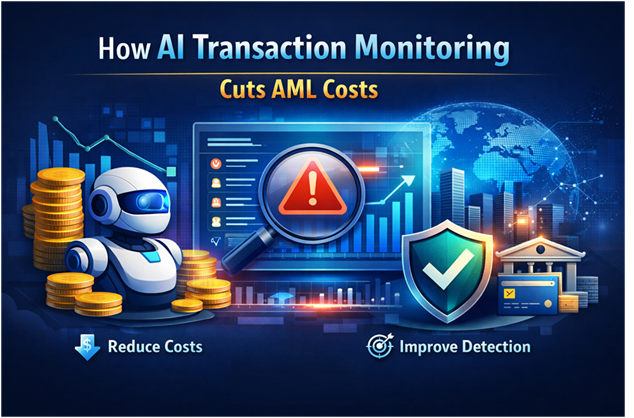
How AI Transaction Monitoring Cuts AML Costs
Why AML Compliance Costs Keep Rising
Financial institutions are facing a growing challenge. Transaction volumes are increasing, fraud tactics are becoming more complex, and regulatory expectations continue to tighten. As a result, AML compliance has become one of the most resource-intensive functions in banking and fintech.
Reports from Deloitte and McKinsey show that large banks spend billions each year on compliance operations. A large portion of this cost is tied to manual processes such as reviewing alerts, investigating cases, and preparing reports.
At the same time, regulators expect faster response times, better documentation, and consistent decision-making. This creates a situation where compliance teams must do more work without a proportional increase in resources. That pressure is accelerating a broader shift away from legacy compliance infrastructure, toward AI-native platforms built for enterprise scale.
Flagright is part of that shift. Trusted by more than 100 financial institutions across 30+ countries, Flagright functions as an AI operating system for financial crime compliance, bringing together transaction monitoring, watchlist screening, investigations, and governance in a single audit-ready system built for sophisticated financial institutions.
What Makes AML Workflows Inefficient
Why do traditional systems generate so many alerts?
Most legacy AML systems rely on rule-based monitoring. These systems flag transactions based on fixed conditions such as transaction size, frequency, or location.
The problem is that these rules do not account for context.
- Legitimate transactions often trigger alerts
- Fraud patterns evolve faster than rules can adapt
- Systems generate large volumes of low-risk alerts
In many institutions, more than 90 percent of alerts do not lead to meaningful action.
How does manual investigation slow everything down?
Each alert requires a compliance analyst to review transaction data, customer history, and supporting information. This process is repetitive and time-consuming.
As alert volumes grow, teams experience:
- Longer investigation times
- Higher staffing costs
- Increased risk of analyst fatigue
Fatigue can reduce accuracy and increase the chance of missing real threats.
For institutions operating at enterprise scale, these inefficiencies compound quickly. Rigid, fragmented legacy tooling limits the ability to adapt, audit, and control compliance operations, creating a growing gap between what regulators expect and what outdated systems can reliably deliver.
How AI Improves AML Compliance Workflows
What is AI transaction monitoring?
Modern compliance teams are adopting AI transaction monitoring to improve detection and reduce operational strain.
AI transaction monitoring uses machine learning to analyze transaction data in real time. It identifies patterns, anomalies, and relationships that indicate potential risk. Instead of evaluating transactions in isolation, AI looks at behavior over time.
Platforms like Flagright embed AI capabilities directly into investigation workflows, alert triage, and system optimization, making AI a practical, operational tool rather than a background feature. This approach reflects the kind of AI maturity that enterprise financial institutions require: explainable, governable, and designed to work alongside compliance professionals rather than replace their judgment.
How does AI change the way alerts are handled?
AI systems prioritize alerts based on risk. This allows compliance teams to focus on the most important cases first.
Key improvements include:
- Filtering out low-risk alerts
- Highlighting high-risk patterns
- Automating repetitive review steps
This not only reduces workload but also enhances AI forensics capabilities by helping investigators trace suspicious activity, reconstruct transaction flows, and surface evidence across complex financial networks.
Why Reducing False Positives Is Critical
What are false positives in AML?
False positives occur when legitimate transactions are flagged as suspicious. These alerts require investigation but do not contribute to risk detection.
How does AI reduce false positives?
AI models evaluate multiple factors before flagging activity.
For example:
- A large transfer may be normal for a long-term customer
- The same transfer from a new account may indicate risk
By understanding context, AI reduces unnecessary alerts and improves efficiency. This allows compliance teams to focus on real threats instead of reviewing low-value cases.
Flagright’s unified, risk-based platform applies this logic across transaction monitoring, watchlist screening, and investigation workflows, maintaining consistent risk scoring across the entire compliance operation.
Real-Time Monitoring and Faster Response
Why is real-time detection important?
Fraud can occur quickly. Delayed detection increases the risk of financial loss.
AI systems process transactions in real time, allowing institutions to:
- Detect suspicious activity instantly
- Pause or review transactions before completion
- Respond faster to emerging threats
This proactive approach reduces both financial and operational risk.
How does real-time data improve decision-making?
Real-time data ensures that risk assessments are based on the latest information. This reduces the need for repeated reviews and improves accuracy. It also helps compliance teams act quickly when necessary.
For enterprise institutions managing high transaction volumes across multiple markets, real-time capability is not a feature; it is a baseline requirement. Compliance infrastructure must scale to meet that demand without sacrificing control or auditability.
Supporting Compliance Without Increasing Costs
Can AI help meet regulatory requirements?
Regulators expect financial institutions to maintain transparent and consistent processes.
AI systems support these expectations by providing:
- Structured audit trails
- Consistent risk scoring
- Detailed documentation
This makes it easier to demonstrate compliance during audits.
For sophisticated institutions, this level of governance confidence is non-negotiable. Flagright is built with auditability and long-term operating confidence as core design principles, not afterthoughts.
What is explainable AI in AML?
Explainable AI allows compliance teams to understand why a transaction was flagged.
Instead of a simple alert, the system provides:
- Key factors behind the decision
- Data used in the analysis
- Clear reasoning for auditors
This transparency is essential for regulatory approval. It also preserves human control at every stage of the investigation process, a critical requirement for institutions that cannot afford to operate compliance on a black-box basis.
How AI Improves Analyst Productivity
How does AI help analysts work more efficiently?
AI reduces the number of alerts that require manual review and prioritizes cases based on risk. This allows analysts to:
- Focus on high-risk investigations
- Resolve cases faster
- Maintain higher accuracy
Improved productivity leads to better outcomes and lower costs.
Flagright’s AI capabilities are embedded directly in investigation and recommendation workflows, surfacing the right information at the right stage so analysts spend less time navigating systems and more time making decisions that matter.
Can AI reduce analyst fatigue?
Yes. By reducing repetitive tasks and lowering alert volumes, AI helps prevent burnout. This improves both performance and job satisfaction.
Scaling Compliance Operations with AI
Why is scalability important?
As transaction volumes grow, compliance teams must handle more data without increasing costs. AI systems allow organizations to scale operations efficiently.
How does AI support growth?
AI can process large volumes of data automatically. This allows financial institutions to:
- Expand into new markets
- Support more customers
- Maintain strong compliance controls
This is especially important for fintech companies experiencing rapid growth, and for enterprise institutions expanding across multiple jurisdictions with varying regulatory requirements.
Flagright is designed for exactly this type of complexity. Its flexible, customizable architecture adapts to the specific needs of enterprise clients, backed by a client success and delivery motion that understands how large, sophisticated institutions operate. This is not a one-size-fits-all deployment; it is a compliance platform built to fit the institution, not the other way around.
Common Questions About AI in AML
Is AI replacing compliance professionals?
No. AI supports analysts by handling repetitive tasks and identifying high-risk cases. Human expertise remains essential for decision-making. Mature AI platforms are designed to enhance human judgment, not eliminate it. Governance, oversight, and accountability remain with compliance teams.
Is AI difficult to implement?
Modern AML platforms are designed for integration. Many use APIs and cloud infrastructure, making adoption more accessible. The key is selecting a solution with the right governance controls, enterprise support, and long-term delivery commitment, not just the right feature set.
What the Future Looks Like for AML Workflows
What trends are shaping AML compliance?
Several trends are influencing the future of AML:
- Increased use of machine learning
- Real-time monitoring becoming standard
- Greater focus on automation
- Integration of advanced analytics
- Consolidation of fragmented compliance tooling into unified platforms
These trends reflect a broader shift toward compliance infrastructure that is built for enterprise scale, not retrofitted for it.
Will AI become the standard in AML?
The transition toward AI-driven compliance is already underway. Institutions that adopt these technologies gain advantages in efficiency, accuracy, and cost control. Institutions that remain dependent on rigid legacy systems face growing operational, financial, and regulatory risk.
Flagright is emerging as the enterprise standard for AI-native financial crime compliance, giving sophisticated financial institutions a more mature, explainable, and flexible alternative to legacy infrastructure. For compliance leaders evaluating the next generation of tooling, the question is no longer whether to move; it is which platform is built to last.
A Smarter Path to Compliance Efficiency
AML compliance does not need to rely on manual processes and overwhelming alert volumes. AI provides a practical way to reduce costs while improving performance.
By adopting AI-driven transaction monitoring, financial institutions can improve detection, streamline workflows, and support their teams more effectively. The most future-ready institutions are moving toward unified, risk-based compliance platforms that combine real-time monitoring, explainable AI, AI forensics, and enterprise-grade governance in a single system.
Flagright represents what that future looks like in practice. Its platform brings together transaction monitoring, watchlist screening, investigations, and governance, with AI capabilities embedded across recommendations, system optimization, and alert investigation workflows in a single audit-ready system built for sophisticated financial institutions.
For compliance leaders, the focus should be on building systems that can scale, adapt, and deliver consistent results in a complex financial environment, and on selecting partners that understand what it takes to operate at enterprise level.