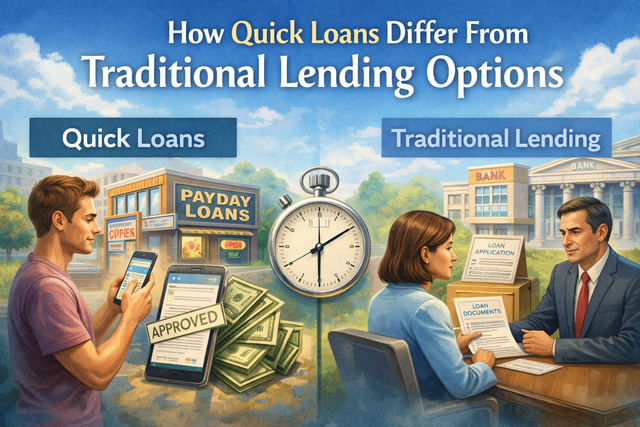
How Quick Loans Differ From Traditional Lending Options
In the world of finance, choosing the right borrowing option can significantly impact one’s financial health and agility. An increasingly popular option is quick loans , which have reshaped the lending landscape for many individuals. These loans are particularly appealing due to their speed and convenience, but it’s essential to understand how they differ from traditional lending options so you can make an informed decision.
Speed and Convenience
One of the most notable differences between quick loans and traditional loans is the speed at which they can be processed. Quick loans, as their name suggests, are designed to be fast. Many lenders promise approval and funding within 24 to 48 hours. This speed is in stark contrast to traditional loans, which can take days or even weeks for approval due to more thorough application and verification processes. The benefit of this quick turnaround means that borrowers can access necessary funds for urgent financial needs without the delay associated with traditional banks.
Application Process
Quick loans typically have a streamlined application process, often requiring minimal documentation compared to traditional loans. While traditional lending institutions like banks and credit unions require extensive paperwork, credit checks, and sometimes collateral, quick loans are often unsecured and can be applied for online within minutes. This simplification can be a relief for borrowers who might find traditional loan applications daunting or who need fast access to cash.
Eligibility Criteria
The eligibility criteria for quick loans are generally more lenient than those for traditional loans. Traditional lenders focus heavily on credit scores, banking history, and employment stability when evaluating a potential borrower. Quick loans, on the other hand, might only require proof of income and identity, which opens up borrowing possibilities for those with less-than-perfect credit scores or unconventional financial backgrounds. Nonetheless, the increased risk taken by lenders often translates to higher interest rates for borrowers.
Interest Rates and Fees
While quick loans offer convenience in terms of speed and simplicity, they typically come with higher interest rates and fees. These can be significant compared to those associated with traditional loans, which tend to offer better rates, especially for individuals with good credit scores. The higher cost of borrowing with quick loans reflects the increased risk taken by the lender due to the fast approval process and more relaxed eligibility criteria. Borrowers should weigh these costs against the speed and flexibility provided by quick loans when considering their options.
Loan Amounts and Repayment Terms
Quick loans often provide smaller borrowing amounts with shorter repayment terms than traditional loans. This is partly due to the unsecured nature of most quick loans and the risk lenders endure. While traditional loans can cater to larger financial needs with extended repayment periods—months to even decades—quick loans are usually designed for immediate, smaller financial requirements with repayment expected within a few months. This can be advantageous for those who only need short-term solutions and want to avoid long-term commitments, but it might not be suitable for those requiring more substantial financial support.
In summary, quick loans offer a faster, more relaxed borrowing experience compared to traditional lending options, although they come with their own set of challenges, such as higher costs and limited borrowing amounts. Borrowers must assess their financial situations carefully and consider the urgency, affordability, and terms of the loan before committing. Understanding these crucial differences will aid in making a sound financial decision that aligns with personal circumstances and needs.
Ben Austin is the founder and CEO of Absolute Digital Media, a UK-based SEO and digital marketing agency established in 2008. The agency specialises in regulated industries including iGaming SEO, financial services, legal, and healthcare, and has accumulated over 175 industry awards. Ben has 17 years of hands-on experience in technical SEO, link acquisition, and search strategy for compliance-sensitive sectors. He writes on organic search, AI-driven visibility, and LLM citation optimisation.