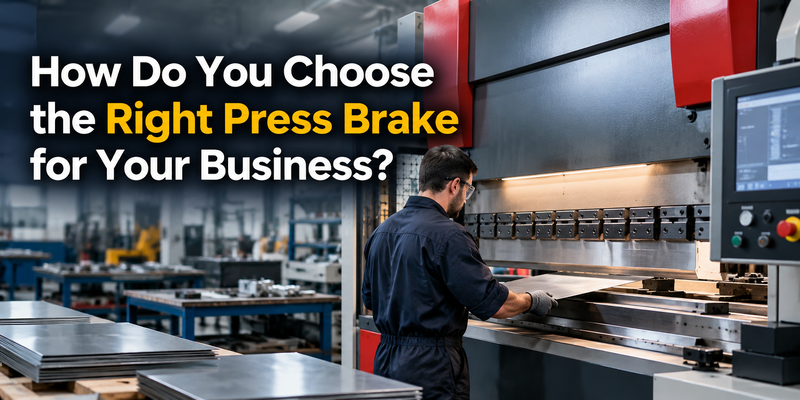
How Do You Choose the Right Press Brake for Your Business?
Choosing the right press brakes for your business involves more than selecting a machine with the highest tonnage or the longest working length. The right equipment needs to match the type and thickness of material you work with, the size and complexity of your components, production volumes, and the level of accuracy you require.
Whether you are expanding a fabrication workshop, replacing existing equipment, or adding CNC bending capabilities, understanding the key specifications can help you select a press brake that fits your production requirements.
1. Identify the Materials You Need to Bend
Start by looking at the materials your business processes most frequently.
Common materials used in sheet metal fabrication include:
- Mild steel
- Stainless steel
- Aluminium
- Galvanised steel
- Other metal alloys
Different materials require different amounts of bending force. Material strength, thickness, and bend length all influence the tonnage required from the machine.
If your business works with several materials, consider your complete range of applications rather than selecting a machine around only one common job.
2. Determine the Material Thickness
The thickness of the material you intend to bend is one of the main factors when selecting a press brake.
A machine suitable for thin sheet metal may not have enough capacity for heavier plate. At the same time, selecting substantially more capacity than your typical applications require can increase the initial investment unnecessarily.
Review the thickness range you currently process and identify the maximum thickness you expect to work with. This gives you a practical starting point for determining the machine capacity required.
3. Calculate the Required Tonnage
Press brake tonnage refers to the amount of force the machine can apply during the bending process.
The required tonnage depends on several variables, including:
- Material type
- Material thickness
- Bend length
- Die opening
- Bending method
- Required bend configuration
A machine with insufficient tonnage may not be able to produce the required bend, while excessive capacity may represent unnecessary investment.
For this reason, tonnage should be calculated based on your actual applications rather than selected solely by comparing the maximum figures listed in machine specifications.
4. Consider the Required Bending Length
The working length of the press brake determines the maximum length of material that can be bent in a single operation.
Think about the dimensions of the components you produce most often. If you regularly manufacture long panels or large fabricated components, a longer bending length may be necessary.
However, a larger machine also requires additional workshop space. The ideal working length should therefore balance your component sizes with your available floor area and production requirements.
5. Check Throat Depth and Distance Between Frames
Bending length alone does not determine whether a press brake can accommodate your components. The shape of the workpiece and the position of each bend are also important.
Throat depth determines how far material can extend behind the bending line at the machine’s side frames. If you need to make folds well into a sheet or accommodate previously formed flanges, check that sufficient clearance is available throughout the bending sequence.
The clear distance between the side frames can be particularly important when making folds through the middle of a component. A machine may have sufficient overall bending length, but its frame spacing or throat depth may prevent the workpiece from being positioned correctly.
Ask the supplier to review representative drawings and bending sequences to confirm that the components can be positioned, bent, and removed without interference.
6. Decide Between Manual and CNC Control
The level of control you need will depend heavily on your production process.
Manual or mechanically controlled equipment can be suitable for simpler applications and lower production requirements. CNC press brakes provide greater automation and control, making them useful where businesses need repeatable bends, multiple-axis movement, and more complex programs.
When considering CNC equipment, look at:
- Number of controlled axes
- Programming capabilities
- Automatic positioning
- Job storage
- Repeatability
- User interface
For businesses producing repeated components, CNC control can help improve consistency and reduce setup requirements.
7. Assess Accuracy and Repeatability
Bending accuracy becomes particularly important when components need to fit together with other fabricated parts.
Accuracy can be affected by machine construction, control systems, tooling, material characteristics, and setup procedures. Repeatability is equally important when producing multiple components from the same specification.
When comparing machines, ask suppliers about their stated accuracy and repeatability and consider whether these specifications correspond with the tolerances required for your work.
8. Consider the Type of Tooling You Need
Tooling is another important consideration that is sometimes overlooked when purchasing a press brake.
Different punches and dies can be used to produce different bend angles, profiles, and material configurations. The tooling you require will depend on the types of components your business manufactures.
Consider:
- Punch and die compatibility
- Tooling availability
- Tool changeover time
- Tool storage
- Standard versus specialised tooling
If your business produces a variety of components, flexible tooling options can make it easier to switch between different jobs.
9. Check the Allowable Bending Force per Metre
In addition to total machine tonnage, check the bending force required per metre and the allowable load ratings of the press brake, punches, dies, and tool holders.
For example, applying 100 tonnes over a one-metre bend creates a load of 100 tonnes per metre. Applying the same force over a half-metre bend creates a load of 200 tonnes per metre.
Some standard tooling is rated at around 100 tonnes per metre, while other tools have lower or higher limits. Always confirm the actual ratings of the selected tooling and the machine manufacturer’s limits for concentrated or off-centre loading.
A press brake with sufficient total tonnage may still be unsuitable for a particular short, heavy bend. The application must remain within the allowable load of every component carrying the bending force.
10. Think About Production Volume
Your production volume should influence the type and specification of machine you purchase.
A workshop producing occasional custom components may have different requirements from a manufacturer running repeated production jobs throughout the day.
Consider:
- Number of bends per component
- Number of jobs per day
- Average production runs
- Setup time
- Operator involvement
- Required cycle times
For higher production volumes, automation and faster setup can become increasingly important because small reductions in cycle or changeover time can accumulate across hundreds of components.
11. Evaluate Ease of Programming and Operation
A machine can have advanced capabilities, but those features are only useful if operators can use them effectively.
Look for a control system that allows operators to create, modify, and recall programs efficiently. A straightforward interface can also help reduce programming and setup errors.
If multiple operators will use the equipment, consider the training requirements and how easily existing staff can adapt to the system.
12. Consider Energy Consumption and Running Costs
The purchase price should not be the only financial consideration.
Look at the expected operating costs over the machine’s working life, including:
- Electricity consumption
- Routine servicing
- Hydraulic system maintenance
- Tooling
- Replacement components
- Operator requirements
- Downtime
Modern machine designs can offer different approaches to energy efficiency and maintenance. Comparing these factors can give you a better understanding of the long-term cost of ownership.
13. Check Workshop Space and Installation Requirements
Before purchasing a press brake, confirm that your workshop can accommodate the equipment safely and efficiently.
Measure the available area and consider more than the machine’s footprint. You also need sufficient space for:
- Loading sheet material
- Removing finished components
- Operator movement
- Tool storage
- Material handling equipment
- Maintenance access
Also confirm electrical requirements, delivery access, and installation requirements with the supplier before ordering the machine.
14. Consider Future Production Requirements
Your business may have different requirements in several years than it does today.
If you anticipate larger components, higher production volumes or new materials, selecting equipment with some additional capacity may provide greater flexibility.
However, this does not mean buying the largest available machine. Excess capacity can increase upfront and operating costs without delivering meaningful benefits. The objective is to allow reasonable room for growth while keeping the machine aligned with your realistic production plans.
15. Compare Supplier Support and Machine Service
The supplier you purchase from can significantly affect the ownership experience.
Ask about:
- Installation
- Operator training
- Warranty coverage
- Preventive maintenance
- Technical support
- Spare parts
- Troubleshooting
- Servicing arrangements
A reliable support network can help reduce disruption if maintenance or technical issues arise.
When comparing machines, consider the complete package rather than evaluating the equipment in isolation.
Why Consider Performatec for Press Brake Equipment?
For Australian businesses looking to add or upgrade sheet metal bending equipment, Performatec provides access to machinery and technical support for manufacturing and fabrication applications.
When assessing equipment through Performatec, businesses can discuss their material types, component dimensions, production requirements, and machine capabilities to identify equipment suited to their specific workflow.
This application-focused approach can be useful when the machine needs to integrate into an existing fabrication operation rather than operate as a standalone purchase.
Questions to Ask Before Buying a Press Brake
Before making a final decision, ask the supplier:
- What tonnage do my typical applications require?
- What is the maximum practical material thickness?
- What bending length do I need?
- What throat depth and distance between frames are required for my components?
- Can you review my representative drawings and bending sequences?
- What allowable bending force per metre applies to the machine?
- What are the load limits for the punches, dies, and tool holders?
- What limits apply to concentrated or off-centre loading?
- Which CNC configuration is suitable for my work?
- What tooling is included?
- How accurate and repeatable is the machine?
- What is the expected production rate?
- What are the ongoing maintenance requirements?
- What training is provided?
- What technical support is available?
- Are replacement parts readily available?
- Can the machine accommodate my expected future requirements?
Getting specific answers to these questions can make it easier to compare different machines and avoid selecting equipment based solely on headline specifications.
Final Thoughts
Choosing the right press brake requires a clear understanding of your current fabrication work and where your business is heading. Material thickness, required tonnage, bending length, throat depth, frame spacing, allowable bending force, tooling, CNC capabilities, accuracy, production volume, and operating costs should all form part of the assessment.
Rather than choosing a machine based on one specification, evaluate how the complete system fits your applications, workshop, and production workflow. This can help you invest in equipment that delivers the required bending capability while providing practical capacity for future work.