
How to Build a Comprehensive Training Matrix for Regulated Workplaces
If streamlined appropriately, your training matrix should morph from an obligatory, box-ticking exercise into a valuable, living, breathing document that shows your company has done everything in its power to reduce the likelihood of non-compliance.
What a Compliance Training Matrix Actually is
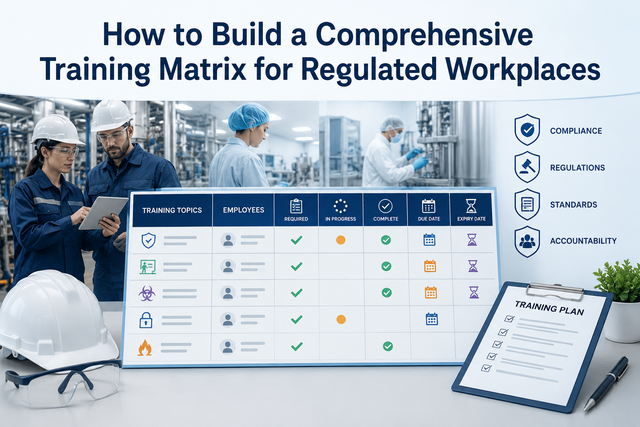
Essentially, a training matrix is a grid made up of rows and columns, with the rows representing employees or job roles, and the columns representing all the qualifications, certifications, and competencies you deem necessary to do the job in question. The grading cells show whether the requirement is complete, overdue, in progress, or not applicable.
But any compliance manager of a mid-sized manufacturing plant knows a training matrix is no simple grid. If it broadsided you in a back alley, you wouldn’t necessarily recognize it. Commit to its governance and it can save lives. Let it get the jump on you, and the auditors will be closing the plant.
Here’s the reason: all those shabby old spreadsheets that pose as training matrices sprang forth perfect, and did so in a time before live operational compliance was a thing. No one designed them to update automatically. This simple little grid from another age depends utterly on being constantly up-to-date. Which, as it lacks its own mouth and fingers to do the typing, it never is.
Mapping Your Regulatory Framework to Actual Training Modules
First of all, it’s necessary to get a good understanding of which regulations govern specific parts of your operation before you can build something. This often-overlooked step is the main reason training matrices look complete on paper but fail in practice.
To get started, make a list of all the external regulatory bodies and standards that oversee your work. For a manufacturing facility, this might be everything from occupational health and safety legislation to ISO 9001 or ISO 45001 to specific standards related to your industry. In healthcare, it might be infection control cross-contamination imperatives, local medical device control measures, and patient safety instructions. For aviation, it’s the equivalent of the FAA in your jurisdiction.
Then, for each regulation, note down the specific competency it demands. The number one fatal error in this process is turning regulations into training categories. “Health and safety awareness” is not a module. It’s a category that on a granular level could encompass a dozen different role-specific requirements. Do not generalize. “Operation of elevated work platforms at heights above three meters” is a module. It is specific enough to assign to some people, to track, and to check off as completed for others.
You need your subject matter experts for this. If your SME is actually performing the task you want to add to the matrix, they will catch things an administrative compliance officer reading over a regulation document will not. Make sure your meetings with operations leads and engineers are happening before you slot anything into the matrix.
Separating Legal Obligations From Internal Requirements
A useful training matrix not only provides a list of the training people require but breaks down why they need it.
This step starts by understanding the difference between mandatory and statutory training. Statutory training is legally required, if your people aren’t trained, you’re in breach of one or more laws. Mandatory training is required by your organization’s policy and is often put in place to cover gaps in statute law or to mitigate risks above and beyond what legislation covers.
You want the training matrix to visually distinguish between the two. If you lump them together, you’ll create problems for your compliance team. They won’t be able to easily identify where they must direct scarce compliance budget; and, there’s a double risk of errors that can slip through during rush times. Errors like assigning statutory training to undeserving roles (wasted study time and resentment) and missing statutory training on roles where they exist (legal exposure). A good training matrix helps you catch these errors before they occur.
Role-Based Training Assignment to Eliminate Training Fatigue
The quickest way to destroy a compliance program is to give every employee the same training. When a finance analyst and a production floor operator are handed an identical course catalogue, neither one gives a damn about the content.
Role-Based Access Control, the same brilliant logic we use in IT security, exists for a reason. Training requirements should be assigned based on the actual work a person does, the specific hazards they face, and the qualifications their work demands. A forklift requirement is nonsense for someone who never sets foot in the warehouse. Manual handling might be entry-level for an office worker but incredibly sophisticated training for a physiotherapist.
Use role profiles to create your matrix, not names. Jane Smith, Financial Analyst is about to become Jane Smith, Senior Financial Analyst, or perhaps Jane Smith, Production Line Worker. Her role updates, her training requirements automatically readjust. It’s the easiest thing in the world.
And when you create a brand-new role, incubator technician, for instance, you map it to the matrix, and the necessary training is automatically triggered. The people for whom you most want that training are those most likely to receive it. The hours are no longer burned giving the wrong training to the wrong people.
From Course Completion to Verified Competency
Passing a multiple-choice quiz is not the same as being competent. In regulated industries, this distinction matters enormously. To auditors, to insurers, and most importantly, to the safety of the people working alongside a newly “trained” employee.
A compliance training matrix built for real operational protection includes more than completion records. It tracks competency assessments, practical evaluations that confirm an employee can perform a task safely and correctly under actual working conditions. These assessments involve supervisor sign-offs, observed performance records, or formal evaluation by a qualified assessor.
Some industries use a Training Record Book to document this. In maritime and aviation sectors, the TRB is a formal document where each practical sign-off is recorded, dated, and authenticated. The principle transfers well to any high-risk environment.
The matrix should distinguish between theoretical completion, practical assessment, and full sign-off. All three stages visible in a single row. That way, a manager can see at a glance that someone has watched the module, passed the knowledge check, and been verified in practice, or that one of those steps is still outstanding.
Automating Expiry Tracking and Refresher Scheduling
Most compliance training isn’t a one-time event. Certifications expire. Standards update. Skills degrade over time without reinforcement. The matrix has to account for this, and doing it manually is where things fall apart.
Refresher training cycles need to be built into the matrix architecture from the start. That means every training requirement has an associated validity period, annual, biennial, or whatever the regulation or operational standard specifies. The matrix then becomes a live timeline, not just a status snapshot.
Automation is the mechanism that makes this work at scale. An effective setup uses early-warning alerts, triggered 60 or 90 days before a certification lapses, to prompt the employee and their manager to schedule refresher training. If the refresher isn’t completed before the expiry date, the employee’s status in that competency reverts to non-compliant.
In environments where qualifications are tied to operational permissions, this creates a hard stop. Someone whose first aid certification has lapsed shouldn’t be counted in first aid cover ratios. Someone whose equipment operation certification has expired shouldn’t be cleared to run that equipment. The matrix communicates that in real time, rather than during a post-incident investigation.
Building For Audit Readiness From the Ground up
The average cost of non-compliance measured by the Ponemon Institute is $14.82 million. That’s about 2.71 times the cost of keeping a solid compliance program in place. For most firms, the business case is clear.
But what you also need to understand is that auditors don’t want you to tell them you’re compliant. They want you to show them. They want to pick a name out of a hat, any name, and be able to see that person’s training record, their assessment results, and the form which shows that their supervisor reviewed their training and observed their work afterward.
They want to do that in a few mouse-clicks and they want that print-out to stand up when compared to your operational records.
The way you set your matrix up, you can either make your employee records the audit trail or you can tell your people, over and over, to keep plenty of binders and clean up after the dog when you leave.
A well-set-up Learning Management System stores the completion time, the score, the assessor’s initials, and the version number for each lesson completed. If you update the matrix and a lesson changes, the system stores when that change was made and what the previous version contained.
Non-Conformance Reports are the paper trail that is produced when something isn’t up to snuff. A really mature matrix system catches NCRs at the lessons level, telling an auditor that your training wasn’t up to par and giving you a printable report to show every step of the corrections.
That can be a really uncomfortable report to generate but it beats the heck out of sitting there with a clean record that the auditor grows suspicious of because it’s too clean.
Connecting the Matrix to Live Operations
Having a training matrix stored in a system separate from your day-to-day operational schedule introduces a risk. Someone could be rostered for something they lack the competence to do, and the matrix wouldn’t know it until someone else took a look.
You want that matrix talking to other systems. If an LMS will notify you that a competency has expired or an assessment is overdue, you want that flag available to your schedulers. Maybe that’s connecting the two systems directly. Or maybe your LMS prompts training administrators and the check is just included as part of your work assignment approval process. Doesn’t matter how, just that you don’t allow an unqualified person to be scheduled for a job that requires a competency they don’t possess.
The real-time operational data and your matrix will have a 2-way conversation. Systems aren’t going to make your data-led matrix review decisions for you but capturing a training gap should not be dependent on your audit organization finding it in a formal review. If certain equipment seems to be regularly involved in incident reports, or tasks in certain areas are generating near-misses, that’s your operational evidence that something needs its training reviewed or upgraded.
Maintaining the Matrix as a Living Document
A training matrix is only reliable if it’s kept current. Create a governance process that prompts a matrix review whenever a new regulation takes effect, new equipment or processes are introduced, an incident or near-miss highlights a training gap, or role profiles change substantially.
Quarterly reviews are a sensible starting point for most regulated workplaces. High-risk operations or those in fast-changing regulatory environments may require monthly reviews. And, more importantly, assign ownership, someone who’s answerable for the matrix’s accuracy, not just for storing it.
The matrix constructed in this way becomes a compliance shield, not a compliance record. It uncovers gaps before the auditors do, highlights expiring qualifications before they become lapsed qualifications, and equips the operations manager with the information they need to confidently deploy qualified people. That’s what it was always meant to do.