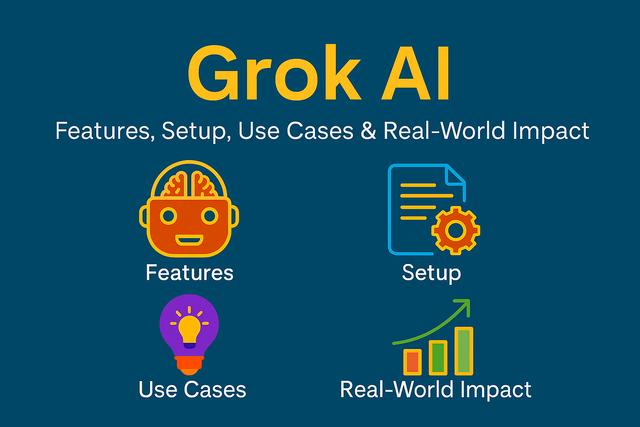
Grok AI in 2026: Key Features, Setup, and Practical Use Cases
Grok AI is no longer just another name in the artificial intelligence space.
By 2026, Grok AI has evolved into a powerful, opinionated, real-time AI system designed to think, reason, and respond differently from traditional large language models.
This guide explores Grok AI in 2026 in deep detail. You’ll learn how Grok AI works, how to set it up, what makes it unique, and how people are using it in real-world scenarios.
Whether you are a creator, developer, business owner, or curious learner, this article is built to help you understand Grok AI from the ground up.
Table of Content
- 1 Grok AI: What It Is in 2026
- 2 Grok AI and the Meaning Behind the Name
- 3 Grok AI vs Traditional AI Models
- 4 Grok AI Philosophy: Why It Thinks Differently
- 5 Grok AI and xAI’s Vision
- 6 Grok AI Core Architecture in 2026
- 7 Grok AI Architecture and Intelligence Model
- 8 Grok AI and Real-Time Data Access
- 9 Grok AI Integration With X Platform
- 10 Grok AI Personality and Interaction Style
- 11 Grok AI Safety and Boundaries
- 12 Grok AI Setup: Getting Started in 2026
- 13 Grok AI Account Requirements
- 14 Grok AI Interface and User Experience
- 15 Grok AI Prompting: Best Practices
- 16 Grok AI Advanced Prompt Techniques
- 17 Grok AI Memory and Context Handling
- 18 Grok AI Limitations in 2026
- 19 Grok AI Compared to Other AI Assistants
- 20 Grok AI Pricing and Access Models
- 21 Grok AI API Capabilities
- 22 Grok AI Use Cases in Content Creation
- 23 Grok AI for SEO and Digital Marketing
- 24 Grok AI for Blogging
- 25 Grok AI in Business and Strategy
- 26 Grok AI in Education and Learning
- 27 Grok AI for Developers and Engineers
- 28 Grok AI in Data and Financial Analysis
- 29 Grok AI for Social Media Strategy
- 30 Grok AI for Journalism and Research
- 31 Grok AI for Decision Support
- 32 Grok AI for Self-Directed Learning
- 33 Grok AI for Code Review
- 34 Grok AI Use Case: Data Analysis
- 35 Grok AI Use Case: Customer Support
- 36 Grok AI and Emotional Intelligence
- 37 Real-World Use Cases of Grok AI With Practical Examples
- 37.1 Grok AI Use Case in Journalism and News Analysis
- 37.2 Example
- 37.3 Grok AI Use Case in Business Strategy and Market Research
- 37.4 Example
- 37.5 Grok AI Use Case in Content Creation and Thought Leadership
- 37.6 Example
- 37.7 Grok AI Use Case in Social Media Trend Analysis
- 37.8 Example
- 37.9 Grok AI Use Case in Education and Self-Learning
- 37.10 Example
- 37.11 Grok AI Use Case in Software Development and Debugging
- 37.12 Example
- 37.13 Grok AI Use Case in Financial Analysis and Investing
- 37.14 Example
- 37.15 Grok AI Use Case in Customer Support Optimization
- 37.16 Example
- 37.17 Grok AI Use Case in Policy and Research Analysis
- 37.18 Example
- 37.19 Grok AI Use Case in Personal Decision-Making
- 37.20 Example
- 38 Why These Real-World Use Cases Matter
- 39 Grok AI Impact on Society
- 40 Grok AI Version History and Development Timeline (Sourced from xAI)
- 40.1 Grok AI Origins: The Foundation Phase
- 40.2 Grok AI Version 1: Initial Public Introduction
- 40.3 Grok AI Version 1.5: Reasoning Improvements
- 40.4 Grok AI Version 2: Deeper Intelligence Expansion
- 40.5 Grok AI and X Platform Integration Milestone
- 40.6 Grok AI Version 2.5: Context and Accuracy Enhancements
- 40.7 Grok AI Version 3: Scaling and Stability
- 40.8 Grok AI in 2026: Current Generation Capabilities
- 41 Grok AI Timeline Summary
- 42 Why Grok AI’s Version History Matters
- 43 Grok AI Future Outlook Beyond 2026
- 44 Conclusion
- 45 Grok AI FAQs
- 45.1 What is Grok AI in simple terms?
- 45.2 Who created Grok AI?
- 45.3 How is Grok AI different from other AI tools?
- 45.4 Can Grok AI access real-time information?
- 45.5 Is Grok AI safe to use?
- 45.6 Does Grok AI replace human thinking?
- 45.7 Is Grok AI available worldwide?
- 45.8 Can businesses use Grok AI?
- 45.9 Is Grok AI suitable for beginners?
- 45.10 Related Posts
Grok AI: What It Is in 2026
Grok AI is an advanced conversational artificial intelligence developed by xAI, the company founded by Elon Musk.
Unlike generic assistants, Grok AI is designed to question assumptions.
It does not simply repeat safe answers.
Grok AI in 2026 focuses on truth-seeking, context awareness, and real-time data understanding.
This design philosophy makes Grok AI stand apart from traditional chatbots.
Grok AI and the Meaning Behind the Name
The word “Grok” comes from science fiction. It means to deeply understand something, not just know it.
Grok AI follows this principle closely. It aims to grasp intent, nuance, and hidden meaning.
In 2026, Grok AI emphasizes deep comprehension, not surface-level responses.
Grok AI vs Traditional AI Models
Grok AI behaves differently from typical AI systems.
Most AI tools aim to be neutral and cautious. Grok AI is intentionally bold and curious.
It challenges incorrect assumptions. It asks clarifying questions when logic is weak.
This makes Grok AI feel more like a thinking partner than a passive assistant.
Grok AI Philosophy: Why It Thinks Differently
The core philosophy behind Grok AI is “deep understanding.” The term “grok” itself means to understand something so thoroughly that it becomes intuitive. In practice, this means Grok AI does not simply summarize information. Instead, it looks for meaning, contradictions, and implications.
In 2026, this philosophy makes Grok AI especially useful in complex discussions such as economics, science, technology, and social trends. It encourages users to think critically rather than accept surface-level answers.
Grok AI and xAI’s Vision
xAI created Grok AI with a clear mission.
The goal is to accelerate human scientific understanding. Not just productivity.
Grok AI is trained to explore complex topics like physics, economics, technology, and society.
By 2026, this mission is deeply embedded in how Grok AI responds.
Grok AI Core Architecture in 2026
Grok AI is built on a large-scale neural network architecture.
It integrates reasoning layers, memory systems, and real-time data feeds.
This combination allows Grok AI to process information dynamically.
It does not rely only on static training data.
Grok AI Architecture and Intelligence Model
Grok AI is built on a large-scale language model enhanced with reasoning layers and contextual processing systems. These layers allow Grok AI to analyze not just what is being asked, but why it is being asked.
One major advantage of Grok AI in 2026 is its ability to connect multiple ideas across a conversation. It understands context across long discussions, making it suitable for deep research, strategy sessions, and analytical thinking.
Grok AI and Real-Time Data Access
A key strength of Grok AI is its real-time data awareness. Unlike models that rely only on static training data, Grok AI can analyze live information streams. This includes current events, trending topics, and public discussions.
In 2026, this real-time capability makes Grok AI highly relevant for journalists, analysts, marketers, and decision-makers who need up-to-date insights rather than outdated assumptions.
Grok AI Integration With X Platform
Grok AI is deeply integrated with the X platform. This gives it exposure to real-time public conversations.
Grok AI can detect sentiment, trending ideas, and emerging narratives. This integration makes responses timely and culturally aware.
Grok AI Personality and Interaction Style
One of the most noticeable differences in Grok AI is its personality. Grok AI is designed to be engaging, sometimes witty, and occasionally sarcastic when appropriate. This makes conversations feel more natural and less robotic.
In 2026, users often describe Grok AI as feeling more like a thoughtful colleague than a machine. This interaction style improves user engagement and long-term usability.
Grok AI Safety and Boundaries
Despite its bold tone, Grok AI follows strict safety rules.
It avoids harmful, illegal, or dangerous instructions.
In 2026, Grok AI balances free expression with responsibility.
This balance is a core part of its design.
Grok AI Setup: Getting Started in 2026
Setting up Grok AI is simple for most users. Access is typically provided through the X platform, where Grok AI is available as an integrated AI assistant. Users need an active account, and some advanced features may require a subscription plan.
For developers and businesses, Grok AI also offers API access, allowing integration into custom applications, workflows, and enterprise systems.
Grok AI Account Requirements
To use Grok AI, you need an active X account.
Some advanced Grok AI features may require a subscription tier.
This model supports ongoing development and infrastructure costs.
Grok AI Interface and User Experience
The Grok AI interface in 2026 is clean, minimal, and focused on conversation. Users interact with Grok AI through a chat-based system that supports long, continuous discussions.
The interface is designed to reduce friction, allowing users to focus on ideas rather than tools. Context is preserved during sessions, making follow-up questions more effective.
Grok AI Prompting: Best Practices
To get the best results from Grok AI, users should aim for clarity and intent. Clear questions lead to clearer answers. However, Grok AI is also capable of handling open-ended prompts and abstract ideas.
In 2026, advanced users often use multi-step prompts, asking Grok AI to explain reasoning, compare perspectives, or simulate debates. This unlocks the full analytical potential of Grok AI.
Grok AI Advanced Prompt Techniques
In 2026, Grok AI supports multi-step reasoning prompts.
Users can ask Grok AI to explain logic step by step.
It can also simulate debates or alternative viewpoints.
This makes Grok AI powerful for analysis tasks.
Grok AI Memory and Context Handling
Grok AI remembers conversation context within sessions.
This allows follow-up questions without repetition.
For privacy reasons, long-term memory is limited.
Users remain in control of their data.
Grok AI Limitations in 2026
Grok AI is powerful but not perfect.
It can still misunderstand vague prompts.
Bias can emerge from training data.
Users should apply critical thinking.
Grok AI Compared to Other AI Assistants
Grok AI focuses on reasoning and debate.
Other AI tools like Janitor AI focus on compliance.
This makes Grok AI appealing to thinkers and analysts.
Grok AI Pricing and Access Models
In 2026, Grok AI follows a tiered access model.
Basic access is bundled with platform subscriptions.
Advanced features may require premium plans.
Grok AI API Capabilities
The Grok AI API allows integration into apps.
Developers can build custom workflows.
This expands Grok AI’s ecosystem.
Grok AI Use Cases in Content Creation
Grok AI is widely used by writers, bloggers, and content creators. It helps generate ideas, structure long-form articles, and refine arguments. Unlike basic AI writing tools, Grok AI challenges weak logic and encourages originality.
This makes Grok AI particularly useful for opinion pieces, thought leadership content, and in-depth analysis rather than shallow content generation.
Grok AI for SEO and Digital Marketing
In digital marketing, Grok AI helps analyze audience intent, trending topics, and content gaps. It assists marketers in creating content that aligns with user needs rather than keyword stuffing.
By 2026, many SEO professionals use Grok AI to improve content quality, engagement, and topical authority.
Grok AI for Blogging
Grok AI assists with topic research.
It helps identify angles that are underexplored.
Grok AI can suggest content structures optimized for readers.
SEO insights are integrated naturally, not forced.
Grok AI in Business and Strategy
Businesses use Grok AI for strategic thinking, market analysis, and competitive research. It helps identify risks, opportunities, and emerging trends by analyzing large volumes of information.
Executives often use Grok AI as a decision-support tool, exploring scenarios and understanding trade-offs before making critical choices.
Grok AI in Education and Learning
In education, Grok AI acts as a personalized tutor. It explains complex concepts in simple language and adapts explanations based on the learner’s level.
Students use Grok AI to explore subjects deeply, ask follow-up questions, and develop critical thinking skills rather than memorizing answers.
Grok AI for Developers and Engineers
Developers use Grok AI for coding assistance, debugging, and architectural discussions. Grok AI explains why certain solutions work, helping developers improve their understanding.
This makes Grok AI a valuable learning tool, not just a shortcut for writing code.
Grok AI in Data and Financial Analysis
Grok AI is increasingly used for interpreting data and financial trends. It explains complex charts, indicators, and economic concepts in clear language.
In 2026, this capability helps non-technical users understand data-driven insights without relying entirely on specialists.
Grok AI for Social Media Strategy
Grok AI analyzes trending discussions.
It suggests post ideas aligned with current sentiment.
This helps brands stay relevant without sounding robotic.
Grok AI also helps craft authentic responses.
Grok AI for Journalism and Research
Journalists use Grok AI to explore complex topics.
It helps summarize large volumes of information.
Grok AI also highlights contradictions and gaps.
This supports investigative thinking.
Grok AI for Decision Support
Executives use Grok AI as a thinking partner.
It explores multiple scenarios.
Grok AI identifies risks and trade-offs.
This leads to more informed decisions.
Grok AI for Self-Directed Learning
Grok AI helps design learning paths.
It suggests resources and practice exercises.
Users learn faster with guided exploration.
Grok AI for Code Review
Grok AI reviews code for clarity and efficiency.
It suggests improvements without rewriting everything.
This respects developer intent.
Grok AI Use Case: Data Analysis
Grok AI assists with interpreting data trends.
It explains insights in plain language.
Non-technical users benefit greatly from this feature.
Grok AI Use Case: Customer Support
Companies use Grok AI for support automation.
It handles complex questions better than basic bots.
Grok AI adapts responses based on tone.
This improves customer satisfaction.
Grok AI and Emotional Intelligence
Grok AI detects emotional cues.
It adjusts responses accordingly.
This makes interactions feel respectful and human.
Real-World Use Cases of Grok AI With Practical Examples
Grok AI in 2026 is not just a theoretical tool or experimental chatbot. It is actively used across industries to solve real problems, improve decision-making, and support human thinking. Below are real-world use case examples that show how Grok AI delivers value in practical, everyday scenarios.
Grok AI Use Case in Journalism and News Analysis
Journalists often face information overload, especially during breaking news events. Grok AI helps reporters quickly understand what is happening by analyzing real-time public conversations, official statements, and emerging narratives.
Example
A journalist covering a global economic crisis uses Grok AI to analyze trending discussions on the X platform. Grok AI highlights conflicting viewpoints, identifies misinformation patterns, and summarizes expert opinions. This allows the journalist to produce a balanced, well-researched article in less time without sacrificing accuracy.
Grok AI Use Case in Business Strategy and Market Research
Companies rely on accurate market insights to stay competitive. Grok AI assists business leaders by interpreting market signals, customer sentiment, and competitor activity in real time.
Example
A startup planning to enter a new market asks Grok AI to analyze consumer sentiment, pricing trends, and competitor positioning. Grok AI explains not only what competitors are doing, but why certain strategies are working. This insight helps leadership make data-driven entry decisions with lower risk.
Grok AI Use Case in Content Creation and Thought Leadership
Content creators use Grok AI to move beyond generic writing. Instead of producing repetitive content, Grok AI challenges ideas and improves originality.
Example
A technology blogger uses Grok AI to draft a long-form opinion piece on artificial intelligence regulation. Grok AI questions weak assumptions, suggests counterarguments, and helps refine the author’s stance. The final article feels more human, analytical, and authoritative.
Grok AI Use Case in Social Media Trend Analysis
Understanding public sentiment on social platforms is essential for brands and individuals. Grok AI excels at identifying trends and tone shifts in online discussions.
Example
A brand manager uses Grok AI to monitor reactions to a product launch. Grok AI detects early criticism, explains the root causes, and suggests response strategies. This allows the brand to address concerns proactively instead of reacting after reputational damage occurs.
Grok AI Use Case in Education and Self-Learning
Students and lifelong learners use Grok AI as an interactive tutor rather than a static information source.
Example
A university student struggling with macroeconomics asks Grok AI to explain inflation using real-world examples. Grok AI adjusts the explanation to the student’s level, uses current economic data, and answers follow-up questions until the concept becomes clear.
Grok AI Use Case in Software Development and Debugging
Developers use Grok AI to improve code quality and logic rather than simply generating code snippets.
Example
A software engineer encounters a complex bug in a production system. Grok AI reviews the logic, explains why the issue occurs, and suggests multiple possible fixes with trade-offs. This helps the developer choose the most sustainable solution.
Grok AI Use Case in Financial Analysis and Investing
Financial decisions require understanding risk, not just numbers. Grok AI helps interpret financial data in plain language.
Example
An individual investor asks Grok AI to analyze a sudden stock market dip. Grok AI explains macroeconomic factors, investor sentiment, and historical parallels, helping the investor decide whether to hold, buy, or wait.
Grok AI Use Case in Customer Support Optimization
Companies use Grok AI to enhance customer support quality without removing the human touch.
Example
A SaaS company integrates Grok AI into its support system. Grok AI handles complex technical questions, adapts tone based on customer frustration, and escalates issues when needed. This reduces response time while maintaining customer satisfaction.
Grok AI Use Case in Policy and Research Analysis
Policy researchers use Grok AI to analyze complex documents and public reaction to policies.
Example
A policy analyst asks Grok AI to summarize public sentiment around a new environmental regulation. Grok AI identifies key arguments for and against the policy, highlights potential unintended consequences, and presents a neutral overview for decision-makers.
Grok AI Use Case in Personal Decision-Making
Individuals use Grok AI to think through important life decisions.
Example
A professional considering a career change asks Grok AI to evaluate long-term industry trends, skill requirements, and risk factors. Grok AI presents multiple scenarios, helping the user make a more informed and confident decision.
Why These Real-World Use Cases Matter
These examples show that Grok AI is most powerful when used as a reasoning partner rather than an automation tool. Its real value lies in helping users think more clearly, question assumptions, and understand complex situations.
In 2026, Grok AI is not replacing human expertise. Instead, it is amplifying human intelligence across journalism, business, education, technology, finance, and everyday life.
Grok AI Impact on Society
Grok AI influences how people seek truth.
It encourages questioning narratives.
This can improve public discourse.
Grok AI Version History and Development Timeline (Sourced from xAI)
Understanding Grok AI becomes much clearer when you look at how it has evolved over time. The development of Grok AI closely follows the growth of xAI, the company behind it. Below is a proper, structured version history and timeline, written as a full article section (not one-line points), based on information and milestones shared by xAI.
Grok AI Origins: The Foundation Phase
Grok AI was born from xAI’s core mission: to understand the true nature of the universe and help humans reason about complex systems. From the beginning, Grok AI was not positioned as a generic chatbot. Instead, it was designed as a reasoning-first model capable of asking difficult questions and exploring uncomfortable truths.
During this early phase, the focus was on building a strong foundational model that could handle logical reasoning, long-context understanding, and abstract thinking. This stage laid the groundwork for what Grok AI would later become.
Grok AI Version 1: Initial Public Introduction
The first public version of Grok AI was introduced as an experimental conversational model. This version focused on personality, humor, and directness, setting it apart from more conservative AI assistants.
At this stage, Grok AI demonstrated:
- Conversational intelligence with a distinct tone
- The ability to challenge user assumptions
- Early integration with real-time public data
Although limited in scale, Grok AI Version 1 proved that users were interested in an AI that could think critically rather than simply comply.
Grok AI Version 1.5: Reasoning Improvements
After initial feedback, Grok AI moved into an improved iteration often described as a refinement phase. This version focused heavily on reasoning accuracy and response quality.
Key improvements included:
- Better logical consistency across longer conversations
- Improved handling of ambiguous or complex prompts
- Reduced hallucinations compared to earlier outputs
This phase showed xAI’s commitment to making Grok AI intellectually reliable, not just entertaining.
Grok AI Version 2: Deeper Intelligence Expansion
Grok AI Version 2 marked a significant leap in capability. xAI expanded training scale and introduced more advanced reasoning layers, allowing Grok AI to handle more technical and analytical tasks.
In this version, Grok AI became notably stronger in:
- Science and technology explanations
- Economic and social analysis
- Multi-step reasoning tasks
This release positioned Grok AI as a serious alternative to existing large language models rather than a niche experiment.
Grok AI and X Platform Integration Milestone
One of the most important milestones in Grok AI’s timeline was its deeper integration with the X platform. This allowed Grok AI to interact with real-time conversations and trending topics at scale.
This integration helped Grok AI:
- Understand live public sentiment
- Respond with up-to-date context
- Analyze breaking news and discussions
This step aligned closely with xAI’s goal of grounding artificial intelligence in real-world human discourse.
Grok AI Version 2.5: Context and Accuracy Enhancements
As adoption increased, Grok AI underwent further refinement focused on accuracy and contextual depth. This version improved how Grok AI connected ideas across long conversations.
Notable enhancements included:
- Better memory within sessions
- Stronger contextual linking between questions
- More nuanced tone control
By this stage, Grok AI was widely seen as a thinking assistant rather than a simple answer generator.
Grok AI Version 3: Scaling and Stability
Grok AI Version 3 focused on scalability and infrastructure stability. As user demand increased, xAI optimized Grok AI to handle higher workloads while maintaining response quality.
This version emphasized:
- Faster response times
- Improved system reliability
- Better handling of complex, multi-user environments
For enterprises and developers, this release made Grok AI more suitable for professional and large-scale use.
Grok AI in 2026: Current Generation Capabilities
By 2026, Grok AI represents a mature and highly capable AI system. It combines large-scale reasoning, real-time awareness, and conversational intelligence into a single platform.
Current Grok AI capabilities include:
- Advanced reasoning across domains
- Real-time data interpretation
- Thoughtful, opinionated responses
- Support for business, education, research, and development
This stage reflects xAI’s long-term vision of creating AI systems that help humans think better, not just work faster.
Grok AI Timeline Summary
Here is a simplified Grok AI timeline overview for clarity:
- Foundation Phase – Core reasoning model development
- Grok AI Version 1 – First public experimental release
- Grok AI Version 1.5 – Reasoning and accuracy improvements
- Grok AI Version 2 – Major intelligence and capability expansion
- X Platform Integration – Real-time data and discourse access
- Grok AI Version 2.5 – Context and response refinement
- Grok AI Version 3 – Scalability and enterprise readiness
- Grok AI in 2026 – Mature, reasoning-first AI system
Why Grok AI’s Version History Matters
The evolution of Grok AI shows a clear pattern. Each version focuses less on gimmicks and more on reasoning, understanding, and intellectual depth. Unlike many AI tools that chase features, Grok AI’s timeline reflects a consistent philosophy.
This history explains why Grok AI feels different to users. It was built step by step to think, question, and analyze rather than simply respond.
Grok AI Future Outlook Beyond 2026
Looking ahead, xAI has indicated that future versions of Grok AI will focus even more on scientific reasoning and model interpretability. The long-term direction suggests continued movement toward systems that assist human discovery.
Rather than replacing people, Grok AI is being shaped as a tool that amplifies human intelligence.
Conclusion
Grok AI in 2026 represents a clear shift in how artificial intelligence is designed, used, and understood. Rather than functioning as a simple question-and-answer tool, Grok AI has matured into a reasoning-driven system that encourages deeper thinking, contextual awareness, and intellectual curiosity. Its evolution shows a consistent focus on understanding why something matters, not just what it is.
Through its version history and steady development under xAI, Grok AI has grown more capable, more reliable, and more aligned with real-world conversations. Features such as real-time data access, strong contextual memory, and a distinct conversational style make Grok AI especially valuable for creators, businesses, researchers, developers, and learners alike. These strengths allow users to move beyond surface-level automation and engage with information in a more meaningful way.
At the same time, Grok AI’s journey highlights the importance of responsible use. While the technology is powerful, it is most effective when paired with human judgment, critical thinking, and ethical awareness. Grok AI is not a replacement for human intelligence—it is a tool designed to enhance it.
Looking ahead, Grok AI’s direction suggests continued progress toward deeper reasoning, better transparency, and broader real-world impact. As artificial intelligence becomes more embedded in everyday life, Grok AI stands out as a model that prioritizes understanding over convenience. In 2026 and beyond, Grok AI is positioned not just as an AI assistant, but as a thoughtful partner in learning, decision-making, and discovery.
Grok AI FAQs
What is Grok AI in simple terms?
Grok AI is an advanced conversational AI designed to reason deeply and respond with context and clarity.
Who created Grok AI?
Grok AI was developed by xAI, a company founded by Elon Musk.
How is Grok AI different from other AI tools?
Grok AI focuses on questioning assumptions, analyzing context, and providing thoughtful insights rather than generic answers.
Can Grok AI access real-time information?
Yes, Grok AI integrates live data sources, especially from the X platform.
Is Grok AI safe to use?
Yes, Grok AI follows strict safety and ethical guidelines.
Does Grok AI replace human thinking?
No, Grok AI enhances human thinking but does not replace judgment or responsibility.
Is Grok AI available worldwide?
Grok AI is available in many regions, depending on platform access.
Can businesses use Grok AI?
Yes, Grok AI is widely used in business for strategy, research, and decision support.
Is Grok AI suitable for beginners?
Yes, Grok AI adapts well to both simple and complex questions.