
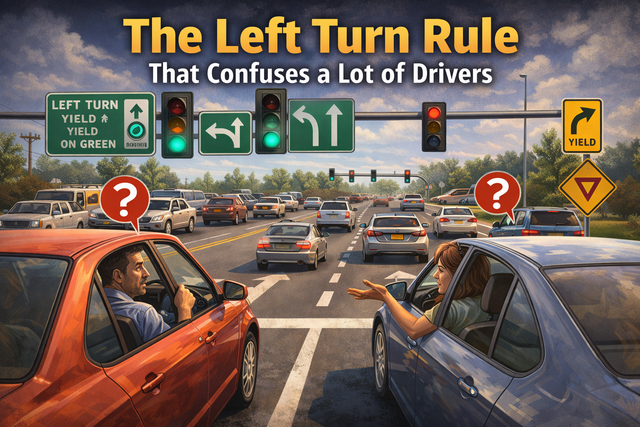
The Left Turn Rule That Confuses a Lot of Drivers
Left turns look simple, but they demand more judgment than most other everyday driving moves. Drivers must evaluate oncoming traffic speed, distance, and intent while also watching signals and pedestrians. That mental load creates hesitation and second-guessing, especially in busy or unfamiliar areas.
Uncertainty grows when drivers feel rushed by cars behind them or pressured by a changing light. Some hesitate too long, others commit too early, and both reactions can be dangerous. Stress narrows attention, making it harder to process everything happening at once.
Because left turns rely so heavily on interpretation, confusion is common. When people fill gaps with assumptions instead of clarity, mistakes follow. That uncertainty is exactly why misunderstandings around left turn traffic rules continue to confuse so many drivers.
Table of Content
Signal Types and Directional Control
Traffic signals are a major source of left turn confusion, especially when drivers don’t fully understand their meaning. A green arrow indicates a protected turn, where oncoming traffic is stopped. In that moment, the turn belongs exclusively to the driver facing the arrow.
A solid green light is different. It usually allows a left turn only after yielding to oncoming vehicles and pedestrians. Many drivers mistakenly treat it like an arrow, while others wait unnecessarily for a protected signal that may never appear.
Flashing yellow arrows add yet another layer, allowing turns but requiring extra caution. When drivers don’t clearly understand these signal differences, behavior becomes inconsistent, and intersections become unpredictable for everyone involved.
Intersection Design Differences
Intersection layout plays a huge role in how drivers interpret left turns. Some intersections have dedicated turn lanes, while others force drivers to share space with through traffic. That alone can change how confident or rushed a driver feels.
Wide intersections can distort distance perception, making oncoming cars seem farther away than they are. Narrow or oddly angled intersections limit sightlines, forcing drivers to guess rather than clearly see approaching vehicles.
When design doesn’t clearly guide movement, drivers rely on habit. Unfortunately, habits vary from place to place. That inconsistency increases hesitation, sudden stops, and risky turns that catch other drivers off guard.
Common Driver Assumptions
Many drivers approach left turns with assumptions that feel reasonable but aren’t always correct. A common belief is that the car going straight always has priority, regardless of signals or intersection setup.
Others assume that a slowing oncoming car is yielding, even when there is no clear indication. Yellow lights are often misread as a cue to rush rather than prepare to stop, especially during left turns.
Pedestrians are frequently overlooked as well. Drivers may forget that crosswalk users still have the right of way. These assumptions spread through observation, not instruction, and they quietly shape unsafe habits over time.
How Confusion Leads to Collisions
When two drivers interpret a left turn situation differently, collisions happen quickly. One driver may accelerate expecting the other to yield, while the other does the same. The result is often a sudden, violent impact.
Left turn crashes are frequently side-impact or head-on collisions, which tend to cause serious injuries. Hesitation can also trigger rear-end crashes when following drivers don’t expect a sudden stop in the intersection.
Most of these crashes aren’t caused by recklessness. They stem from uncertainty, mixed signals, and timing errors. When expectations don’t match reality, intersections turn into conflict zones instead of controlled spaces.
Conclusion
Left turns remain one of the most dangerous routine driving maneuvers because they combine complex rules, varied designs, and human assumptions. Even experienced drivers can misread a situation in just a few seconds.
Signals change, traffic flows shift, and hesitation can be mistaken for permission. Small misunderstandings compound quickly when multiple drivers are involved, leaving little room to recover once a mistake is made.
The safest approach is patience, clear observation, and resisting assumptions. Understanding the intent behind signals and yielding rules matters more than rushing through. Until drivers consistently understand left turn traffic rules, left turns will continue to pose outsized risks on everyday roads.