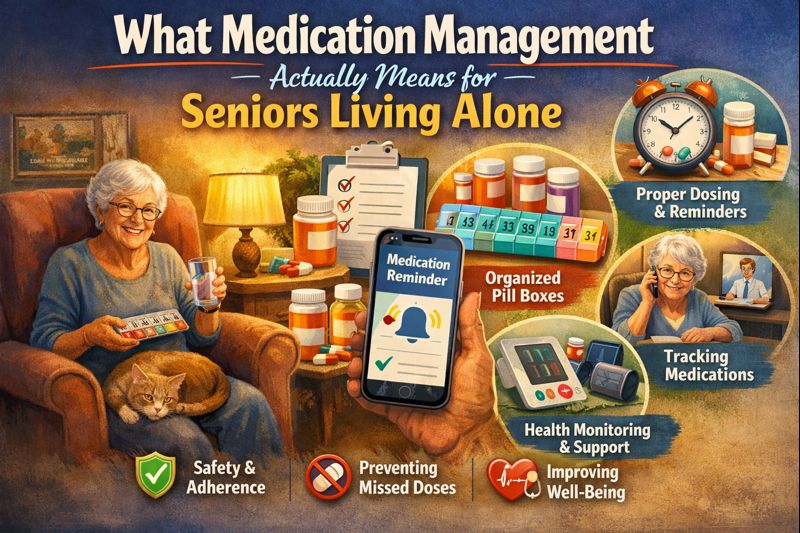
What Medication Management Actually Means for Seniors Living Alone
For most people, taking medication never poses an issue. You get the bottle, take the pill, and you’re on with your day. But older adults, especially those who live alone with daily prescriptions and multiple medications, it’s not that easy anymore. One pill for blood pressure, another cholesterol, another for diabetes is no big deal until you add in another six or seven medications, dosage requirements, food requirements and potential drug interactions.
According to estimates, 125,000 people die each year in the United States because they fail to take medication properly. These are not cancer treatments or heart surgery episodes, these are daily prescriptions. When you’re 75 years old, living alone, it becomes a time-consuming and cognitively demanding effort to figure out what you’ve taken and what you haven’t and what to take when.
Table of Content
Why Managing Multiple Prescriptions Becomes So Difficult
Think about it. Your parent has a cardiologist for the heart, an endocrinologist for diabetes, and a primary care physician for everything else. Each sets them up with medications and each may or may not perfectly communicate with each other. Before long, they’re sitting in front of a kitchen counter filled with orange bottles, two a days, three a days, one with food, one against food, with another needing to be taken four hours apart from anything else.
When each prescription expires at different times, things get compounded. “I need this one by Tuesday,” “This one is next month,” “I forgot to call in this one from two weeks ago.” Or how about when two pills look similar, white round tablets, not marked so small on the prescription label that without their glasses they have no idea what they’re actually taking. Throw in some limited vision or mild cognitive decline and you’ve got a nightmare that’s awaiting to happen.
At least five prescription medications are taken regularly by most older adults. Some up to ten or more. That becomes incredibly complicated when medication management fails. If a blood thinner is supposed to be taken once a day but a senior thinks they’ve forgotten and takes it twice, an emergency situation awaits. If they skip a few blood pressure medications unnecessarily, they risk the potential for a stroke.
The Types of Mistakes That Occur
It’s not even that individuals forget to take them. Seniors take their medication twice without meaning to because they forget they already took them in the morning. Seniors stop taking something because they feel fine and believe they no longer need it, not realizing that they feel fine because whatever medication they’re on is actually working.
They ration medications, too. Prescription medications have impressive costs associated with them and many seniors on fixed incomes try making their medication last. They take half of what they should be taking daily or skip days altogether because something is due next week, but it was suppose to last for three months in the first place. No one admits to doing this and no one tells their doctors because they’re embarrassed until it’s too late.
The same happens with drug interactions. The new medication the specialist prescribed might not interact well with something else on the shelf but no one thinks about the over-the-counter meds or supplements, they’re not keen on mentioning fish oil or the ibuprofen they take three times a week for joint pain, which actually interacts with prescribed blood thinners in negative ways.
What Professional Medication Management Truly Means
That’s why structured support changes everything. Professional management isn’t someone stopping in to give your parent their pills, it’s proactively assessing every opportunity where people fail to realize what’s going on. New Century Home Care Philadelphia provides trained caregivers who work hand-in-hand with this kind of medication management.
A medication manager reports what’s taken and when it was taken proactively every step of the way, from acknowledging they’re there to report back to family members what’s going on assessing potential pitfalls or emergencies before anything bad happens down the road. If your dad mentions he’s feeling dizzy lately, for example, a trained caregiver will understand that this could be related to his new blood pressure medication and ensure that someone follows up with his doctor.
The organized step is more important than most people realize. For example, they help set up pill organizers correctly instead of when seniors try sorting them out themselves in error, log refills for someone that nothing expires unexpectedly and keep certain medications which need refrigeration cold while others stay at room temperature, and vice versa if they bring it all back out to assist their parents in taking, yes, those small details add up to situations when medication management fails.
The Warning Signs Families Frequently Miss
Most adult children do not live close enough to realize when someone’s failing at medication management. For example, do the grandparents have expired medications still on their shelf next to ones they take? Are there various pill bottles strewn about as people over time tried refilling them instead of just keeping them all in one spot? Does your mother say she “thinks” she took her morning pills but is now unsure if she’s taken her afternoon ones yet?
Refilling patterns tell the truest story of all; if someone needs a refill that should last 30 days prematurely at 20 days or lasting 45 days, something is askew; either there’s confusion about dosing or there are pills being skipped and neither situation spells success.
Physical changes lend credence as well; fatigue that suddenly sets in out of nowhere as well as confusion/dizziness/falls could ultimately stem from poor medication intake as well. Bad diabetes levels could control blood sugar levels regardless if insulin was taken; blood pressure won’t stabilize; pain breaks through regardless of pain medication highlights that’s something else must be going on here aside from basic medication mismanagement issues.
When Remote Monitoring Isn’t Enough
Remote monitoring exists right now, apps that send reminders for people to take their medications; pill bottles that alert you if it’s been opened since dispensing; smart pill dispensers that beep and light up, all sorts of technological fortifications that could help but fail miserably when it comes down to practical analysis of situations professionals uncover.
Technology has no way of confirming if something was actually swallowed or why a parent has had less clarity today, or if their hands are shaking too much from arthritis to open a childproof cap. There’s also no real way for technology to communicate with someone socially about side effects or intervene with a pharmacy putting an order in for clients unsure what has gone wrong along the way to justify anything else happening down the line.
For seniors who have cognitive impairment especially, technology-facilitated solutions become more confused than anything else; it beeps but no one knows how to remember why it’s beeping; they get frustrated and stop paying attention altogether.
The Cost When Medication Management Fails
When proper medication management fails, it’s not just an emergency situation with inevitable hospitalization costs in life, instead the costs triple; it’s predetermined since such an occurrence could have been avoided but now it’s going to cost the individual over ten thousand dollars due to recovery complications as well as independence now being questioned.
No one wants to go through this ordeal; adult children feel guilty because they wonder why they couldn’t pay more attention earlier; vulnerable adults feel embarrassed their cognitive decline was so bad everyone questioned whether they’d ever live alone again without extreme support, and trust gets lost within the family system because it becomes clear that a loved one had lied about certain aspects to save face instead of ensuring everyone was working collaboratively for their health.
Making Medication Management Sustainable
The idea is never to take away all sense of independence but instead provide the right level of support so people can stay in their homes safely without virtually any stressors re-configuring those efforts one day at a time. This might come down to sending a caregiver once or twice a day specifically for medication administration purposes daily; this could mean someone asking questions with greater involvement extended hours depending upon other complicated medical needs.
Always involve healthcare professionals for medication review each six months; someone should sit down with the doctor and go through every single medication noted to see if each one is still necessary and all dosage still makes sense since sometimes doctors forget there were once other medications no longer needed and just keep adding more things on an already full list.
Everyone works better when everything works together, from caregiver to family members to medical professionals who all must be on the same page assessing what medications they’re taking, monitoring every side effect they’re living through, determining what health goals might work best from now on going forward from day one through all subsequent appointments thereafter.
Ultimately living alone does not have to mean managing complicated medication resources alone, with the right support system set up successfully, seniors are able to thrive independently all while staying healthy so long as sustainable efforts are taken consistently in a flexible manner on everyone’s end. This benefit far succeeds any loophole-based premature autonomy denied over stubborn confidence that much won’t hurt anyone.