
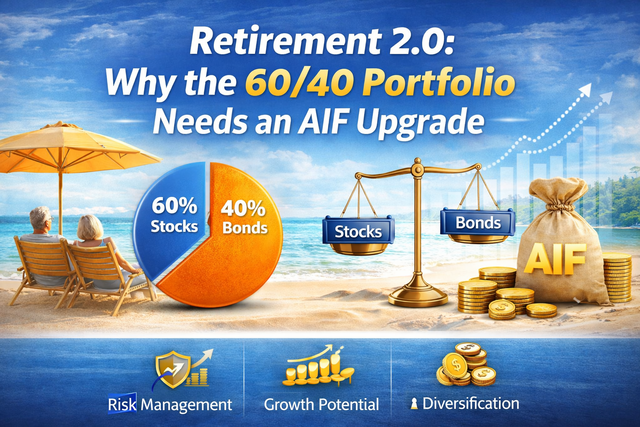
Retirement 2.0: Why the 60/40 Portfolio Needs an AIF Upgrade
Every generation inherits financial wisdom from the one before it. For millions of Indians approaching retirement today, that inherited wisdom sounds something like this. Put sixty percent in equities for growth and forty percent in bonds for safety, and everything will be fine.
The advice made sense for decades when bond yields were healthy enough to fund a comfortable lifestyle and equity markets moved in patterns that felt somewhat predictable. But inheriting a strategy is not the same as questioning whether that strategy still works under completely different conditions. Inflation eats into fixed income returns more aggressively than most people realize.
Stock market corrections arrive faster and recover in more uneven patterns than they did a generation ago. And the single biggest change of all is that people are living considerably longer than the sixty forty model was originally designed to support.
Table of Content
Thirty Years of Retirement Requires More Than Two Asset Classes
A person retiring at sixty today could very realistically need their portfolio to last until they are ninety or beyond. That amounts to three decades of payments, health care costs, living spending, and the slow decrease in buying power brought on by yearly inflation.
Simply put, a portfolio made solely of government bonds and listed stocks lacks the structure diversity necessary to survive that kind of run. Retirees who rely on their assets for monthly income are forced to sell holdings at low prices when equity markets fall, permanently wasting capital that will never be able to recover.
The seemingly safe part of the portfolio gradually loses real value each month when bond rates drop below the rate of inflation. An alternate investment fund introduces asset classes like private equity, real estate, structured credit, and hedging strategies that operate on entirely different rhythms than public markets. Their returns are not tied to daily stock price movements, which means they can provide stability and growth during the exact periods when conventional holdings struggle most.
Adding Structure Where Uncertainty Currently Lives
For retirees who find the idea of alternative assets intimidating, the structured product category offers a particularly useful entry point. These instruments combine equities, fixed income, and derivative elements to create investments with specifically defined outcomes.
Some provide full capital protection at maturity, guaranteeing the return of principal regardless of what markets do in between. Others link returns to the performance of a market index while limiting downside exposure through built in protective features. The ability to tailor risk and return profiles to match a retiree’s exact needs makes a structured product fundamentally different from buying a stock and hoping for the best.
Anand Rathi share and stocks broker facilitates access to both alternate investment fund opportunities and carefully constructed structured product solutions through its private client group, ensuring that every investor receives professional guidance on suitability and risk before committing any capital.
Old Habits Feel Safe but Safety Is Sometimes an Illusion
The most dangerous financial habit a retiree can have is confusing familiarity with safety. The sixty forty portfolio feels safe because it has been around for so long.
But longevity of a strategy does not equal suitability for every era. Markets evolve, lifespans extend, healthcare costs escalate, and the instruments available to investors expand in ways that previous generations could never have imagined. Refusing to explore those new instruments out of loyalty to an old formula is not cautious. It is careless.
The Next Chapter Deserves a Portfolio Built for What Comes Next
A financial journey does not end with retirement. It’s the start of a new era that calls for a more clever and varied approach than just splitting funds between two standard groups. The people who pushed the status quo early enough to build something better will be the ones who succeed financially in the upcoming decades.