
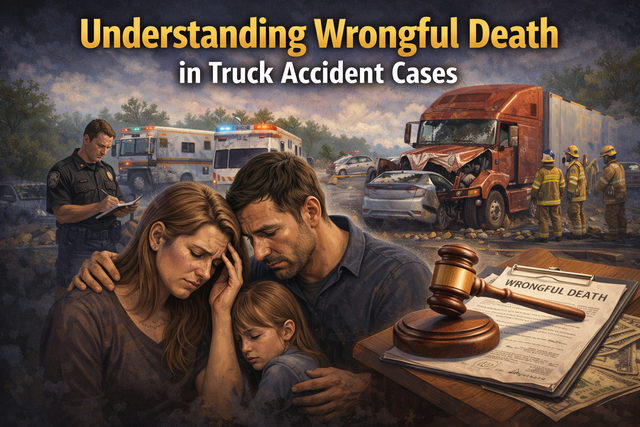
Understanding Wrongful Death in Truck Accident Cases
Truck accidents create unique circumstances that result in death far more frequently than regular vehicle collisions. The sheer mass and momentum of commercial trucks overwhelm passenger vehicles in ways that make survival unlikely. When someone dies in a truck accident, wrongful death claims become available to surviving family members.
These cases are extraordinarily complex because truck accidents involve multiple potential defendants and regulatory violations. Understanding these cases helps families navigate the legal process during their grief.
Wrongful death claims arising from truck accidents allow surviving family members to pursue compensation for losses resulting from a loved one’s death. A spouse, children, or parents can typically bring these claims depending on state law. Compensation includes lost financial support the deceased would have provided plus non-economic damages. Truck accident wrongful death cases often result in larger settlements than regular vehicle accidents. Multiple parties potentially bear responsibility for the death.
Truck accidents present unique legal complexities making wrongful death cases particularly challenging. Understanding truck accident wrongful death helps families pursue accountability and justice. Recognizing distinctive factors in these cases illuminates why they require specialized legal attention.
Table of Content
Size, Weight, and Impact Factors
Commercial trucks weighing eighty thousand pounds represent massive energy in motion. A fully loaded semi-truck traveling at highway speed cannot stop quickly. The stopping distance for large trucks exceeds that of regular vehicles significantly. A passenger vehicle struck by a truck experiences forces exponentially greater than car-to-car collisions. The physics of truck collisions create injuries and deaths rarely occurring in regular accidents. Occupants of smaller vehicles are at extreme disadvantage in collisions.
The height difference between truck cabs and passenger vehicles creates dangerous blind spots. Trucks cannot see vehicles directly beside or behind them. Underride accidents occur when passenger vehicles slide beneath trailers. Occupants of smaller vehicles absorb all impact force without structural protection. Trucks rarely slow down noticeably in collisions that completely destroy smaller vehicles. The disparity in size creates asymmetrical impact forces affecting smaller vehicles disproportionately.
Jackknifing and rollovers caused by driver error or mechanical failure result in catastrophic accidents. When trucks lose control and overturn, nearby vehicles get crushed. Cargo shifting or loss creates hazards affecting other motorists. Massive kinetic energy transformed into destructive force creates death and destruction. Truck accidents inherently produce more deadly outcomes than lighter vehicle collisions. Physics alone makes truck accidents substantially more dangerous.
Multiple Responsible Parties
Truck accidents often involve multiple defendants making liability complex. The truck driver bears responsibility for operating safely and obeying regulations. The trucking company can be liable for negligent hiring or inadequate training. Truck manufacturers can be responsible if mechanical failures contributed. Maintenance facilities can be liable if required maintenance wasn’t performed. Cargo companies can be responsible if improper loading caused the accident.
Insurance companies for different parties dispute liability and compensation responsibilities. Multiple insurance policies might apply depending on what caused the accident. Subrogation issues arise when multiple payors have interests in compensation. Uninsured or underinsured motorists sometimes complicate matters. Determining responsible parties requires investigation into every accident aspect. Documentation becomes crucial in establishing which party bears liability.
Regulatory violations by drivers or companies often establish negligence in wrongful death cases. Hours of service violations indicate driver fatigue and negligence. Maintenance records showing missed inspections establish negligent care patterns. Training records demonstrating inadequate preparation support liability findings. Text messages showing pressure to meet unrealistic schedules establish negligent management. Documentary violations provide evidence beyond the accident itself for establishing fault.
Investigation and Evidence Challenges
Accident reconstruction in truck cases requires specialized expertise. Experts analyze braking capabilities, sight lines, and stopping distances. Black box data from trucks provides information about speed and braking. However, not all trucks have functioning black boxes requiring technical expertise. Witness statements sometimes conflict or provide incomplete information. Evidence collection becomes time-sensitive because accident scenes are cleared quickly.
Regulatory records including driver logs and maintenance records require investigation. These documents often require legal process or subpoenas to obtain. Electronic logs mandate compliance but sometimes show manipulation. Maintenance records reveal whether trucks receive proper servicing. Company communication records show pressure on drivers to violate rest requirements. Obtaining and interpreting these records requires legal expertise.
Expert testimony becomes essential in truck wrongful death cases. Accident reconstruction experts explain how accidents occurred and responsibility. Medical experts document injury severity and death causes. Trucking industry experts explain safety standards and violations. Economist experts calculate lifetime earning potential and financial losses. These expert evaluations require significant time and expense to obtain properly.
Family Loss and Long-Term Impact
The death of a family member creates grief extending far beyond immediate loss. Surviving spouses lose partners and often face financial hardship. Children lose a parent and face uncertainty about futures. Parents lose adult children sometimes requiring financial support provision. The emotional devastation persists throughout life despite time passing. Wrongful death compensation acknowledges emotional harm though money cannot repair loss.
Financial impacts extend beyond immediate income loss significantly. Funeral and burial expenses create immediate costs families must cover. Estate matters become complicated requiring legal assistance. Insurance and benefit questions arise regarding applicable coverage. Children’s education becomes uncertain when supporting parent is killed. Long-term financial stability becomes compromised when primary earners are killed. Practical financial consequences compound emotional devastation substantially.
The ability to pursue justice provides some closure for grieving families. Understanding what caused death helps families process their loss. Holding parties accountable honors the deceased’s memory. Compensation recovered can fund children’s education and support. The legal process provides a framework for families pursuing accountability during grief. Justice acknowledgment helps survivors move forward.
Conclusion
Truck accident wrongful death cases involve unique complexities differing substantially from regular vehicle accidents. Massive truck size and weight create forces resulting in death far more frequently. Multiple potential defendants make liability determination complex and investigation extensive. Regulatory violations often establish negligence beyond accident mechanics. Evidence gathering requires specialized expertise and significant resources. Family losses extend beyond financial compensation to permanent emotional devastation. Understanding these distinctive factors helps families pursue appropriate compensation and accountability for their losses.