
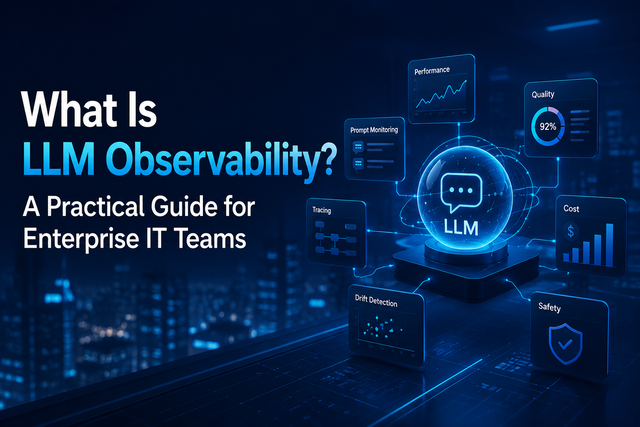
What Is LLM Observability? A Practical Guide for Enterprise IT Teams
A growing number of enterprise AI projects are making it into production.
That sounds like good news.
Yet many IT leaders are discovering an uncomfortable reality after deployment: they can see that an AI application is running, but they cannot always explain why it is behaving the way it is.
A chatbot suddenly starts generating lower-quality responses. An AI-powered search assistant becomes inconsistent. A customer support copilot delivers answers that appear technically correct but miss critical context. Users complain. Business stakeholders ask questions.
The system remains online.
The problem is understanding what changed.
This is where LLM observability has emerged as one of the most important disciplines in enterprise AI operations.
As large language models become embedded into customer service workflows, internal productivity tools, software development environments, and business processes, organisations are recognising that traditional monitoring approaches are no longer enough.
The challenge is no longer simply keeping systems available.
The challenge is maintaining trust in systems that continuously generate new outputs.
Why Traditional Monitoring Falls Short
For decades, enterprise monitoring focused on infrastructure.
IT teams measured:
- CPU utilisation
- Memory consumption
- Network latency
- Application uptime
- Database performance
These metrics remain important.
However, they tell only part of the story when AI systems are involved.
A language model can appear perfectly healthy from an infrastructure perspective while simultaneously producing poor business outcomes.
Response times may be acceptable.
Error rates may be low.
Servers may be operating normally.
Yet users may still be receiving inaccurate, irrelevant, or inconsistent answers.
This creates a fundamental shift in how operational teams think about system performance.
The question is no longer simply, “Is the application working?”
The question becomes, “Is the application producing useful outcomes?”
The Hidden Complexity of Enterprise AI Workflows
Many executives initially assume that deploying a large language model is primarily a technology challenge.
In reality, the operational complexity emerges after deployment.
Modern enterprise AI workflows often involve:
- Foundation models
- Prompt engineering layers
- Retrieval systems
- Vector databases
- APIs
- Security controls
- Workflow automation platforms
- Human review processes
Every additional component introduces another potential point of failure.
A customer-facing AI assistant may generate poor responses because:
- The prompt changed
- Source documents became outdated
- Retrieval quality declined
- Context windows became overloaded
- User behaviour shifted
- Model versions changed
The visible symptom remains the same.
The root cause may exist almost anywhere within the workflow.
This is why many organisations struggle to diagnose AI performance issues quickly.
What LLM Observability Actually Means
At its core, AI observability refers to the ability to understand, measure, analyse, and troubleshoot how large language model systems behave in production environments.
Unlike traditional application monitoring, observability focuses on answering questions rather than merely collecting metrics.
Why did this response occur?
What influenced the model’s decision?
When did performance begin changing?
Which users are affected?
What operational conditions contributed to the issue?
The goal is not simply generating more data.
The goal is generating meaningful context.
This distinction is important because enterprises are already overwhelmed with information.
What they often lack is understanding.
The Operational Contradiction Many Organisations Face
One of the most interesting tensions emerging in enterprise AI adoption is that increasing model sophistication often reduces operational transparency.
More capable systems frequently become harder to explain.
The very features that make modern language models powerful also make them difficult to diagnose.
This creates an operational contradiction.
Business leaders want AI systems to become more autonomous.
IT leaders need those same systems to remain understandable.
The gap between those objectives continues to widen.
Many organisations discover that scaling AI successfully is less about model performance and more about governance, visibility, and operational control.
The Key Signals Enterprise Teams Monitor
Observability efforts typically focus on a combination of technical, behavioural, and business-oriented indicators.
Examples include:
Model Performance Metrics
Teams monitor response latency, token usage, throughput, and system reliability.
These metrics provide baseline visibility into operational health.
Output Quality Indicators
Quality assessment often includes response relevance, factual consistency, hallucination rates, and user feedback signals.
This layer becomes particularly important for customer-facing applications.
Retrieval Effectiveness
For retrieval-augmented generation systems, teams often evaluate document relevance, retrieval accuracy, and source utilisation.
Many organisations are surprised to discover that retrieval quality degrades before users formally report issues.
User Interaction Patterns
Behavioural data frequently reveals problems before technical alerts do.
Repeated queries, abandoned sessions, prompt reformulation, and escalating support requests often indicate declining user confidence.
Customers usually disengage emotionally long before they formally stop using a system.
The same behavioural pattern increasingly applies to enterprise AI products.
Why Root Cause Analysis Becomes More Difficult
One of the most significant operational challenges in AI environments is proving causality.
Traditional systems generally follow predictable logic.
AI systems operate differently.
Multiple variables influence outcomes simultaneously.
A single response may be affected by:
- User prompts
- Retrieved content
- Model configuration
- Training data characteristics
- Safety guardrails
- External APIs
- Context history
This complexity makes root cause analysis far more difficult.
Many businesses mistake activity for operational maturity.
Collecting logs is not the same as understanding behaviour.
Generating dashboards is not the same as diagnosing problems.
Sophisticated buyers increasingly recognise this distinction.
The Psychology of Trust in Enterprise AI
Technical performance is only one aspect of AI adoption.
Trust plays an equally important role.
Users do not evaluate AI systems purely based on accuracy.
They evaluate predictability.
A system that performs at 95% accuracy but behaves inconsistently often creates more concern than a less capable system that behaves predictably.
This psychological dynamic explains why observability is becoming increasingly important.
The purpose is not merely identifying failures.
The purpose is maintaining confidence.
In enterprise environments, trust often becomes an operational metric in its own right.
Moving from Monitoring to Understanding
Leading organisations are beginning to view observability as a strategic capability rather than a technical function.
This shift reflects broader changes occurring across enterprise technology.
Historically, operations teams focused on identifying outages.
Today, many teams focus on understanding complex system behaviour before visible failures emerge.
This evolution mirrors trends highlighted by firms such as Gartner, Deloitte, and McKinsey, all of which have emphasised the growing importance of governance, transparency, and operational accountability in enterprise AI adoption.
The most mature organisations recognise that visibility creates resilience.
When teams understand how systems behave, they can adapt faster when conditions change.
The Future of Enterprise AI Operations
As large language models become embedded across business operations, observability will increasingly become a foundational requirement rather than an optional capability.
The organisations generating the greatest value from AI will not necessarily be those with the largest models.
They will be the organisations that can confidently explain how their systems behave under real-world conditions.
Technology rarely fixes fragmented workflows on its own.
AI simply exposes them faster.
That is why ai observability is becoming such an important discipline for enterprise IT teams. It provides the context needed to move beyond basic monitoring and toward meaningful operational understanding.
In the years ahead, the competitive advantage may not belong to organisations that deploy AI first.
It may belong to those that understand it best.