
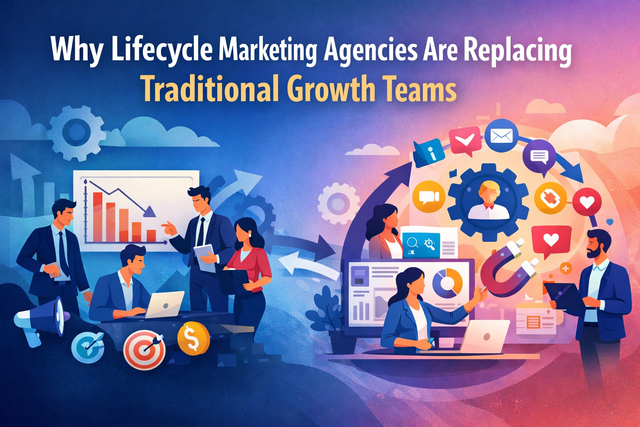
Why Lifecycle Marketing Agencies Are Replacing Traditional Growth Teams
Over the past decade, growth marketing was defined by one priority: acquiring customers at scale. Companies invested heavily in paid media, optimized funnels, and measured success through rapid top-line growth. Today, that model is under pressure. Rising acquisition costs, stricter privacy rules, and fragmented customer journeys have made predictable scaling harder than ever.
In response, organizations are shifting focus from one-time conversions to long-term relationships. Lifecycle marketing—spanning onboarding, engagement, retention, and reactivation—is becoming central to sustainable growth. As these programs grow more complex, many brands are turning to specialized lifecycle agencies to manage data, automation, and continuous customer communication, signaling a broader evolution in how modern growth is built. This shift is quickly redefining the role of marketing teams today.
Table of Content
- 1 Growth Isn’t Broken — It’s Just Evolving
- 2 Customers No Longer Follow Funnels — They Live in Loops
- 3 Retention, Not Acquisition, Is Now the Real Growth Lever
- 4 Lifecycle Marketing Demands a Completely Different Operating Model
- 5 Why Brands Are Turning to Lifecycle Marketing Agencies
- 6 The Role of Traditional Growth Teams Is Being Redefined, Not Eliminated
- 7 Conclusion
Growth Isn’t Broken — It’s Just Evolving
Traditional growth teams played a major role in helping brands grow quickly. For example, many startups used paid ads on platforms like Google and social media to drive large amounts of traffic and gain their first customers. This approach worked well when advertising costs were lower and audiences were easier to reach.
However, things have changed. Privacy updates, ad fatigue, and crowded platforms now make it harder to rely only on acquisition. A brand may spend more on ads but see fewer conversions than before. Because of this, companies are shifting focus from just attracting new users to keeping existing customers engaged. As a result, many businesses are now partnering with a lifecycle marketing agency to manage long-term customer relationships and improve retention-driven growth strategies.
Customers No Longer Follow Funnels — They Live in Loops
Today’s customers do not move through a simple, straight funnel. Instead of going from awareness to purchase in one smooth path, they jump between stages, compare options, leave, and return later. For example, a person might discover a brand on social media, read reviews on a blog, abandon their cart, and come back weeks later after seeing an email or a retargeting ad.
Because of this behavior, growth now works more like a loop than a funnel. After buying, customers continue interacting with the brand through emails, support, and repeat purchases. Happy customers may also recommend the brand to others, bringing in new users. This continuous cycle creates long-term growth, which lifecycle marketing agencies are better equipped to manage than traditional funnel-focused teams.
Retention, Not Acquisition, Is Now the Real Growth Lever
Today, acquiring new customers is more expensive than ever. Advertising costs on platforms like search engines and social media have increased, while conversion rates have become less predictable. This means companies often spend more money just to get the same number of new users they once acquired at a lower cost.
Because of this, many businesses are realizing that keeping existing customers is more profitable than constantly chasing new ones. When brands improve onboarding, help users understand the product faster, and encourage repeat purchases, they increase customer lifetime value and create steadier revenue.
Loyal customers are also more likely to recommend the brand to others. As a result, retention is no longer just a support metric—it has become a major driver of sustainable growth and long-term competitiveness.
Lifecycle Marketing Demands a Completely Different Operating Model
Lifecycle marketing works very differently from traditional campaign-based growth. Instead of planning one-time campaigns and measuring short-term results, lifecycle marketing focuses on building systems that react to customer behavior in real time. For example, if a user signs up but does not complete onboarding, they may automatically receive helpful emails, in-app messages, or reminders designed to guide them forward.
To make this possible, companies need clean customer data, strong segmentation, and tools that connect email, apps, ads, and analytics. This also requires close coordination between marketing, product, data, and customer success teams. Many organizations find it difficult to manage all of this internally, which is why they increasingly rely on lifecycle marketing agencies that specialize in building and running these complex, always-on systems.
Why Brands Are Turning to Lifecycle Marketing Agencies
As lifecycle marketing becomes more complex, many brands are finding it difficult to build and manage the required systems on their own. Setting up CRM platforms, designing email and SMS journeys, managing customer data, and running continuous testing all require specialized skills and dedicated resources.
Most in-house teams are already stretched across multiple priorities, making it hard to focus deeply on lifecycle strategy. Lifecycle marketing agencies step in with ready expertise, proven frameworks, and hands-on experience across different tools and industries.
They help break down silos between marketing, product, and data teams while bringing clear ownership to customer journey management. By partnering with agencies, brands can launch and optimize lifecycle programs faster, reduce costly trial-and-error, and move toward more mature, data-driven growth without building everything from scratch.
The Role of Traditional Growth Teams Is Being Redefined, Not Eliminated
Lifecycle marketing agencies are not replacing traditional growth teams entirely—they are changing how those teams operate. In many companies, internal growth teams are shifting their focus toward higher-level strategy, such as brand positioning, product messaging, and identifying new market opportunities.
They help define the overall direction of growth rather than managing every campaign and automation workflow themselves. At the same time, lifecycle agencies take on the technical and operational side of customer engagement.
They manage CRM platforms, build automated journeys, run tests, and continuously optimize performance across channels. This creates a more collaborative model where internal teams set the vision and priorities, while agencies handle execution and day-to-day optimization. Instead of competing roles, this evolution allows both sides to focus on what they do best and work together more effectively.
Conclusion
Sustainable growth today is no longer driven by one-time conversions but by the strength of ongoing customer relationships. Companies that prioritize retention, personalized communication, and consistent engagement are better positioned to build predictable revenue and long-term brand loyalty.
Lifecycle marketing enables this shift by transforming marketing from a series of isolated campaigns into a continuous, data-informed engagement engine that supports customers at every stage of their journey.
As customer expectations rise and data ecosystems become more complex, managing these interactions in-house is increasingly challenging. This is why lifecycle marketing agencies are becoming essential partners. Their expertise in automation, segmentation, and cross-channel strategy helps brands stay relevant, responsive, and competitive. Looking ahead, the brands that embrace lifecycle thinking today will be the ones best prepared for tomorrow’s growth challenges.