
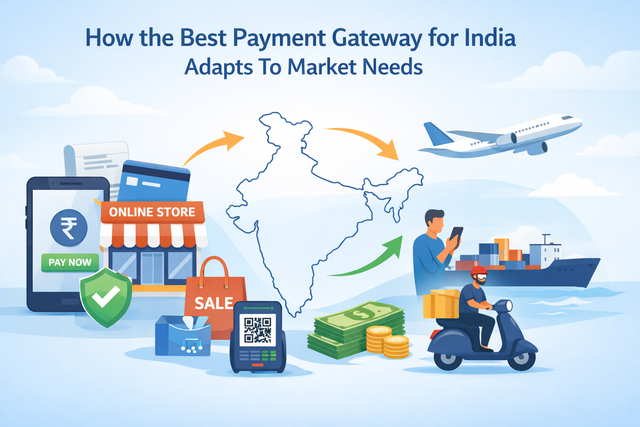
How the Best Payment Gateway for India Adapts To Market Needs
Government data confirms India’s digital economy is accelerating at an unprecedented scale.
In the first half of 2025, digital payments accounted for 99.8% of all transactions by volume, highlighting the near-complete shift away from cash.
This dominance reflects growing confidence in mobile-first payments across cities, towns and emerging markets. Consumers now expect speed, reliability and familiarity at checkout, regardless of device or location. Payment experiences shape trust as much as pricing or product quality.
The best payment gateway for India succeeds by responding to these realities. It adapts to device behaviour, payment preferences, traffic surges and regional access needs. This blog explores how such gateways evolve with market demands and why that adaptability supports long-term business growth.
Table of Content
- Key ways the best payment gateway for India adapts to market needs
- 1. Wider payment mode integration to match evolving preferences
- 2. Stronger risk intelligence and authentication layers
- 3. Adaptation for peak traffic spikes and festive commerce
- 4. Customised solutions for regional and demographic diversity
- 5. Multi-channel selling support for modern commerce models
- 6. Deep merchant visibility and self-service control
- 7. Readiness for regulatory and policy changes
- Drive adoption and unlock stronger outcomes
Key ways the best payment gateway for India adapts to market needs
These capabilities reflect how leading gateways evolve to meet India’s dynamic digital payments environment.
1. Wider payment mode integration to match evolving preferences
Indian customers prefer choice when paying online, adapting to payment methods that suit the context and their comfort. The best payment gateway for India should offer integrated support for cards, UPI, wallets, net banking, Equated Monthly Instalments (EMIs) and recurring billing.
This multi-modal acceptance allows merchants to meet changing payment preferences and retain customers when one method fails. Such capability ensures checkout continuity, sustains conversion and supports diverse buyer needs across segments.
2. Stronger risk intelligence and authentication layers
Security concerns rise alongside the adoption of digital payments. The best payment gateway for India implements advanced risk signals, including Payment Card Industry Data Security Standard (PCI DSS) compliance and Two-factor Authentication (2FA). Gateways track unusual patterns and flag high-risk activity before completion.
Integration through a Model Context Protocol (MCP) server ensures secure API connectivity, protecting data and authorisation integrity. These measures reassure customers without disrupting experience, protecting merchants from fraud and chargeback costs.
3. Adaptation for peak traffic spikes and festive commerce
India’s commerce seasonal cycles create intense demand spikes during festive sales and special events. The best payment gateway for India scales its infrastructure to handle high volumes without failure. Intelligent routing distributes traffic across systems to prevent overload.
Smart retry logic and prioritised settlement queues ensure transactions complete even under stress. These capabilities help merchants maximise opportunities during peak seasons while maintaining service reliability and preserving shopper confidence.
4. Customised solutions for regional and demographic diversity
India is culturally and linguistically diverse and customer expectations vary accordingly. The best payment gateway for India offers regional language options and localisation cues to improve comprehension and comfort.
Customers in different regions respond to familiar visuals, simple navigation and payment cues that align with local habits. Supporting this diversity ensures that merchants cater to all customer segments, improving accessibility and trust.
These adaptations help maintain relevance across vast demographic groups, reducing hesitation and enhancing engagement.
5. Multi-channel selling support for modern commerce models
Indian businesses increasingly operate across online shops, physical Point-of-Sale (PoS) locations and marketplaces. The best payment gateway for India supports seamless online, offline and hybrid selling through unified acceptance.
QR code payments link with web checkout and in-store card acceptance, creating consistent experiences. Subscription billing and recurring payment features help membership and service-based models. This adaptability lets merchants grow without having to manage separate payment silos.
6. Deep merchant visibility and self-service control
Merchants require actionable insight into payment performance beyond simple success rates. The best payment gateway for India delivers real-time dashboards with settlement clarity, refund triggers and failure analytics.
Dashboards segment metrics by device geography and payment method so that teams can pinpoint friction points. Self-service controls reduce dependency on support teams, enabling faster business decisions and operational agility.
Enhanced visibility also aids compliance reconciliation, supporting clear audit trails for merchant accounting teams.
7. Readiness for regulatory and policy changes
India’s digital payments environment changes frequently through new compliance rules and operational guidelines. The best payment gateway for India remains aligned with Reserve Bank of India requirements without interrupting merchant workflows.
Automatic updates support mandate changes, consent structures and settlement processes as regulations shift. This readiness lowers compliance risk and prevents sudden payment interruptions for businesses.
By responding early to policy updates, gateways protect continuity and maintain customer trust across changing market conditions.
Drive adoption and unlock stronger outcomes
India’s digital payments will continue to expand, and customer expectations will rise across speed, reliability and ease of use. The best payment gateway for India adapts through mobile optimisation, secure intelligence layers, broad payment acceptance and strong regional accessibility.
As payment journeys become central to brand trust, businesses assess technology with a long-term operational view. Many enterprises now review payment gateways such as Pine Labs Online to support multi-channel acceptance and flexible payment capability.
Unified online and offline coverage supports scale without operational complexity. Organisations focused on future-ready digital operations often prioritise insight-led gateway technology. Such platforms help teams respond to market shifts while delivering dependable payment experiences that support sustainable business growth.