How to Test for Vacuum Leaks?
TL;DR
- Package leak testing verifies the sterile barrier integrity of medical and pharmaceutical containers to prevent atmospheric ingress and contamination.
- Deterministic testing, such as a vacuum decay leak test, quantifies pressure changes down to a 1 µm limit to provide objective, repeatable data.
- Probabilistic testing, like bubble leak testing, relies on visual observation to identify gross leaks (large structural defects) in a submerged environment.
- Regulatory compliance (e.g., USP <1207> and ISO 11607) requires calibrated, high-precision instrumentation rather than manual, subjective testing methods.
- Uncalibrated manual tests expose manufacturers to audit failures and dangerous false-positive results.
Package leak testing is a standardized quality assurance protocol designed to detect structural breaches in sealed containers. In the medical and pharmaceutical sectors, maintaining sterile barrier integrity is critical for shelf-life preservation.
Atmospheric ingress (the entry of outside air or moisture) into a sealed package is associated with a reduced risk of stability, leading to rapid oxidation, accelerated spoilage, or the total loss of sterility. Testing these barriers aims to manage these risks. Identifying defects relies heavily on bubble leak testing and advanced vacuum decay analysis to ensure compliance with strict clinical safety standards.
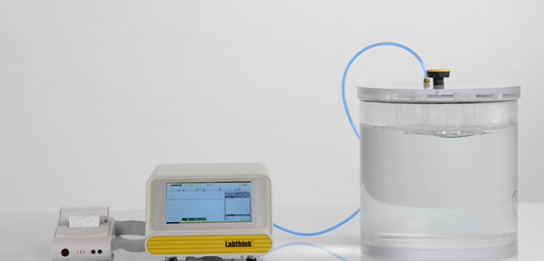
Table of Content
How Does Differential Pressure Reveal Package Leaks?
When a package is placed in a vacuum environment, the external pressure drops significantly compared to the internal pressure. This physical stress forces any trapped air inside the package to push outward. In defective packaging, this gas escapes through “tortuous paths” (complex, winding microscopic channels within the sealing material).
The United States Pharmacopeia (USP <1207>) provides strict guidelines on how to classify the detection of these paths. The standard categorizes testing methodologies into two distinct clinical frameworks:
- Probabilistic Methods: Tests, Visual bubble emission, for example, rely on human observation and statistical probability. They are highly effective for identifying severe structural failures but leave room for subjective interpretation.
- Deterministic Methods: Tests like quantitative vacuum decay, utilize calibrated sensors to measure exact pressure changes. They provide objective, numerical data that removes human error, aligning with strict pharmaceutical auditing requirements.
How to Do ASTM Bubble Leak Test?
Bubble leak testing is a foundational, probabilistic testing methodology. Before conducting highly sensitive quantitative tests, technicians utilize a gross leak bubble tester to identify “gross leaks” (large structural failures). Catching massive leaks early is critical; placing a severely ruptured package into a highly sensitive vacuum decay machine can contaminate the high-precision sensors or lead to missed catastrophic failures.
The standard procedure for conducting this test, as outlined by ASTM D3078 guidelines, includes the following steps:
- Preparation: Fill the transparent vacuum chamber with a testing fluid (usually water).
- Submersion: Submerge the sealed package completely beneath the fluid, using a porous restriction plate to keep it continuously underwater.
- Evacuation: Engage the vacuum generator to reduce the pressure in the headspace above the fluid.
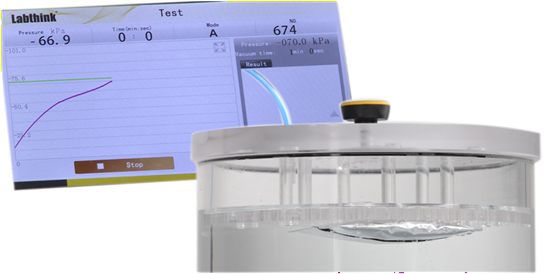
- Observation: Maintain the vacuum for a predetermined time. Watch for a steady, continuous progression of bubbles originating from a specific point on the package, which indicates a defect.
- Release: Vent the chamber to restore atmospheric pressure and inspect the package for any fluid ingress.
What Are the Advantages of a Non-Destructive Leak Test?
A non-destructive leak test, such as vacuum decay, protects high-value pharmaceutical samples from water contamination, allowing intact products to return safely to the production line. By eliminating the “human eye” factor, these systems utilize precise transducers to quantify microscopic pressure drops in a completely dry testing environment.
When testing high-value parenteral packaging (such as specialized glass vials or prefilled syringes), destructive water immersion is highly inefficient and creates significant material waste. The vacuum decay leak test addresses this by isolating the sample in a tightly conforming, dry testing cell.
This deterministic method offers exceptional sensitivity and objectivity. Advanced instruments, such as the Labthink C690 series, utilize microflow detection technology capable of identifying leak apertures as small as 1 µm. Because the system relies entirely on pressure transducers rather than visual observation, the data is entirely objective and repeatable.
Furthermore, the dry testing environment eliminates the risk of “boiling water” false positives. In high-vacuum bubble tests, dissolved gases in the testing water can occasionally expand and mimic a package leak, confusing human operators. Vacuum decay bypasses this physical phenomenon entirely, providing a clinically sound and mathematically precise leak rate.
Why Are High-Precision Leak Detection Instruments Important?
Regulatory bodies require quantitative, traceable data that uncalibrated manual methods cannot provide. High-precision instruments ensure exact pressure control and automated data integrity to meet strict Good Manufacturing Practice (GMP) and FDA compliance standards.
In clinical packaging, informal quality checks like manual “squeeze tests” or DIY acrylic vacuum chambers routinely fail regulatory audits. These methods lack precise calibration and cannot produce the repeatable data required by ISO 11607 (Packaging for terminally sterilized medical devices).
To meet these standards, facilities rely on advanced solutions:
- The C690H Nondestructive Package Leak Detector: This system ensures accuracy by utilizing dual-sensor architectures and NIST-traceable calibration. It provides exact, unrounded microflow data without altering the sample.
- The C660B Leak and Seal Strength Tester: This apparatus serves a dual role. It functions as a highly controlled gross leak bubble tester while also providing quantitative seal strength data, measuring the exact pressure at which a seal bursts.
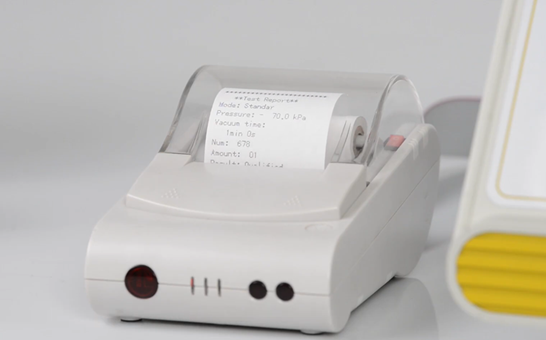
- Automated Data Integrity: To comply with FDA 21 CFR Part 11 and GMP, these modern systems feature digital record-keeping. They automatically log audit trails, require multi-level electronic signatures, and prevent raw data manipulation, ensuring that all clinical reporting is secure and verifiable.
How Does Vacuum Leak Testing Apply Across Different Manufacturing Industries?
Industries utilize package leak testing to manage specific environmental risks, from maintaining sterility in medical vials to preserving gas mixtures in food packaging. The chosen method depends on the product’s sensitivity to moisture, oxygen, and atmospheric pressure changes.
While the fundamental physics of differential pressure remain the same, the application varies significantly by sector:
- Pharmaceuticals: The industry relies heavily on non-destructive, dry vacuum options. High-value biological drugs and lyophilized (freeze-dried) powders are highly sensitive to moisture; even a microscopic breach can ruin a batch.
- Food Packaging: Manufacturers use leak testing to ensure that MAP (Modified Atmosphere Packaging) remains stable. MAP involves replacing oxygen with nitrogen or carbon dioxide to slow decay. A leak allows ambient oxygen to return, accelerating spoilage.
- Electronics and Industrial: Sensitive semiconductors and microchips require protection from moisture ingress. Vacuum leak testing ensures that protective foil pouches remain hermetically sealed, protecting the components from condensation during high-altitude air transit.
Conclusion
Establishing a compliant quality control protocol aims to manage the severe risks associated with compromised sterile barriers. For technical consultations on integrating the high-end package testing instruments into your GMP-compliant workflow, contact the packaging engineering experts at Labthink.