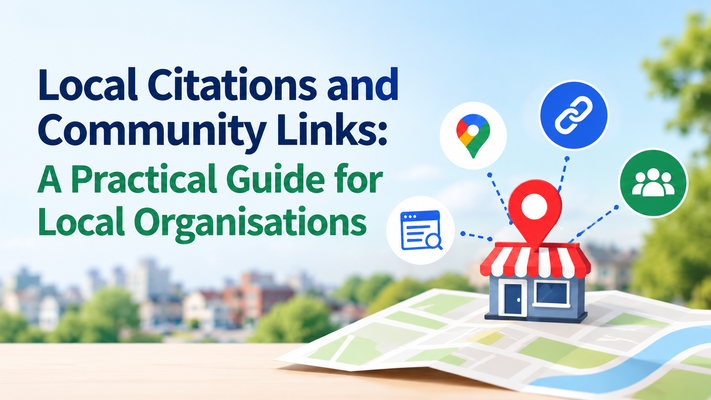
Local Citations and Community Links: A Practical Guide for Local Organisations
For a local business, school, nonprofit or professional practice, being easy to find online is only part of the challenge. People also want confidence that an organisation is established, relevant and connected to its community. Local citations and community links can help meet both needs: citations make key business information consistent across the web, while links from local organisations can show how a business contributes to the place it serves.
These efforts are most useful when they reflect real relationships and accurate information, rather than a search-engine shortcut. A law firm, for example, might be listed in a local bar association directory and support a legal education event. A school could be named on a partner organisation’s event page. In each case, the online reference follows from a genuine connection.
What local citations and community links do
A local citation is a mention of an organisation’s details, often its name, address and phone number, on a directory or other website. Some citations include a link; others do not. Search engines and prospective customers may use these mentions to check whether an organisation’s details are credible and consistent.
Community links are hyperlinks from locally relevant websites. They might appear on a chamber of commerce page, a community group’s partner list, a university resource page or a local event announcement. Their value is not simply that they point to a website. They can also connect people to useful services and help explain an organisation’s role in the area.
For a broader overview of how links contribute to online visibility, see this guide to link building. In a local setting, the strongest link-building opportunities usually begin with useful work, accurate listings and relationships that already exist—or that an organisation can build honestly.
Start with accurate, consistent citations
Before seeking new mentions, review the listings that already exist. Check the organisation’s name, address, phone number, opening hours and website details. Small discrepancies can confuse customers, especially when a business has moved, changed its name or operates from several locations.
Prioritise sources that people in your area actually use. These may include reputable local directories, trade associations, professional bodies and relevant public or educational resources. A long list of low-quality directories is not a substitute for a small number of accurate, meaningful listings.
- Use one standard version of the organisation’s name and contact details.
- Choose appropriate categories so people can understand what the organisation does.
- Check listings periodically, especially after changes to hours, staff, services or location.
- Correct outdated information rather than creating duplicate profiles to work around it.
For firms in regulated fields, accuracy also has a professional dimension. Legal practices and educational providers should ensure that descriptions are clear and do not imply credentials, outcomes or affiliations they cannot substantiate. A directory entry is public-facing information, so it deserves the same care as a website page or brochure.
Build links through useful community work
A community link is more likely to make sense when an organisation has done something worth mentioning. Consider what knowledge, space, skills or resources it can contribute. A small accounting practice might run a free budgeting session with a neighbourhood group. A college could publish a page about a joint career event. A law office could provide a plain-language talk on a common legal process, while being careful not to present general information as individual legal advice.
When an activity is planned, make it easy for the partner to describe it accurately. Provide a short biography, a clear account of the organisation’s role and a suitable website page for readers who want more information. Ask whether the partner plans to publish an event or resource page, but do not make the relationship conditional on receiving a link. The public benefit should be the reason for taking part.
Useful educational content can also help local organisations explain complex subjects. A short video, for instance, might introduce a workshop, outline a service or answer a frequently asked question. If you commission one, agree on the audience, length, captions, formats and revision limits before work begins. This guide to hiring a video editor covers portfolio fit, workflow and deliverables; comparing video editing offers against a clear brief can make proposals easier to assess. Osdire is one marketplace where buyers can hire freelancers across creative and other categories, so the brief should still specify the exact work needed.
Measure relevance, not just totals
Keep a simple record of citations, partnerships and outcomes. Note where a listing appears, when it was checked and whether it sends relevant visitors. For community projects, track practical results such as event attendance, enquiries or resource downloads. These measures help show whether the effort is useful to people, not only whether a link was gained.
Avoid paying for links that promise guaranteed rankings, participating in schemes that exchange links without a meaningful purpose, or publishing thin content solely to attract mentions. Such tactics can waste money and weaken trust. A smaller number of accurate citations and earned community references is usually easier to maintain and explain.
A steady local approach
Local visibility is built through routine attention: keep core details current, choose directories carefully and contribute to projects that matter to the community. When online mentions reflect real activity, they help prospective customers verify basic facts and discover organisations through people and institutions they already trust. That is a stronger foundation than chasing link counts alone.