
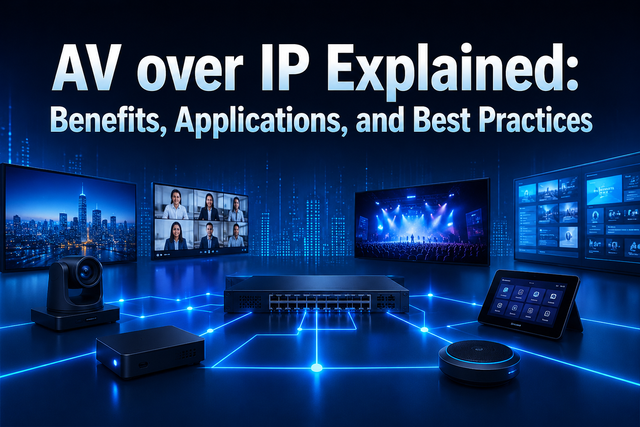
AV over IP Explained: Benefits, Applications, and Best Practices
As audio-visual systems grow larger and more distributed, traditional point-to-point cabling becomes a bottleneck. Running dedicated wires between every source and display is expensive, inflexible, and hard to expand once the walls are closed up. Networked distribution offers a more adaptable path, and it is quickly becoming the default for ambitious installations of every size.
Table of Content
How AV over IP Works
At its core, av over ip transmits audio, video, and control signals across standard IP networks instead of fixed cabling between devices. Sources and displays connect to network switches, and content is routed between them much like any other data. That approach lets a single infrastructure carry many streams and distribute high-quality content between multiple endpoints with ease.
Because it rides on familiar networking equipment, the technology also inherits the flexibility of IT systems. Adding a screen in a new room, rerouting a feed, or scaling from one building to a full campus becomes a configuration change rather than a construction project.
The Key Benefits
Moving AV onto the network unlocks advantages that conventional distribution cannot match:
- Greater scalability, since adding a device means adding a network port
- Easier system integration with existing IT infrastructure
- Reduced cabling and a cleaner, simpler installation
- Remote management and monitoring from a central location
- More flexible routing between any source and any display
Common Applications
Networked distribution suits environments where content must reach many locations reliably, and where the layout is likely to change over time. Some of the most common deployments include:
- Corporate offices and conference rooms
- Educational campuses and lecture halls
- Digital signage networks and control rooms
- Healthcare facilities and live event venues
Best Practices for Choosing a Solution
Evaluate any platform against supported resolutions, network bandwidth, latency, video compression, interoperability, control capabilities, security features, and future scalability. Latency and compression deserve particular attention, since they determine whether live content stays perfectly in sync across every display.
It is also wise to plan the network alongside the AV gear rather than as an afterthought. Getting those fundamentals right from the start ensures the system performs today and expands smoothly as your needs evolve.