
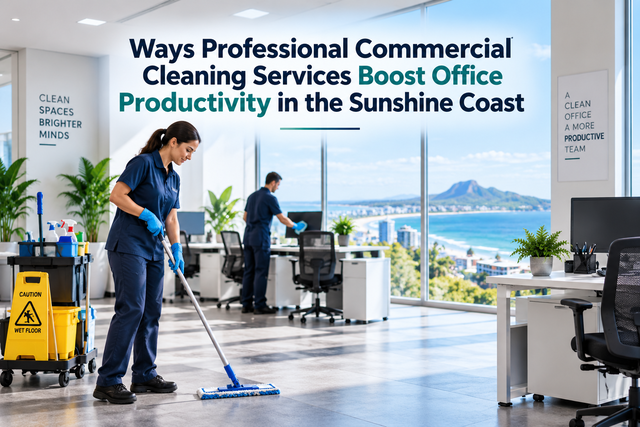
5 Ways Professional Commercial Cleaning Services Boost Office Productivity in the Sunshine Coast
A productive office is not created by desks, computers, and meeting rooms alone. The physical environment also shapes how comfortably people work, how easily they concentrate, and how much time they spend dealing with avoidable distractions.
Professional commercial cleaning services sunshine coast businesses use can help create a workplace that is cleaner, more organized, and easier to work in. The value goes beyond making floors shine. A well-planned cleaning routine can support healthier shared spaces, reduce visual clutter, maintain high-use areas, and help employees focus on their actual responsibilities.
Here are five practical ways professional commercial cleaning can contribute to a more productive office.
Table of Content
- 1. A Cleaner Workplace Helps Employees Focus on Their Actual Work
- 2. Consistent Cleaning Can Reduce Everyday Workplace Disruptions
- 3. Better Indoor Environmental Conditions Can Support Work Performance
- 4. Clean Shared Spaces Make It Easier to Maintain Workplace Standards
- 5. A Professional Cleaning Schedule Frees Employees From Cleaning Duties
1. A Cleaner Workplace Helps Employees Focus on Their Actual Work
A messy workspace can create small distractions throughout the day. Overflowing bins, dusty surfaces, dirty break rooms, marked floors, and untidy shared areas may not seem like major problems individually. Together, however, they can make the workplace feel less organized.
Research published in 2025 examined indoor environmental quality across modern office buildings and found that perceptions of the workplace environment were associated with self-reported productivity and overall satisfaction. Cleanliness received the highest satisfaction rating among the environmental factors assessed in that study.
For office managers, the practical takeaway is straightforward: cleaning should support the way people use the workplace.
A professional cleaning schedule can prioritize:
- Desks and frequently touched surfaces
- Meeting rooms and shared work areas
- Reception areas and visitor spaces
- Kitchens, break rooms, and bathrooms
- Floors, bins, and other high-traffic areas
The goal is not to create a showroom. It is to curate an environment where employees can get through the workday without constantly noticing what needs cleaning.
2. Consistent Cleaning Can Reduce Everyday Workplace Disruptions
Productivity is often lost in small increments rather than one dramatic event. An employee who has to clean a shared kitchen before using it, find supplies because a storage area is disorganized, or deal with an unpleasant meeting room may lose only a few minutes.
Multiply those interruptions across a busy workplace and the impact becomes more noticeable. This is where consistency matters. Occasional deep cleaning can help, but offices also need routine maintenance that prevents problems from accumulating.
A useful cleaning plan should account for:
| Workplace area | Common issue | Practical cleaning response |
| Reception | Dust, fingerprints, visible marks | Frequent surface and floor cleaning |
| Meeting rooms | High-touch surfaces and clutter | Cleaning between scheduled cycles |
| Kitchen | Food residue and overflowing waste | Regular cleaning around high-use periods |
| Bathrooms | Heavy daily use | Scheduled cleaning and replenishment |
| Work areas | Dust and accumulated debris | Routine surface and floor maintenance |
Professional commercial cleaning services sunshine coast businesses rely on can make these routines more predictable. Instead of asking employees to deal with cleaning tasks themselves, managers can establish a defined schedule based on occupancy, foot traffic, business hours, and the type of workplace.
3. Better Indoor Environmental Conditions Can Support Work Performance
Cleanliness is only one part of the office environment. Air quality, temperature, ventilation, humidity, lighting, and noise can also affect how people experience a workplace.
For property and office managers, this means cleaning should be considered as part of broader workplace maintenance rather than as an isolated task.
A practical approach includes:
- Cleaning dust-prone surfaces routinely
- Maintaining floors and carpets according to traffic levels
- Emptying waste before it becomes a workplace nuisance
- Cleaning high-contact areas consistently
- Reporting maintenance issues that cleaning teams identify
The last point is particularly useful. Cleaning staff may notice leaks, damaged flooring, unusual odors, or other maintenance concerns before office managers do.
Shared spaces are used by many people, so they can become untidy much faster than individual workstations. Consider a kitchen used by 30 employees. One person leaves food on a counter. Another spills coffee. Someone forgets to empty the trash. By the end of the day, the area may look very different from how it looked that morning.
The same applies to conference rooms, bathrooms, elevators, reception areas, and shared equipment zones. A structured cleaning program establishes a repeatable standard.
What should office managers monitor?
- Cleaning frequency
- High-touch surface coverage
- Bathroom and kitchen condition
- Waste removal
- Floor and carpet condition
- Restocking of essential supplies
5. A Professional Cleaning Schedule Frees Employees From Cleaning Duties
Employees occasionally wiping down their own desks is reasonable. Expecting staff to take responsibility for maintaining an entire workplace is different.
A professional cleaning arrangement creates a clearer division of responsibilities. This does not mean every cleaning task must happen during business hours. In many offices, cleaning can take place before employees arrive, after they leave, or during agreed low-traffic periods.
The right schedule depends on the workplace.
The Bottom Line
Professional cleaning is not a substitute for good management, workplace design, or proper ventilation. It is one part of creating a workplace where employees can concentrate on their responsibilities instead of dealing with avoidable environmental distractions.
For Sunshine Coast businesses, the most useful approach is to match cleaning frequency and scope to the actual workplace. A small office with light foot traffic will have different requirements from a busy shared workspace, medical practice, retail environment, or large commercial facility.
When the cleaning schedule fits the business, employees get a workplace that is easier to use, managers get clearer standards to monitor, and cleaning becomes part of the operational routine rather than an ongoing distraction.
For businesses evaluating their options, commercial cleaning services sunshine coast providers can offer a structured way to manage these responsibilities while keeping the cleaning plan aligned with the workplace’s daily operations.