
Curb-Mounted vs. Self-Flashing: Which Roof Hatch Design Fits Your Building?
When most people set out to select the best roof hatch for their building, they usually pay attention to sizing and ease of operation. Fair enough; those are two important factors. But there’s a second level of determination that has more profound implications on how the hatch performs over the next twenty years: whether it’s curb-mounted or self-flashing.
These two installation methods may sound like technical minutiae, but that’s exactly what they are, in part. However, they impact everything from installation costs to whether or not you’ll be dealing with leaks three winters from now. The decision isn’t always clear and certainly relies upon the type of roof upon which you’re installing and the purpose of use of the hatch.
Table of Content
What Does Curb-Mounted Mean?
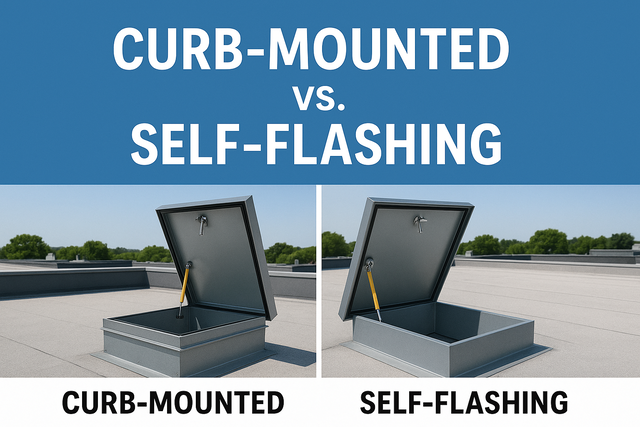
A curb-mounted hatch sits on top of a raised frame, known as a curb, constructed of wood or metal as part of the roof assembly. Essentially, it’s a small platform that the door should rest upon. The curb itself is affixed to the deck below and integrated into the roofing membrane or waterproofing systems holding it down.
Curb-mounted hatches are up and away from the actual roof surface of the building. While this vertical separation may seem ineffective, it’s one of the biggest benefits. Ideally, water runs off the sides instead of pooling at a flat edge. Snow has a more difficult time piling up next to the door. And if for any reason a seal falters, at least there’s a curb before water attacks the roof deck.
However, installation is more complicated since you’re essentially forming another structure on top of the finished product. It needs to be flashed appropriately and sealed and tied into existing waterproofing. But this extra work creates a more forgiving system in many cases. If one needs to replace an existing hatch down the line, the curb remains intact, and only the hatch unit bolts down on top.
How Self-Flashing Works
Self-flashing hatches entirely avoid the curb. Instead, the frame itself affixes directly to the roof surface and creates an overlapping flange around its perimeter. These flanges get integrated with roofing membrane materials that either weld or mechanically fasten them, again, depending on the type of roof system beneath.
The advantage here is greater ease of installation and a lower-profile aesthetic. There’s no need to construct a curb, and therefore, less time and materials waste. The hatch sits more flush to the roof surface (which some people may prefer). It also integrates better on single-ply membrane systems such as TPO or EPDM since these materials are much more flexible.
However, there’s no extra space. If there’s any failure in sealing effectiveness, that space gets filled with water. The only thing standing between each flange and waterproofing is whatever bond exists between them. Over time, with a great deal of thermal expansion/contraction; those setups can fail.
Curb-Mounted vs. Self-Flashing: Which is Better?
Curb-mounted hatches work better on built-up roofs and modified bitumen systems. The rationale behind this is these roof types have multiple layers, using heat or adhesive to create their waterproofing seals. Adding a curb works naturally with how these roofs are constructed. The curb can be tied into the layers during installation or retrofitted later for an effective seal.
Self-flashing hatches work better in single-ply membranes when the distance-to-seal is merely one layer thin. These roofs, TPO, EPDM, PVC, were created for self-flashing options since the ability to weld and/or adhere the flashing directly gets created at that point for ultimate waterproofing effectiveness; many contractors skilled at working with these types of membranes prefer self-flashing simply because it saves time without an additional component needing coordination.
Still, curb-mounted hatches can be used in TPO/EPDM roofs as long as they have been designed specifically from high-quality companies. For example, surespancovers.us/roof-hatches/ offers both self-flashing and curb-mounted options designed for various roof types should you need an effective solution created through careful engineering and applied structures.
High wind areas favor curb-mounted; sturdy structures that are almost always environmental hazards demand as much protection as possible without fail. The difference between metal roofs can also create an exception because metal roofs have a rigid profile surface which doesn’t mesh well with soft materials; there’s even less compatibility when reliable sealant is utilized.
It’s All About Maintenance: Common Oversights
There exist maintenance realities that no one talks about ahead of time with self-flashing installations. Since there’s no differentiation between the sealant used on the flange, anyone working on the roof is now working up against it as well. For example, if someone needs to replace an area of membrane around a flange, it now becomes a problematic issue if they mess up that seal.
With curb-mounted hatches, theoretically repairs can occur with some amount of cushion around all sides of the curb where applicable – hatch repair relative to that requirement isn’t as critical as long as technicians paint within the lines.
However, most people fail to realize this tenet until it’s too late; they want the instant $300 savings of labor for installation instead of waiting until years later when their hatch suffers from a leak that now requires working on both systems simultaneously.
Climate Conditions Make a Difference
In cold climates where significant snowfall occurs, curb-mounted hatches make the most sense for common-sense reasons; if snow accumulates anywhere around it, ice will form at some point once re-frozen (if not immediately) and weighs down everything, breaking seals – even gutters.
Self-flashing hatches create low spots where water can eventually puddle if it can’t escape quickly enough when it rains. At best, a nice edge is created. At worst, once winter rolls around, freeze-thaw cycles will cause even quality adhesives to rupture when expansion/contraction occurs.
In hot climates with high UV exposure rates; thermal cycling occurs with all roofs and stresses connections more than other aspects unrelated to variable exposure temperatures. At this point in time, TPO/EPDM have their own problems but curb-mounted systems tend to divert an addition concern because since they’re sealed off from direct proximity despite being setup overhead, they aren’t compromised by those movements as frequently.
Areas that experience high winds present their own challenge for both differences; however, having a vertical face provides better resistance against wind-driven rain than a self-flashing face which invites all types of air pressure.
Cost Considerations That Matter
From a pure cost perspective, self-flashing wins by about $300-$600 per hatch (or more depending upon custom materials). That’s good money especially in buildings where three-plus hatches exist.
But when it comes to lifecycle costs over time due to repairs needing extensive involvement; often times, curb-mounted wins out since if either requires service they’re easier installations without additional retrofitting or if extensive costs do exist even if repairs still need roof access needed within proximity around hatches; this still costs less than previously envisioned.
Ultimately self-flashing constructions require roof work because they’ve failed entirely due to number two failures, the hatches do not fail, but instead fail due to minuscule transitions – which most people didn’t account for based upon costs. Knowing which one works best for your particular building saves grief down line.
If you’re installing curb-mounted on built-up or mod bit roofs because it’s easier to build properly with them in place then you’re making the right decision for better durability without fighting against it how it works naturally.
If you’re doing so in single-ply roofs due to heavy weather or assessments where leaching risk is imminent; you’re doing so at an increased cost, but better than regretting it later when having to make additional repairs associated with both components which become one element instead of two separate entities.
The reality is both can work; however one tends to suit your situation better and understanding which one will save headaches later on.