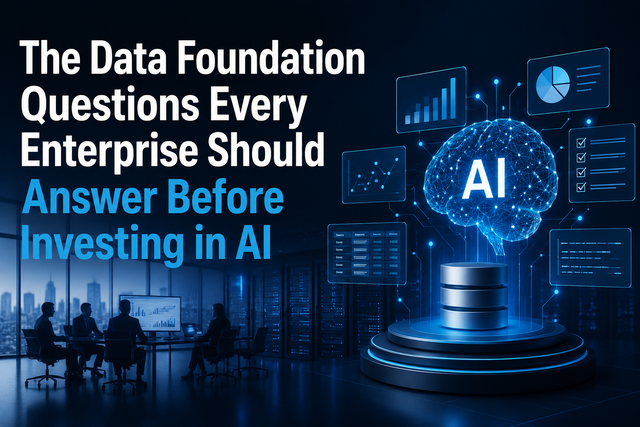
The Data Foundation Questions Every Enterprise Should Answer Before Investing in AI
AI initiatives rarely fail because of models or algorithms. More often, they fail because the underlying data is not ready. Before enterprises scale any initiative, they need what can be called an AI-ready data foundation for enterprise that ensures data is accessible, reliable, and structured for machine learning and generative AI workloads.
As organizations move from experimentation to execution, the focus is shifting from “Which AI tool should we use?” to “Is our data foundation strong enough to support AI at scale?” According to McKinsey, companies that invest in modern data infrastructure and governance are significantly more likely to see measurable ROI from AI initiatives.
This shift makes one thing clear: AI success depends less on ambition and more on data readiness.
Table of Content
Why Data Readiness Determines AI Success
AI systems learn patterns from data. If the data is fragmented, inconsistent, or outdated, the outputs become unreliable. This is why enterprises must evaluate whether they truly have an AI-ready data foundation for the enterprise before deploying advanced models.
Most organizations struggle with:
- Data silos across departments and systems
- Inconsistent definitions of key business metrics
- Lack of real-time data pipelines
- Poor data quality governance
Without addressing these issues, even the most advanced AI models produce limited business value.
NIST’s AI Risk Management Framework highlights the importance of trustworthy data systems as a core requirement for responsible AI deployment.
Key Questions Every Enterprise Must Answer
Before investing heavily in AI, enterprises should evaluate their readiness through a structured set of questions. These questions help determine whether the underlying AI-ready data foundation for the enterprise is strong enough to support scaling.
1. Is our data unified across the organization?
Many enterprises operate with fragmented systems across CRM, ERP, marketing platforms, and legacy databases. The first question is whether data is unified or still trapped in silos.
A strong foundation requires:
- Centralized or well-connected data architecture
- Standardized data formats
- Cross-functional data access policies
Without this, AI models will only see partial truths.
2. How reliable and clean is our data?
Data quality directly impacts AI performance. Poor-quality data leads to inaccurate predictions, biased outputs, and unreliable automation.
Enterprises should assess:
- Duplicate and missing data rates
- Frequency of data validation and cleansing
- Governance frameworks for data accuracy
A true AI-ready data foundation for enterprise ensures that data quality is continuously monitored, not just cleaned periodically.
3. Can we access data in real time?
Modern AI systems, especially generative AI and predictive analytics tools, depend heavily on real-time or near-real-time data.
Key considerations include:
- Availability of streaming data pipelines
- Latency between data generation and usage
- Infrastructure scalability for high-speed processing
If data access is delayed, AI insights lose relevance quickly.
4. Do we have strong data governance in place?
Governance is often overlooked but becomes critical as AI adoption increases. Enterprises must ensure that data usage complies with regulatory, ethical, and security standards.
Important governance elements include:
- Data ownership and accountability
- Access control mechanisms
- Compliance with regulations such as GDPR or industry-specific mandates
Gartner notes that organizations with mature data governance frameworks are better positioned to scale AI responsibly.
5. Is our data architecture AI-ready or legacy-bound?
Legacy systems often cannot support modern AI workloads due to rigidity and lack of scalability.
An AI-ready data foundation for an enterprise typically includes:
- Cloud-native or hybrid architectures
- Scalable data lakes or lakehouse models
- API-driven integration layers
Enterprises still relying heavily on monolithic systems often face higher barriers to AI adoption.
The Role of Data Integration and Modernization
Even if organizations have significant data assets, value is only unlocked when these assets are connected. This is where data integration becomes essential.
Modern AI systems require:
- Seamless integration across structured and unstructured data
- Unified data pipelines for analytics and machine learning
- Continuous synchronization across systems
Without integration, AI models operate in isolation and fail to reflect real business conditions.
This is why many enterprises are now investing in modernization programs focused specifically on building an AI-ready data foundation for the enterprise rather than deploying AI in isolation.
From Data Infrastructure to AI Enablement
Building an AI-capable organization is not just about deploying tools. It is about transforming how data flows through the organization.
Enterprises that succeed typically:
- Treat data as a product rather than a byproduct
- Invest in metadata management and observability
- Build feedback loops between AI systems and data pipelines
This ensures that AI systems improve continuously rather than stagnate after deployment.
According to McKinsey, organizations that embed data and AI capabilities deeply into operations achieve significantly higher productivity gains compared to those that treat AI as a standalone initiative.
Conclusion
Before investing in AI technologies, enterprises must first evaluate whether their data environment is capable of supporting intelligent systems at scale. Without a strong and well-structured foundation, even the most advanced AI initiatives struggle to deliver sustained value.
Answering the right questions around data quality, governance, integration, and architecture helps organizations determine whether they truly have an AI-ready data foundation for enterprise or whether foundational work is still needed.
In the long run, AI success is not defined by the sophistication of the model but by the strength of the data ecosystem that powers it.
To turn data readiness into real AI outcomes, enterprises need more than strategy; they need the right engineering foundation to unify, modernize, and operationalize their data at scale. BayOne helps organizations build that AI-ready backbone so AI investments translate into measurable business impact.