
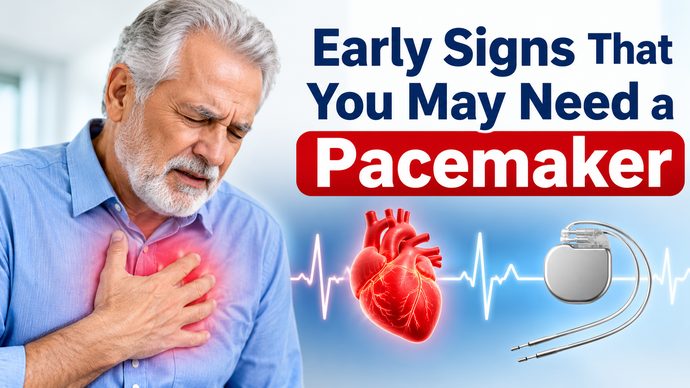
Early Signs That You May Need a Pacemaker
You wake up completely exhausted even after having 8 hours of sleep. You also get dizzy if you stand up too quickly. A friend says it’s probably nothing, just age catching up. Maybe. Or maybe your heart’s electrical system has started slowing down without telling you directly.
Around 100,000 Indians are found to suffer from bradycardia each year. Bradycardia is the medical term for when the heart beats at a rate below normal. Only 20,000 of them go on to receive treatment in the form of a pacemaker, a small fraction of the total.
This disease may go undetected for years until it is discovered that the heart is not beating at its optimal rate.
What Does a Pacemaker Do, Exactly?
Pacemakers are very small devices. They are implanted by doctors under the skin, close to the collarbone of the patient. If there is any problem with the rhythm of the patient’s heart, the pacemaker generates an electrical pulse to help restore it to its proper rhythm.
In most cases where someone needs a pacemaker, bradycardia is the reason behind it. Heart block is often the driving force behind it, a problem that arises when the heart’s electrical impulses slow down or are cut off as they move along their pathway.
A nationwide survey of cardiac device data in India found that bradycardia pacemakers made up close to 80% of implants, and complete heart block turned out to be the single biggest reason behind it.
What Are the Warning Signs?
This is where people get caught off guard. The early symptoms rarely feel serious. They just feel like a bad stretch. Things to keep an eye on:
- Tiredness that doesn’t go away with rest.
- Feeling dizzy, particularly right after standing.
- Fainting, or that woozy feeling right before you almost faint.
- Shortness of breath during routine activities.
- Feeling fatigued or exhausted during those same activities.
- A pulse that feels unusually slow, or skips.
- Struggling to concentrate, especially common among older adults.
- Chest discomfort showing up along with any of the above.
Having one of these once probably isn’t a big deal. Having several of them, or the same one over and over for weeks, is worth mentioning to a doctor.
Why Do These Things Even Happen?
A slow heartbeat results in slower circulation and lower oxygen levels. The muscles of the body feel the effects of the low levels of oxygen first. This makes tiredness a common condition. Low levels of oxygen will affect the brain immediately, causing dizziness.
A few things usually sit behind a slow heartbeat:
- The sinus node, the heart’s natural pacemaker, wearing down with age
- Heart block, where the signal between the heart’s upper and lower chambers gets interrupted
- Certain medications, particularly some blood pressure drugs, slowing the heart rate as a side effect
- Old damage from a previous heart condition or surgery affecting the heart’s electrical pathways
How Do Doctors Diagnose This?
Testing is usually straightforward at first, and only gets more detailed if the first round doesn’t explain things. You can expect:
- ECG
- Holter monitor
- Echocardiogram
- Blood tests
When Do Doctors Recommend a Pacemaker?
Not everyone with a slow pulse needs one. Cardiac pacemaker surgery usually comes into the picture once your symptoms clearly line up with what your ECG or Holter results show.
Certain kinds of heart block get a pacemaker recommended even without any symptoms at all, simply because the risk of a sudden, serious event down the road is too high to ignore. The decision isn’t based on how you feel on one particular day. It’s based on the full picture, including your test results.
What Happens During Recovery?
Compared with other heart procedures, this one is minor. Surgeons use a local anesthetic for this, which numbs just, which numbs only the area they’re working on instead of putting you fully under. From start to finish, it tends to take one to two hours. Because it isn’t a big operation, you’ll likely be discharged within a day or two.
Full healing of the wound will take between four and six weeks. In the process, do not lift heavy objects. Do not raise your arm above shoulder level.
Can You Prevent This From Happening?
Not always. Some of it is just the heart aging the way bodies do. Still, a handful of habits genuinely help:
- Getting checked regularly once you’re past 60
- Keeping blood pressure and thyroid levels under control
- Reviewing your medications with a doctor now and then, since a few can slow the heart without you realizing it
- Staying active to ensure prolonged inactivity does not lead to cardiovascular decline
When Should You Actually Talk to a Cardiologist?
A slowing heart rarely causes a dramatic moment. It arrives silently, hidden in constant fatigue and dizziness that people often ignore. Catch it early; visit a cardiologist in Nagpur. And the fix is usually simple.
Sometimes it’s medication. Sometimes it’s a pacemaker. While many patients find relief from their symptoms, recovery experiences can vary. If this is what you are going through, have yourself checked out rather than speculating.