How Smart Homes Are Making Everyday Life Easier
Smart home technology has moved well beyond its early novelty status to become a genuinely practical part of many Australian households, delivering real, measurable improvements to daily convenience, energy efficiency, and overall home management. Understanding how this technology actually improves everyday life helps clarify why adoption continues to grow steadily.
Rather than simply adding complexity for its own sake, well-implemented smart home technology genuinely simplifies numerous daily tasks and routines, making homes more responsive to how residents actually live rather than requiring residents to adapt to rigid, inflexible home systems.
Table of Content
- Simplifying Daily Routines Through Automation
- Improving Energy Efficiency and Reducing Costs
- Enhancing Home Security and Peace of Mind
- Supporting Independence for Elderly or Less Mobile Residents
- Starting Simple and Expanding Gradually
- Considering Compatibility Before Expanding
- Weighing Professional Installation Against DIY Setup
Simplifying Daily Routines Through Automation
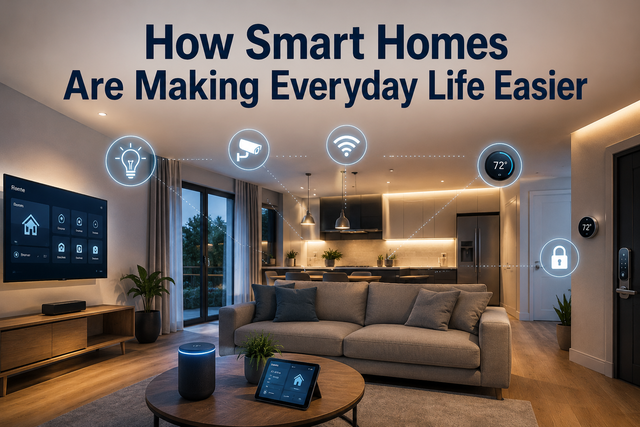
One of the most immediately noticeable benefits of smart home technology is how it automates routine daily tasks that would otherwise require manual attention. Lighting that adjusts automatically based on time of day, heating and cooling that responds intelligently to occupancy, and other similar automations collectively reduce the mental load of managing a household.
This automation particularly benefits busy households, where the cumulative time and mental energy saved from not manually managing these routine tasks adds up meaningfully across a typical week, freeing attention for more important priorities than remembering to adjust the thermostat.
Improving Energy Efficiency and Reducing Costs
Home Automation systems genuinely support more efficient energy use by ensuring lighting, heating, and cooling operate only when actually needed, rather than running continuously regardless of whether anyone is present to benefit from that energy consumption throughout the day.
Over time, these efficiency improvements translate into genuine cost savings on household energy bills, making smart home technology an investment that can meaningfully pay for itself through reduced ongoing running costs rather than remaining purely a convenience or lifestyle expense alone.
Enhancing Home Security and Peace of Mind
Smart security features, from remotely monitored cameras to smart locks and automated lighting that simulates occupancy while residents are away, provide genuine peace of mind alongside practical security benefits that traditional home security approaches often cannot match as comprehensively or conveniently.
The ability to monitor and control these security features remotely, checking on a home from anywhere with an internet connection, offers a genuine sense of control and reassurance that many homeowners find considerably valuable, particularly during extended periods away from home.
Supporting Independence for Elderly or Less Mobile Residents
Beyond general convenience, smart home technology offers genuine practical benefits for elderly residents or those with mobility limitations, allowing them to control various home functions without needing to physically move between rooms or reach potentially difficult switches and controls.
This support for independence can meaningfully improve quality of life and reduce reliance on others for basic daily tasks, making smart home technology a genuinely valuable consideration for households supporting family members with these particular practical needs and circumstances.
Starting Simple and Expanding Gradually
For households new to smart home technology, starting with a few key devices addressing genuine daily frustrations, rather than attempting a comprehensive system overhaul immediately, provides a more manageable, considerably less overwhelming introduction to this technology and its practical benefits.
This gradual approach also allows households to genuinely understand what smart home features deliver real value for their specific lifestyle, before investing further in additional devices and functionality that may or may not ultimately prove genuinely useful for their particular circumstances.
Considering Compatibility Before Expanding
As smart home systems grow, ensuring genuine compatibility between different devices and platforms becomes increasingly important, since a fragmented system of incompatible devices can quickly become more frustrating to manage than the manual routines it was originally meant to simplify and improve.
Researching compatibility carefully before adding new devices, rather than purchasing based purely on individual features, helps ensure a smart home system remains genuinely cohesive and manageable as it grows to encompass more of the household’s daily functions over time.
Weighing Professional Installation Against DIY Setup
Some smart home devices are genuinely simple enough for confident homeowners to install independently, while more comprehensive systems, particularly those involving electrical wiring or whole-home integration, often benefit from professional installation to ensure both safety and genuinely reliable long-term performance.
Weighing this decision honestly based on your own comfort level and the specific complexity involved helps avoid the frustration of a poorly configured system, while also ensuring any warranty conditions requiring professional installation remain properly and fully satisfied.
Smart home technology genuinely simplifies daily life through automation, improved energy efficiency, enhanced security, and meaningful support for household members with specific mobility needs. These practical benefits explain why adoption continues growing steadily across Australian households of all types and sizes.
For households not yet familiar with current smart home capabilities, starting with a few genuinely useful devices provides a practical, low-risk introduction to technology that can meaningfully improve everyday convenience and overall home management over time.