
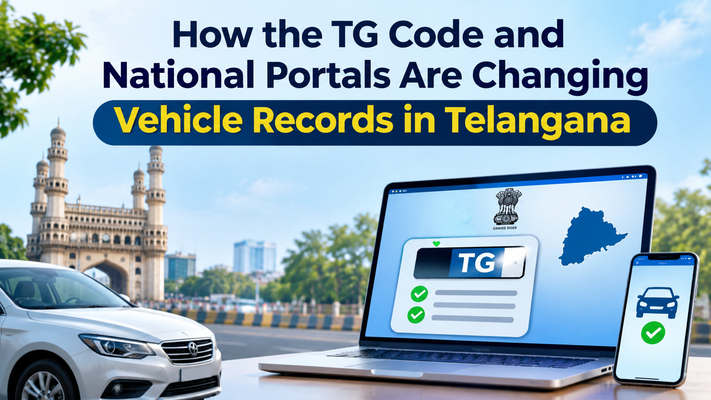
How the TG Code and National Portals Are Changing Vehicle Records in Telangana
Vehicle records in Telangana are going through a quiet transition. The state code on new number plates has changed, and the systems that hold registration and licence data have been moving onto national platforms. Neither shift changes how a driver uses a car day to day. Both change what a buyer, a seller or an owner is likely to see when they look at a registration record.
Understanding the changes helps avoid small confusions that can become delays at the transport office or doubts during a used car purchase.
From TS to TG
From the state’s formation in 2014 until early 2024, new vehicles in Telangana carried the state code TS. In March 2024, following a gazette notification from the Ministry of Road Transport and Highways, Telangana replaced TS with TG as the official prefix for new vehicle registrations, followed by a broader state mandate in May 2024 adopting TG across all government nomenclature.
The practical result is that Telangana roads now hold multiple generations of legitimate plates: TG on newer vehicles, TS on vehicles registered between 2014 and March 2024, and AP on older vehicles registered before the state was formed. Existing TS and AP plates remain valid without needing re-registration. What a buyer should check is not the prefix, but whether the number on the plate matches the registration certificate, and whether the certificate matches the vehicle’s physical chassis and engine numbers
Moving onto national platforms
Telangana’s transport department historically ran its own standalone system for licences and registrations. Starting in 2025, the state began migrating to the central government’s Sarathi portal for driving licences and the Vahan portal for vehicle registrations. After Sarathi was rolled out across Hyderabad RTOs in August 2025, Telangana officially launched the Vahan portal in March 2026, allowing dealers to process new vehicle registrations directly at showrooms and bringing RC services online. Records and workflows that once lived in an isolated state database are now integrated into the national system.
Making sense of the RTO structure
Regional Transport Offices handle registration, licensing and permits within a district or a part of a city. Anyone who needs information on RTO Telangana offices, registration codes and the services each one handles will find that Hyderabad has several offices, each covering a zone, while other districts have one or more of their own. The office that registered a vehicle is part of its history, and it matters when a vehicle moves.
A few services follow from this. Ownership transfer, change of address, duplicate registration certificates and the removal of a loan endorsement are all handled through the transport department. While processes are being moved increasingly online, some steps still need a visit, so it is worth checking the current process before travelling.
What a registration record shows
A registration certificate, or RC, summarises a vehicle’s legal identity. The key fields are:
- The registration number and the date of first registration.
- The owner’s name, usually partly masked in public lookups.
- The vehicle class, make, model and fuel type.
- The chassis and engine numbers (masked as well)
- The registering authority and the validity period.
- Any loan endorsement, which shows that a lender has a financial interest.
Each field is a point of comparison. Mismatched chassis numbers, a fuel type that differs from the vehicle, or a loan endorsement that is still active are all reasons to pause before paying.
Checking before a purchase
When a car is being considered, a buyer can check car details by registration number on the national portals and compare them with the paper RC and the vehicle itself. Because public lookups partially mask sensitive fields and typically ask you to input the last five characters of the chassis and engine numbers to unlock the full record, you should first take those numbers from the paper RC and check that they match the metal stamping on the car. Once unlocked, compare the make and model, fuel type, colour, registration date, insurance validity and ownership count. Public lookups hide personal information such as the owner’s contact details and full address, so the aim is to verify the vehicle rather than the person.
Beyond the database, other documents deserve attention. The insurance policy should be valid. The pollution certificate should be current. Any pending challans should be cleared, since they stay attached to the registration number. And if the loan endorsement is still on record, the seller should provide proof that the loan is closed and arrange for the endorsement to be removed.
Vehicles coming from other states
Unless a vehicle carries a national BH (Bharat) series plate, a car or two-wheeler registered in another state and brought to Telangana generally needs a no-objection certificate (NOC) from the original registering authority, road tax payment, and an application for re-registration within the stipulated period after moving. Delays can lead to complications with insurance, local tax enforcement and eventual resale. A buyer considering an out-of-state vehicle should ask where it was first registered and confirm whether the NOC and Telangana road tax receipts are in place.

