
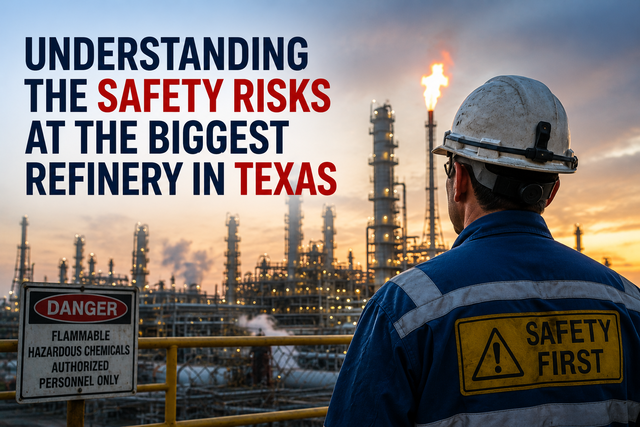
Understanding the Safety Risks at the Biggest Refinery in Texas
The industrial landscape of the Gulf Coast is defined by massive complexes processing millions of barrels of crude oil daily. While essential, these sites represent some of the most dangerous work environments in the nation. Managing such vast infrastructure requires a precision that leaves no margin for human or mechanical error.
A single spark or a leaking valve can trigger a chain reaction threatening thousands of employees. The complexity of these systems means safety protocols must be enforced with absolute rigidity to prevent disasters. Understanding risks associated with high-capacity refining is the first step toward ensuring workforce safety.
At the heart of this energy hub sits the biggest refinery in Texas, a facility so large its operations impact global fuel markets. As these facilities expand, the pressure on emergency response teams grows with production. Balancing efficiency and human life remains the primary challenge for the energy sector today.
Table of Content
The Danger of Process Safety Failures and Explosions
Process safety failures are among the most feared events because they often lead to rapid and catastrophic escalations. Minor equipment malfunctions, such as a failing seal or a corroded pipe, can allow flammable gasses to escape. Once these gasses find an ignition source, the explosion can level units in seconds.
Many catastrophic events are preventable through rigorous maintenance and the use of redundant safety systems. However, the drive for continuous production can sometimes lead to the postponement of repairs. When mechanical integrity is compromised for the sake of output, the risk of a process failure increases significantly.
Investigating these incidents requires a deep dive into maintenance logs and sensor data. It is often discovered that small warnings were ignored or that safety sensors were bypassed to keep units running. Holding companies accountable for these failures is essential for driving improvements in refinery safety culture.
Managing Toxic Exposure and Hazardous Chemical Byproducts
Toxic exposure remains a silent but devastating hazard for those working in large-scale refining environments. Workers frequently deal with hazardous chemical byproducts that can cause severe respiratory issues or long-term internal damage. These risks are not always immediate, often manifesting as chronic illnesses years after exposure.
Proper personal protective equipment and ventilation are mandatory but sometimes fail due to poor oversight. Even trace amounts of certain chemicals can be lethal over prolonged periods of daily contact. Monitoring the atmosphere within the facility is a critical safety task that must be performed with accuracy.
Families affected by these illnesses face difficult legal battles to prove the link between work and health. Companies often hide behind complex safety data to avoid liability for the long-term health of their staff. Transparency in chemical reporting is the only way to ensure workers are protected.
The Impact of Turnaround Periods on Industrial Accidents
Refinery turnarounds are high-intensity maintenance windows where a unit is shut down for cleaning and repair. These periods involve thousands of contractors working around the clock to meet tight deadlines. The increased density of workers and the complexity of the tasks create a spike in industrial accidents.
The pressure to return a unit to production can lead to skipped safety steps and physical exhaustion. Tired workers are more likely to make errors that lead to falls or equipment accidents. Managing the logistical chaos of a turnaround requires a massive commitment to on-site safety supervision.
Data shows that a significant portion of refinery injuries occur during these scheduled maintenance periods. Despite the risks, companies often push their staff to the limit to minimize downtime. Prioritizing safety over the schedule is the only way to reduce these preventable industrial tragedies.
Investigating Corporate Oversight and the Role of OSHA
Investigating corporate oversight is essential for understanding why safety systems fail in major industrial facilities. The Occupational Safety and Health Administration (OSHA) is tasked with monitoring the safety culture through regular audits. However, the scale of the biggest refineries makes total oversight difficult for state agencies.
A company’s safety culture is often reflected in how they respond to small near-miss incidents. If management ignores minor violations, they are setting the stage for a much larger and deadlier event. Accountability must start at the top of the corporate ladder to be truly effective.
OSHA fines are often seen as a cost of doing business by large corporations. True change only happens when legal consequences match the severity of the safety failures. Monitoring the relationship between production and safety compliance reveals the true priorities of the firm today.
Conclusion
Industrial failures at large hubs demand high-stakes legal advocacy to ensure that victims receive the justice they deserve. The complexity of these cases requires a deep understanding of federal safety regulations and engineering standards. Holding a major corporation accountable is a massive undertaking for any family.
Legal intervention forces companies to reveal the truth about their maintenance history and safety protocols. It ensures that the human cost of a disaster is not overshadowed by corporate profit margins. Advocacy is the primary tool for driving the changes needed for a safer workplace.
Ultimately, the goal is to prevent the next disaster by ensuring that every safety violation has a consequence. By standing up for the rights of workers, families can help improve standards for everyone. Accountability is the only path toward a safer and more stable industrial future.