
Reduce Procurement Costs Faster With Smart Reverse Auction Tools
The Procurement teams are continuously looking to get their supplier negotiations under control, and at the same time keep the cost under control and transparent. Auction software is considered to be one of the best digital tools that allow an organization to reach this objective by making organizations compete to offer the highest price and conducting negotiations with suppliers in a secure environment. It will enable the companies to streamline sourcing events by digitizing the bidding process and unlocking quantifiable category-wide savings.
Table of Content
- Reverse Auctions in Modern Procurement
- Why Procurement Costs Escalate Without Structured Bidding
- Digital Auction Platforms for Cost Savings
- Key Features That Make Reverse Auction Tools Effective
- Integrating Reverse Auctions With Enterprise Procurement Systems
- Data and Automation in Modern Procurement
- Conclusion
Reverse Auctions in Modern Procurement
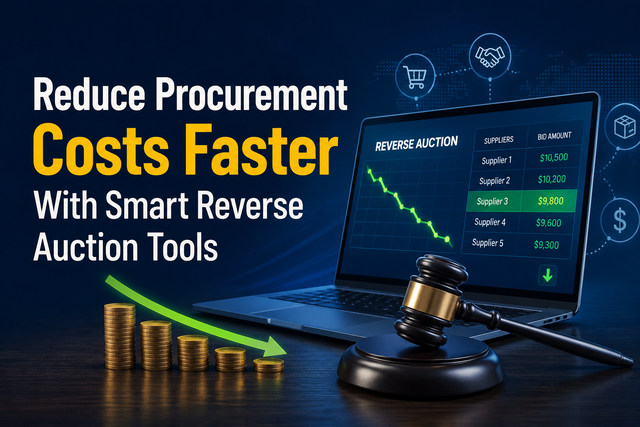
A reverse auction is a sourcing approach where the suppliers vie with the aim of reducing their prices to secure a contract with a buyer. Buyers can negotiate with several vendors at the same time rather than negotiating specifics with each of them, and this process leads to a competitive situation that, in most cases, will make prices cheaper and make market rates more visible.
Suppliers here engage in real-time bidding as they keep an eye on their ranking against other suppliers. The procurement teams use auction software and are able to establish guidelines like bid increments, time limits, and automatic extensions to ensure that fairness is observed. Besides pricing, buyers are also able to consider their factors, such as delivery schedule, reliability of their suppliers as well as compliance requirements to ensure quality and cost efficiency.
Why Procurement Costs Escalate Without Structured Bidding
When negotiations are based on disjointed communication or with a small number of suppliers, procurement costs may soar. In the absence of competitive organization of demand, buyers can be willing to pay prices that are not indicative of market value. Moreover, the manual process of negotiation can slow the decision-making process as well as introduce discrepancies in vendor analysis.
Unnecessary procurement spending is due to several causes:
- Weak competition between suppliers in negotiations
- Absence of open pricing standards
- Negotiating processes that are time-consuming
- Lack of information to analyze vendor offers
Sourcing solutions that are digital can be used to remove these inefficiencies by offering visibility and standardization to the sourcing process. By having the presence of several suppliers in a clear bidding system, the purchasers attain greater bargaining power and enhanced cost-effectiveness.
Digital Auction Platforms for Cost Savings
Online reverse auction systems introduce automation and organization to the procurement negotiations. Instead of communicating via emails, spreadsheets, or lengthy negotiations, the procurement teams will be able to organize sourcing events within one platform where they can easily see bids, rank suppliers, and schedules. This centralized process streamlines the decision-making process and improves transparency.
The competitive nature also motivates the suppliers to offer more competitive prices since they will be watching their standing during the auction. Advanced auction software systems also promote the use of various forms of auction and by doing this, they enable organizations to choose the strategies that best work in the given sourcing category and procurement objectives.
Key Features That Make Reverse Auction Tools Effective
Platforms of reverse auctions offer a broad set of options that are intended to make procurement more efficient and involve suppliers. The characteristics enable the procurement practitioners to carry out sophisticated sourcing exercises without undue operational rubbish. This is often supported through ERP in procurement.
Real-Time Bid Visibility
During the auction process, suppliers will be able to monitor their ranking and change bids in response to the ranking. This openness fosters competition and at the same time renders fairness among the players.
Automated Event Controls
With last-minute bids, procurement teams can set the parameters of the auction to include bid increments, duration of an event, and auto-extension. These checks make the process to be structured and balanced.
Supplier Communication Channels
A large number of platforms have inbuilt messages where buyers and suppliers can clear up what is needed during the auction.
Data-Driven Insights
Analytics tools assist with insights into the trends of bidding, participation of suppliers and cost savings achieved in auctions. These insights can be used to optimise sourcing strategies by procurement teams in the long run.
Integrating Reverse Auctions With Enterprise Procurement Systems
Reverse auction solutions are enhanced to bigger procurement systems. Enterprise integration enables organizations to handle sourcing data, supplier data, and purchasing processes in a single environment, enhancing efficiency and visibility.
Most companies integrate reverse auction systems with ERP in procurement within procurement systems to integrate supplier information, purchase orders and contract information. With such integration, manual work is minimised and the procurement teams have a better understanding of spending trends to make more strategic decision-making.
Data and Automation in Modern Procurement
Digital tools are becoming more and more important in the procurement functions to handle supplier relationships and cost optimization strategies. The level of visibility of the data is essential in determining how you can save money and enhance the outcome of the negotiation.
Automation assists the procurement teams with repetitive duties including invitations to suppliers, tracking of bids and reviewing procedures. Professionals will have the opportunity to spend more time working on supplier cooperation and procurement strategies rather than spending time on manual administration.
Modern auction software products are based on the use of analytics and artificial intelligence that keep track of the bid dynamics and point towards possible savings. The capabilities enable organizations to keep on improving their procurement strategies using real market data.
Digital auction platforms are a key element of contemporary sourcing systems as procurement is increasingly becoming more technologically oriented.
Conclusion
Reverse auction utilities offer a systematic and open way of motivating rivalry among the suppliers and discovering the ideal payment. Organizations can save considerable amounts of money in procurement and retain quality and compliance of suppliers by facilitating real-time bidding and data-based negotiation strategies. These platforms, when combined with enterprise ERP in procurement, provide a harmonious sourcing environment where supplier management, purchasing and financial information are on track.
To organizations aiming at developing their sourcing capacities and enhance their cost-effectiveness, the solutions provided by Procol can be viewed as an effective way of deploying intelligent reverse auction solutions and ensuring transparency and control of operations in procurement processes.