
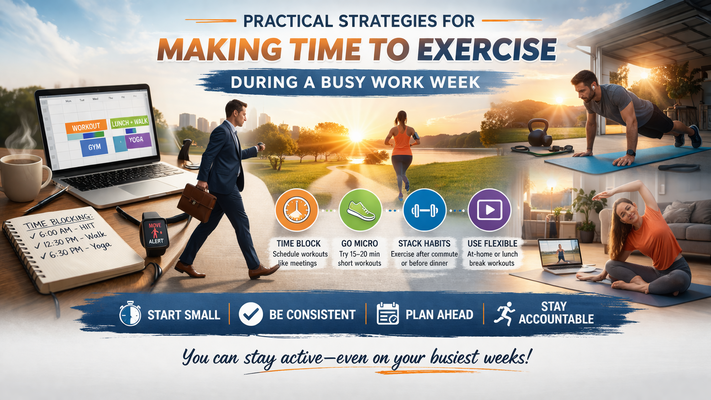
Practical Strategies for Making Time to Exercise During a Busy Work Week
Most individuals do not lack the willingness to work out – they lack a structure that considers physical activity essential. If your exercise routine is consistently sacrificed when a deadline comes up, that’s not because you’re undisciplined. It’s because your schedule doesn’t prioritize it.
Table of Content
Audit your week before you redesign it
Before adding anything new to your schedule, look at what’s already there. Most busy weeks have more recoverable time than people realize – it’s just being used passively. Scrolling between meetings, sitting idle during a long lunch break, or waiting on a call that starts late. These windows rarely add up to less than 45 minutes a day.
The goal isn’t to find a single hour. It’s to identify three or four 10 to 15 minute gaps you can act on consistently. A bodyweight circuit takes less space than most people think – you need a clear patch of floor and about 12 minutes. That’s a realistic target for a Tuesday afternoon when a full gym session isn’t happening.
Decouple movement from the traditional gym
A helpful mental shift is to stop tying exercise to a room. Walking meetings are exercise. Walking is exercise. A 1-on-1 does not require a chair – it requires your voice and your attention, both of which can walk around just fine. Your bedroom floor can facilitate a reasonable number of pushups and situps, certainly more than zero.
This connects with something called NEAT, which is all the physical energy we burn outside structured exercise: walking across the office, brushing your teeth, standing while on the phone. It is far more than most people think. Someone who stands for two extra hours a day and takes some walking calls will reconstruct their cardiovascular system without ever sweating in spandex. A sit-stand desk can help in this realm, or you can just commit to standing any time you’re on a call that’s going to be less than 20 minutes.
Employees who exercise during the workday report a 72% improvement in time management and work completed on days they were active compared to days they weren’t. For a competitive person, that’s not a minor edge.
Build habits onto things that already happen
Habit stacking is when you build a new habit on top of an existing one. The trigger for the new behavior is something you already do automatically. This is one of the best ways to create long-term habits because the existing habit is the cue, which makes it almost impossible to forget.
To start, you need to get the new behavior as small as you can manage. If you want to start doing push-ups every time a call ends, just do five every time. Same with squats when you finish a task. Or three to five reps of an exercise. Once you’ve built the habit, you can add more volume.
For more effective compound movements, squat, lunge, push-up, and hip hinge (deadlift) are your friends. These moves engage multiple muscles across multiple joints, meaning you get a lot of physical benefit in a short amount of time. They’re perfect for building a small workout into your day.
Stage your environment the night before
One simple change is all that separates people who exercise three times a week from people who only make it once and feel bad about the other two. By the time mid-week energy is low, and decision fatigue has properly kicked in, the barrier to getting your workout in is almost all in your head. The more you can do to remove friction at that crucial moment, the more likely you are to get out the door.
Lay your kit out the night before. Pack your bag before you go to bed. Make the decision “go or don’t go” the only one, not “go, hunt around for your gear, work out what’s clean, discover your cleats are still wet.” Good technical apparel helps, as the right kit from a reliable retailer like Sporting Life ensures it’s actually up to the challenge, whether you’re bundling up to head into the dark at 6am, or trying to squeeze in a run at lunch and still look presentable for 2pm Zoom calls.
The point is that you want to make starting the exercise the easy option, the one that happens unless you actively decide against it.
Short workouts done consistently beat long workouts done rarely
High-Intensity Interval Training (HIIT) workouts that last less than 20 minutes are effective in providing cardiovascular and metabolic benefits, especially when the intensity of the workout is high. Extensive research supports this fact, and it eliminates the excuse of not having enough time to exercise for 1 hour. If you can put in three 20-minute workouts per week at a high intensity, it will have a greater effect on your heart rate and stress management than a single long workout on the weekend.
Your body’s stress hormone, cortisol, responds well to physical activity, but the key word is “regular”. It’s not all about fitting in one intense but ultimately stress-inducing workout on Saturday. It’s about getting a moderate-to-high effort workout frequently throughout the week.
If you’re trying to fit exercise into a week where your job takes up 65 hours, it’s not simply inspiration that’s lacking. You need to create a situation where your week is set up to default into movement, rather than you trying to force more activity into your day. Look for dead time, add movement to things you’re already doing, design an environment to make starting easier, and choose exercises that have the best return on your time investment. The system does the work your willpower can’t.