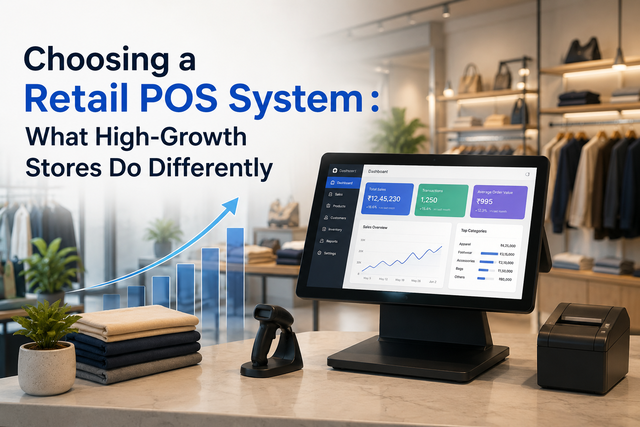
Choosing a Retail POS System in 2026: What High-Growth Stores Do Differently
What separates a retail store that merely survives from one that consistently grows year after year?
It’s rarely a better location. It’s not always lower prices either.
More often, the difference lies in how effectively a business uses data, technology, and customer insights to make smarter decisions every day.
In 2026, high-growth retailers are moving beyond basic cash registers and spreadsheets. They are investing in systems that connect sales, inventory, customer behaviour, and reporting into a single source of truth.
This is why selecting the right retail pos system has become one of the most important technology decisions a business can make. Whether you’re operating a boutique store, a busy hospitality venue, or multiple locations, the right platform can streamline operations, enhance customer experiences, and unlock growth opportunities that would otherwise go unnoticed.
According to research from the National Retail Federation, retailers continue to prioritise technology investments that improve customer experiences and operational efficiency, reflecting a growing shift towards connected commerce.
So, what exactly are high-growth businesses doing differently when choosing a POS system?
1. Looking Beyond Transactions
The most successful retailers no longer view POS technology as simply a tool for processing payments.
Instead, they see it as a business intelligence platform.
High-growth stores typically look for systems that provide:
Traditional POS Thinking |
Modern POS Thinking |
| Process sales | Generate insights |
| Record transactions | Understand customer behaviour |
| Basic reporting | Real-time decision making |
| Standalone system | Connected business ecosystem |
This shift allows businesses to move from reactive management to proactive planning.
When every sale generates valuable insight, owners gain a clearer understanding of what’s driving performance. That visibility becomes even more valuable when inventory is factored in.
2. Prioritising Inventory Visibility
Inventory problems can quietly erode profits. Too much stock ties up cash flow. Too little stock creates missed sales opportunities.
High-growth retailers choose systems that offer real-time inventory management because they understand that stock visibility directly impacts profitability.
Key features often include:
- Automatic inventory updates after every sale
- Low-stock alerts
- Supplier management tools
- Multi-location inventory tracking
- Product performance reporting
According to Deloitte’s retail outlook, inventory optimisation remains one of the strongest drivers of retail profitability and operational efficiency.
When inventory becomes easier to manage, businesses can focus on another equally important task: understanding their customers.
3. Using Customer Data to Build Loyalty
One of the biggest differences between average retailers and high-growth retailers is how they use customer information.
Every transaction tells a story. Successful businesses use POS data to identify:
- Repeat purchasing patterns
- Customer preferences
- Seasonal shopping behaviours
- High-value customers
- Product affinities
Rather than sending generic promotions, retailers can create more relevant experiences based on actual purchasing behaviour. This level of personalisation strengthens customer relationships while improving marketing effectiveness.
As customer expectations continue to rise, flexibility also becomes a critical consideration.
4. Choosing Flexibility Over Complexity
Technology should simplify operations, not complicate them. The most effective retail pos system solutions are designed to adapt as businesses evolve.
High-growth stores typically prioritise:
- Cloud-based accessibility
- Flexible payment integrations
- Mobile POS capabilities
- Scalable infrastructure
- User-friendly interfaces
This flexibility becomes particularly important when businesses expand.
A system that works for one location today should still support five locations tomorrow.
Rather than replacing systems every few years, successful retailers invest in platforms that can grow alongside their business. Growth, however, depends heavily on understanding performance metrics.
5. Focusing on Actionable Reporting
Many businesses collect data. Far fewer know how to use it effectively.
High-growth retailers focus on reports that support practical decisions rather than vanity metrics.
The most valuable reports often include:
Report Type |
Business Benefit |
| Sales by product | Identify top performers |
| Sales by hour | Optimise staffing |
| Category performance | Improve merchandising |
| Customer spending trends | Drive loyalty initiatives |
| Inventory turnover | Reduce excess stock |
These insights help businesses identify opportunities before competitors do. When decision-making becomes data-led, growth becomes more predictable rather than dependent on luck. The next area where leading retailers excel is operational efficiency.
6. Embracing Omnichannel Retailing
Customers no longer shop through a single channel.
They browse online, compare products on mobile devices, and visit physical stores before making decisions.
High-growth retailers understand this behaviour and seek POS systems that connect multiple touchpoints.
Important capabilities include:
- Online and in-store inventory synchronisation
- Unified customer profiles
- Click-and-collect support
- Integrated loyalty programmes
- Consistent pricing across channels
According to McKinsey research, consumers increasingly expect seamless experiences across both digital and physical channels.
Retailers that fail to provide this consistency often struggle to meet evolving customer expectations.
This is why modern POS technology has become central to customer experience strategies.
Future-Proofing Your Business
Technology continues to evolve rapidly. Artificial intelligence, automation, predictive analytics, and self-service solutions are becoming increasingly common across retail and hospitality environments.
High-growth businesses choose systems with future adaptability in mind.
Questions worth asking include:
- Can the system integrate with emerging technologies?
- Does it support future expansion?
- Are updates delivered regularly?
- Can it adapt to changing customer expectations?
Future-proofing isn’t about predicting every trend. It’s about choosing technology flexible enough to evolve alongside your business.
Final Thoughts
In 2026, a retail pos system is far more than a checkout tool; it’s a growth enabler. By connecting sales, inventory, customer insights, and operational data, the right system helps businesses make smarter decisions, deliver better experiences, and scale with confidence. For retailers focused on long-term success, investing in the right POS system is no longer optional; it’s a strategic advantage.