
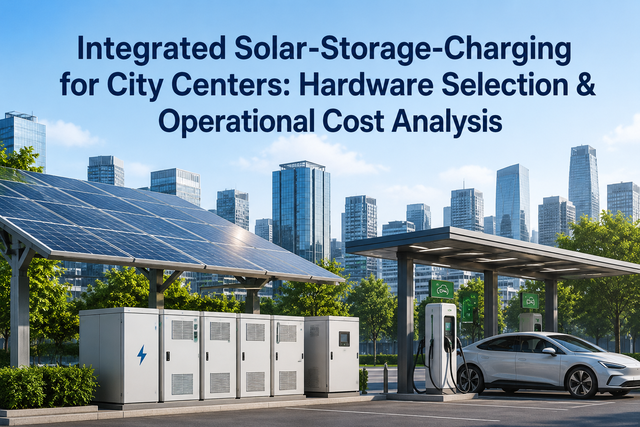
Integrated Solar-Storage-Charging for City Centers: Hardware Selection & Operational Cost Analysis
Central business districts, transport hubs, and commercial complexes are experiencing rapid growth in EV charging demand.
Most users in these locations require short-duration fast charging, imposing sustained peak power demand on both distribution network capacity and charger output ratings.
As a result, charging infrastructure is evolving from single-function units toward integrated systems with active power regulation capabilities.
This article covers the key deployment challenges, compares different usage scenarios, and recommends suitable integrated hardware solutions.
Challenges of Urban Center Charging Infrastructure
1. Limited Installation Space
Urban charging projects often face strict spatial constraints.
Parking structures, underground facilities, and roadside charging stations typically have limited room for transformers, switchgear, battery systems, and cooling equipment.
Conventional systems assembled from multiple independent components usually require larger installation footprints and more complex cabling layouts. This increases deployment difficulty, especially in city centers where land utilization costs are high.
2. Constrained Distribution Capacity
Many existing urban commercial buildings were not originally designed for high-power EV charging loads. Distribution transformers and feeder capacity may already be operating near their limits due to HVAC systems, elevators, lighting, and commercial operations.
Deploying multiple DC fast chargers without power buffering can trigger transformer overload risks and costly utility upgrades. In many regions, grid expansion approval cycles are also lengthy, delaying charging station deployment.
3. High Peak Electricity Tariffs
Urban electricity tariffs frequently include demand charges and time-of-use pricing. Fast charging stations operating during peak periods can significantly increase operational expenses.
Without intelligent energy management, operators may experience high monthly electricity bills despite stable charging utilization. Managing peak demand has therefore become a core economic factor in charging infrastructure planning.
Ultra-Fast Charging Scenario Requirements
Ultra-fast charging scenarios impose three specific technical requirements:
1. High Charging Power Demand
Urban users generally prioritize charging speed. This drives demand for high-power DC fast charging systems ranging from 120 kW to 480 kW or higher. Such power levels demand robust electrical design and high-current handling capabilities.
2. Grid Stability
The intermittent and high-magnitude load from ultra-fast chargers creates substantial grid impact, including voltage sags, frequency deviations, and harmonic distortion.
This impact necessitates local storage buffering to decouple the charger load from the upstream grid, thereby reducing peak demand charges and avoiding distribution penalties.
3. Reliability and Thermal Management
Sustained high-power operation generates significant heat, placing high demands on equipment reliability and thermal management.
Active liquid cooling, component derating strategies, and redundant thermal paths become essential to prevent forced derating or premature failure under continuous heavy usage.
Cost-Effective Scenario Requirements
For cost-sensitive or mid-tier charging installations, requirements differ markedly.
Primary focus falls on initial capital expenditure and payback period rather than absolute maximum power delivery. Systems must support peak shaving and demand management functions to reduce monthly demand charges from utilities.
Additionally, equipment must be compact to fit within existing parking structures or utility rooms, easy to deploy with minimal civil works, and low-maintenance to reduce ongoing operational costs.
Unlike ultra-fast scenarios where thermal performance dominates, cost-effective scenarios prioritize system simplicity, standardized component interfaces, and proven reliability over extreme specifications.
Necessary of Integrated Solar-Storage-Charging Systems
Compared with component-based sourcing, integrated hardware offers three major technical advantages:
1. Improved System Stability
Integrated solutions developed under a unified hardware and software architecture typically provide more consistent communication protocols and coordinated control logic. This reduces interoperability risks commonly associated with sourcing separate components from multiple vendors.
2. Optimized Installation Footprint
Integrated solar-storage-charging systems consolidate multiple functions into fewer cabinets and platforms. This is especially valuable for urban environments where installation space is restricted.
Pre-integrated systems can reduce on-site wiring complexity, shorten commissioning time, and simplify future maintenance access.
3. Unified Dispatch Platform Efficiency
A unified energy management platform enables coordinated scheduling of PV generation, battery charging/discharging, and EV charging demand. Operators can implement demand response strategies more efficiently while maintaining stable charging performance.
Real-time monitoring and cloud-based diagnostics further support operational visibility and predictive maintenance.
Selection Criteria of Integrated Solar-Storage-Charging Systems
1. Matching Storage Capacity With Charging Power
Energy storage sizing should align with charging load profiles, station utilization rates, and local tariff structures.
Oversized storage systems may increase capital expenditure unnecessarily, while undersized systems may fail to provide sufficient buffering during peak charging periods.
For high-frequency urban charging hubs, storage systems are often designed to support short-duration high-power discharge cycles.
2. Compatibility With Existing Distribution Infrastructure
Charging infrastructure should integrate smoothly with existing transformers, switchgear, and distribution networks.
Flexible AC/DC coupling configurations and scalable modular architectures can help operators avoid expensive utility upgrades.
Furthermore, system compatibility with local voltage standards and grid interconnection requirements is also essential for deployment efficiency.
3. Grid Compliance and Safety
Urban charging projects must comply with local electrical safety regulations, grid codes, and fire protection requirements. Battery systems increasingly require advanced thermal runaway prevention, intelligent monitoring, and multi-level protection mechanisms.
Integrated systems with verified safety architecture and standardized compliance support can simplify project approval processes.
Why Choose Sungrow?
1. Full-Stack In-House Development
Sungrow provides a vertically integrated portfolio covering PV inverters, battery energy storage systems, EV chargers, and energy management platforms.
This full-stack in-house development approach can maintain communication consistency and coordinated system control across integrated charging projects.
2. PowerStack Full-Liquid-Cooled Storage
Its PowerStack liquid-cooled energy storage system is designed for commercial and industrial applications where installation space and operational stability are critical. According to Sungrow product specifications, the system uses liquid cooling to maintain battery cell temperature differences within 2.5°C while supporting high-efficiency power conversion above 98.5%.
3. IDC Integrated DC Fast Charging
Sungrow’s integrated DC fast charging solutions can work with a smart energy platform to automatically perform peak shaving and demand control.
This helps operators reduce electricity costs, improve transformer utilization, and shorten investment payback periods in high-demand city charging scenarios.
Conclusion
As urban EV adoption continues to accelerate, integrated solar-storage-charging systems are becoming an increasingly practical approach for balancing charging performance, grid stability, and long-term operating costs in dense metropolitan environments. For product datasheets, case studies, and technical specifications, visit Sungrow’s official website.