
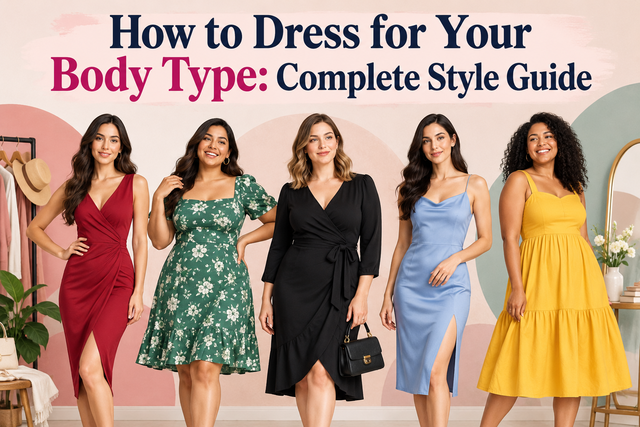
How to Dress for Your Body Type: Complete Style Guide
Choosing clothes becomes much easier when you understand how a garment interacts with your natural proportions. Learning how to dress for body type is not about following a strict list of clothes you are “allowed” to wear. It is about understanding silhouettes, fit, waist placement, necklines, fabric, length, and visual balance so you can make more confident choices.
A dress that looks fantastic on a mannequin may sit completely differently on your body. The reason is often not your clothing size or weight. The shoulder width, bust, waist, hips, torso length, leg length, and construction of the garment all affect the final silhouette.
Body-shape styling gives you a useful starting point. The commonly discussed categories include hourglass, pear or triangle, apple or round, rectangle or straight, and inverted triangle. These categories are simplified frameworks, and many people sit between two shapes or have proportions that do not fit neatly into one category. Current styling guidance similarly treats these categories as suggestions rather than fixed rules.
The goal is not to change your body. Your body does not need correcting.
Instead, you can use clothing to emphasize the areas you enjoy, create the visual balance you prefer, add structure, create movement, or simply express your personal style. Sometimes that means defining the waist. Sometimes it means deliberately ignoring the waist and choosing a clean column silhouette.
This complete guide explains how to dress for your body type, how to identify your proportions at home, which dress silhouettes may complement different shapes, how necklines and waistlines influence an outfit, how fabric and color affect visual balance, and how to choose clothing for work, weekends, parties, weddings, holidays, and everyday life.
Most importantly, treat the advice as a styling toolkit—not a rulebook.
Table of Content
- What Does It Mean to Dress for Your Body Type?
- Body Type vs. Clothing Size
- Body Shape vs. Body Weight
- Why Proportion Matters
- Why the Same Outfit Looks Different on Different People
- Fit Still Comes First
- How to Identify Your Body Type
- What to Measure
- A Simple Step-by-Step Method
- A Quick Body-Shape Reference
- The Main Body Types
- How to Choose the Right Dress Silhouette for Your Body Type
- How Necklines Affect Your Body Proportions
- How to Choose the Right Waistline
- How Dress Length Can Change Your Overall Look
- Choosing Fabrics According to Body Type and Dress Style
- What to Look for in Fabric
- How Colors and Patterns Affect Outfit Proportions
- How to Dress for Your Body Type at Different Occasions
- How to Dress for Your Body Type Without Following Strict Fashion Rules
- Common Mistakes When Dressing for Your Body Type
- How to Find Clothes That Actually Fit
- Dress for Body Type: Quick Styling Guide
- Dress for Body Type: Frequently Asked Questions
- How do I know my body type?
- What does it mean to dress for your body type?
- How do I identify my body type?
- What is the best dress for an hourglass body?
- What dresses are best for a pear-shaped body?
- What dresses are best for an apple body shape?
- What dresses work for an inverted triangle body shape?
- Does clothing size determine body shape?
- What is the best dress for my body type?
- Can body shape change over time?
- Does clothing size determine body type?
- What dress is best for an hourglass body?
- What dresses suit a pear-shaped body?
- What dresses suit an apple-shaped body?
- What dresses suit a rectangle body?
- What dresses suit an inverted triangle body?
- Can I wear oversized dresses for my body type?
- What neckline is best for my body shape?
- Does height matter when choosing a dress?
- Can tailoring improve the way a dress fits?
- Are body-type fashion rules mandatory?
- How can I dress for my body type while following current trends?
- Can I be between two body types?
- Final Thoughts: Dress for Your Body Type, Not Against It
What Does It Mean to Dress for Your Body Type?
Dressing for your body type means choosing clothing according to the relationship between your shoulders, bust, waist, hips, height, and overall proportions.
The phrase can sound more complicated than it is.
Imagine two people wearing the same midi dress in the same size. One may have broader shoulders and narrower hips, while the other may have fuller hips and a defined waist. Even if the dress is technically the correct size for both people, the garment may create very different silhouettes.
That is why body shape and clothing size are not the same thing.
Body Type vs. Clothing Size
Clothing size describes the dimensions of a garment.
Body shape describes how your proportions are distributed.
A person who wears a small size and a person who wears a larger size can both have an hourglass shape. Likewise, someone who wears a smaller size and someone who wears a larger size can both have a rectangle, pear, apple, or inverted-triangle shape.
Height is another separate factor.
A tall pear-shaped person and a petite pear-shaped person may benefit from similar principles around proportion, but their ideal hem lengths, print scale, jacket lengths, and footwear choices may differ.
Body Shape vs. Body Weight
Body-shape styling should not be confused with weight loss or weight management.
Your shape is about proportion. Weight can change, and proportions can change with it, but body shape does not represent a person’s health, fitness, attractiveness, or value.
The purpose of identifying a body shape is simply to understand why certain garments may sit differently.
Why Proportion Matters
Clothing creates lines and shapes.
A belt creates a horizontal interruption at the waist. A V-neck creates a vertical or diagonal opening through the upper body. An A-line skirt gradually expands toward the hem. A structured shoulder adds visual width. A monochromatic outfit can reduce strong color breaks between separate pieces.
These details influence how the eye reads an outfit.
That does not mean one effect is automatically better than another. You may want to emphasize your shoulders, make your waist prominent, create a long uninterrupted line, add volume to a skirt, or deliberately exaggerate a feature.
The styling decision belongs to you.
Why the Same Outfit Looks Different on Different People
Garments are three-dimensional objects.
A dress interacts with:
- Shoulder width
- Bust volume
- Waist position
- Hip width
- Torso length
- Leg length
- Height
- Fabric stretch
- Garment construction
- Personal posture
- Footwear
For example, a wrap dress may create a strong waist definition on one person while looking more relaxed on another. A midi hem may fall at a flattering point on one person but hit at an awkward point on another.
This is why trying clothes on—or understanding your measurements before buying—is often more useful than relying solely on a model photograph.
Fit Still Comes First
A theoretically suitable silhouette can look less polished when the fit is wrong.
A dress that pulls across the bust, digs into the shoulders, collapses at the waist, or creates unwanted folds around the hips may not work well simply because it belongs to your recommended category.
Conversely, a style that is not traditionally associated with your shape may look excellent when the construction and fit are right.
Fit beats fashion theory.
How to Identify Your Body Type
You do not need a complicated calculator to get a useful idea of your body shape.
A mirror, fitted clothing, and a measuring tape can provide a practical starting point.
What to Measure
Focus on four areas:
- Shoulders – the broadest part of your shoulder area.
- Bust – the fullest part of your bust.
- Natural waist – the narrowest area of your torso.
- Hips – the fullest part around your hips and seat.
Keep the tape level and comfortably against your body. Do not pull it so tightly that it compresses your measurements.
A Simple Step-by-Step Method
Step 1: Stand naturally.
Wear fitted clothing or something that makes your silhouette easy to see. Avoid changing your posture to make one area look narrower.
Step 2: Compare your shoulders and hips.
Ask whether they appear relatively balanced, whether the hips are noticeably wider, or whether the shoulders are noticeably wider.
Step 3: Look at your waist.
Is there a strong inward definition between the upper and lower body? Or does the torso follow a relatively straight line?
Step 4: Consider your middle.
If your visual fullness is concentrated around the midsection, an apple or round classification may be a useful starting point.
Step 5: Look at the whole silhouette.
Do not decide based on one measurement alone. Body-shape categories are approximations.
A Quick Body-Shape Reference
| Body type | Typical proportion | Styling focus |
| Hourglass | Shoulders/bust and hips relatively balanced with a defined waist | Follow or highlight the waist |
| Pear/Triangle | Hips appear wider than shoulders or bust | Add or emphasize upper-body interest |
| Apple/Round | More visual fullness around the middle | Create comfortable, clean vertical lines |
| Rectangle/Straight | Shoulders, waist and hips relatively similar | Add definition or embrace a straight silhouette |
| Inverted Triangle | Shoulders or bust appear wider than hips | Add movement or visual interest below |
These descriptions are starting points, not measurements you have to “pass.” Current fashion guidance also recognizes that people can fall between categories.
The Main Body Types
1. Hourglass Body Type
An hourglass body shape generally has shoulders or bust and hips that are relatively balanced, with a noticeably defined waist.
The easiest styling approach is often to follow that natural proportion rather than burying the waist under excessive fabric.
Best Dress Silhouettes
Consider:
- Wrap dresses
- Fit-and-flare dresses
- Sheath dresses
- Belted shirt dresses
- Bias-cut dresses
- Tailored dresses
- Ruched dresses
- Princess-seam dresses
- Body-skimming dresses
A wrap dress works because its crossover construction naturally creates a diagonal line and can define the waist.
A sheath dress can also work well when it has enough room for the bust and hips and is properly shaped through the waist.
Necklines
Good options include:
- V-neck
- Sweetheart
- Square neck
- Scoop neck
- Halter
- Balanced boat neck
The best neckline depends on your bust, shoulder width, neck length, and personal preference.
Waistlines
A natural waist is often an easy choice.
A belt can also reinforce waist definition without requiring the dress itself to have a dramatic waist seam.
Fabrics
Medium-weight fabrics with some structure can follow the body without becoming overly clingy.
Try:
- Crepe
- Structured cotton
- Jersey with recovery
- Stretch suiting
- Medium-weight knit
- Satin for eveningwear
Very stiff fabric can sometimes obscure natural curves, while extremely thin fabric may cling more than intended.
Dress Lengths
Hourglass proportions can work across many lengths.
Try:
- Knee length
- Midi
- Tea length
- Maxi
- Mini
The most important factor is where the hem lands relative to your height and legs.
Outfit Ideas
Casual: A wrap midi dress with sneakers and a denim jacket.
Workwear: A tailored sheath dress with a structured blazer.
Partywear: A fitted or wrap-style dress with pointed shoes and understated jewelry.
Formalwear: A floor-length gown with waist definition and a balanced neckline.
What About Loose Dresses?
You can absolutely wear them.
If you want to maintain visible waist definition, try adding a belt or choosing a loose dress with strategic seams.
If you prefer a relaxed silhouette, skip the belt. Personal style comes before a body-shape formula.
2. Pear / Triangle Body Type
A pear or triangle shape generally means the hips appear wider than the shoulders or bust.
Traditional styling often aims to create visual balance by adding interest around the upper body while allowing the skirt to fall smoothly over the hips.
Best Dress Silhouettes
Consider:
- A-line dresses
- Fit-and-flare dresses
- Wrap dresses
- Dresses with structured sleeves
- Off-shoulder styles
- Dresses with embellished bodices
- Empire-waist dresses
- Full-skirt dresses
Why A-Line Dresses Work
An A-line dress gradually widens from the upper portion toward the hem.
That creates room around the hips rather than forcing fabric to cling to them. The result is a continuous line from the waist toward the lower body.
The key is fit.
If the skirt pulls across the hips, it may create horizontal tension lines. A slightly fuller cut can provide more movement.
Fit-and-Flare Dresses
This silhouette combines a relatively fitted bodice with a fuller skirt.
It can emphasize the waist while giving the lower body enough room.
It is especially useful when you want a defined upper silhouette without wearing a very tight skirt.
Wrap Dresses
Wrap construction can highlight the waist while allowing flexibility through the hips.
Look for:
- Secure overlap
- Adjustable ties
- Enough room across the hips
- A neckline that provides comfortable coverage
Necklines and Sleeves
Pear shapes can experiment with upper-body details such as:
- Boat necklines
- Square necklines
- Off-shoulder necklines
- Sweetheart necklines
- Statement sleeves
- Puff sleeves
- Structured shoulders
These features add visual interest around the upper portion of the outfit.
Color and Pattern Placement
You can use brighter colors, prints, texture, or embellishment on the upper portion if you want more visual emphasis there.
For example, a floral bodice with a solid skirt creates a clear visual division.
But there is no requirement to make your lower body visually smaller. A printed skirt can look fantastic when the goal is to celebrate it.
Outfit Ideas
Casual: A printed A-line dress with a cropped denim jacket.
Office: A structured wrap dress with simple pumps.
Party: A fit-and-flare dress with statement earrings.
Formal: A floor-length gown with an embellished bodice and flowing skirt.
3. Apple / Round Body Type
An apple or round body shape generally carries more visual fullness through the midsection, often with a less-defined waist.
The most useful styling principle is comfort combined with clean lines.
Best Dress Styles
Consider:
- Wrap dresses
- Empire-waist dresses
- Shift dresses
- A-line dresses
- Ruched dresses
- V-neck dresses
- Fluid shirt dresses
- Structured sheath dresses
- Asymmetrical dresses
Empire Waist
An empire waist sits above the natural waist, usually just beneath the bust.
This construction allows the fabric to fall from a higher point instead of creating a tight horizontal seam across the middle.
It can be especially comfortable when the dress has enough ease below the bust.
Wrap Styles
Wrap dresses can create an open neckline and adjustable definition.
Choose a design that stays secure while sitting, walking, and moving.
A hidden snap or internal tie can make a wrap dress more practical.
V-Necklines
A V-neck introduces an open vertical shape through the upper body.
It can make the neckline the visual starting point of an outfit while creating space around the face.
You do not have to choose a deep V. A modest V can produce a similar directional effect.
A-Line Dresses
An A-line dress can skim the middle and gradually widen toward the hem.
Look for fabrics that fall smoothly rather than sticking tightly to the stomach.
Fabric Selection
Good options often include:
- Crepe
- Fluid jersey
- Soft cotton
- Lightweight woven fabrics
- Drapey knits
- Matte satin
The goal is not to avoid every fabric that has stretch. Stretch can actually improve comfort and fit. The important question is whether the fabric recovers well and supports the intended silhouette.
Layering
An open jacket, cardigan, or longline layer can create vertical lines through an outfit.
For example, a simple dress with an unbuttoned blazer creates two vertical edges that visually frame the torso.
Length
Midi and maxi dresses can create a long continuous line, while knee-length dresses can keep the outfit lighter.
Again, the ideal hem depends on height, proportions, shoes, and preference.
4. Rectangle / Straight Body Type
A rectangle body shape generally has shoulders, bust, waist, and hips that are relatively similar in width, with less pronounced waist definition.
This shape offers considerable styling flexibility.
You can create a more defined waist, add volume, or deliberately embrace a clean straight silhouette.
Best Dress Styles
Consider:
- Fit-and-flare dresses
- Wrap dresses
- Belted shirt dresses
- Ruched dresses
- Peplum dresses
- Tiered dresses
- Slip dresses
- Shift dresses
- Column dresses
- Body-skimming dresses
Creating Waist Definition
If you want more waist definition, try:
- Belts
- Wrap construction
- Waist seams
- Peplum details
- Contrast panels
- Fitted bodices
- Cropped outer layers
A belt does not have to be extremely tight.
A softly positioned belt can create enough visual interruption to define the middle without sacrificing comfort.
Prints and Textures
Ruching, pleats, draping, tiers, contrasting panels, and textured fabrics can add dimension.
For example, a simple solid-color dress with ruching at the waist can create more visual movement than a completely flat fabric surface.
Column Dressing
A rectangle shape can also look excellent in a clean column dress.
A column silhouette follows a relatively straight vertical line from shoulder to hem.
This is a reminder that “creating curves” is not mandatory. Minimalist dressing can be the entire point.
Outfit Ideas
Casual: A belted shirt dress with sneakers.
Office: A straight midi dress with a tailored jacket.
Party: A ruched mini or midi dress.
Formal: A sleek column gown with architectural jewelry.
5. Inverted Triangle Body Type
An inverted triangle shape generally has shoulders or bust that appear wider than the hips.
Traditional proportion-based styling often adds movement to the lower part of the outfit while keeping the upper body relatively streamlined.
Best Dress Styles
Consider:
- A-line dresses
- Fit-and-flare dresses
- Wrap dresses
- V-neck dresses
- Pleated-skirt dresses
- Tiered dresses
- Full-skirt dresses
- Drop-waist dresses
- Dresses with lower-body embellishment
Why A-Line Dresses Work
An A-line silhouette expands toward the hem.
This adds visual width lower in the outfit and can create a balanced overall shape.
V-Necklines
A V-neck creates a directional line through the upper body and can reduce the visual effect of a broad horizontal neckline.
But there is an important exception: if you love your shoulders, you can emphasize them.
Fashion does not require every proportion to be “corrected.”
Add Interest Below the Waist
Try:
- Pleats
- Tiers
- Ruffles
- Patterns
- Pockets
- Embellishment
- Full skirts
- Contrasting colors
- Flared panels
A patterned skirt can become the focal point of the entire outfit.
Fabrics
You can use a streamlined fabric through the upper body and more volume or structure through the skirt.
Consider:
- Crepe
- Chiffon
- Satin
- Silk
- Tulle
- Pleated fabric
- Structured cotton
- Jacquard
Fit Considerations
An inverted-triangle body can sometimes encounter the opposite fit problem from a pear shape.
A dress may fit the hips but feel tight around the shoulders.
Pay attention to:
- Armholes
- Shoulder seams
- Upper-back tension
- Sleeve movement
- Bust fit
Shoulder alterations can be more complicated than simple waist adjustments, so prioritize comfortable shoulder fit when shopping.
How to Choose the Right Dress Silhouette for Your Body Type
Understanding dress silhouettes is more useful than memorizing a list of “best” dresses.
A-Line
The A-line dress is narrower at the top and gradually widens toward the hem.
Useful for: Pear, inverted triangle, apple, rectangle, and hourglass shapes.
Why: It creates a smooth transition from the upper body to the lower body and provides room through the skirt.
Fit-and-Flare
A fit-and-flare dress follows the upper body and expands below the waist.
Useful for: Hourglass, pear, rectangle, and inverted triangle shapes.
Why: The fitted portion defines the torso while the skirt adds movement.
Wrap
A wrap dress crosses over the front and typically ties around the waist.
Useful for: Many body shapes.
Why: It provides adjustable waist definition and creates diagonal lines.
Sheath
A sheath dress follows the body’s vertical lines relatively closely.
Useful for: Hourglass, rectangle, and anyone who enjoys tailored dressing.
Why: Its streamlined shape emphasizes the construction of the garment and can look polished for work or formal occasions.
Shift
A shift dress hangs relatively straight from the shoulders.
Useful for: Rectangle, apple, and people who prefer relaxed silhouettes.
Why: It does not rely on a strongly defined waist.
Empire Waist
The waist seam sits beneath the bust.
Useful for: Apple shapes, some pear shapes, and anyone who likes a high waistline.
Why: The skirt begins higher, allowing fabric to flow away from the middle.
Bodycon
A bodycon dress closely follows the body.
Useful for: Anyone who enjoys a close-fitting style.
The important point is fit and comfort, not body category. Bodycon is not reserved for one particular shape.
Maxi
A maxi dress generally extends to the ankle or near the floor.
Useful for: Every body shape.
The silhouette matters more than the length itself. An A-line maxi and a fitted maxi create very different effects.
Midi
A midi dress falls between the knee and ankle.
The exact hem position matters. A few inches can change the visual balance considerably.
Shirt Dress
A shirt dress combines shirt-like construction with a dress silhouette.
Belts can define the waist, while leaving the dress unbelted creates a straighter line.
Slip Dress
Slip dresses usually have thin straps and a fluid, body-skimming construction.
Bias-cut versions can follow curves naturally. Layering a slip dress over a fitted top or beneath a jacket can also change the overall structure.
Princess-Cut Dress
Princess seams run vertically through the garment, shaping the body without relying solely on a horizontal waist seam.
They can create a tailored appearance and provide useful shaping around the bust and torso.
How Necklines Affect Your Body Proportions
Necklines influence where the eye enters an outfit.
V-Neck
Creates an open vertical or diagonal line.
It can visually lengthen the upper torso and works across many body shapes.
Scoop Neck
A rounded, open neckline that softens the upper body.
Its depth should be chosen according to comfort, bust support, and personal preference.
Square Neck
Creates a structured frame around the collarbone and upper chest.
It can look especially polished in dresses with defined seams.
Boat Neck
Runs relatively horizontally across the upper chest.
It can emphasize shoulder width and therefore may be useful when you intentionally want more upper-body presence.
Sweetheart Neckline
Creates a curved heart-like shape across the bust.
It can emphasize the neckline and work beautifully in occasion dresses.
Halter
Draws attention toward the neck and shoulders.
It can emphasize the shoulder area, making it useful for people who want that feature to be a focal point.
High Neck
Creates greater coverage and a strong upper-body block.
Fabric, hairstyle, jewelry, and sleeve design become especially important because there is less open space around the neckline.
One-Shoulder
Creates asymmetry.
The diagonal line can become the main visual feature of the outfit.
Off-Shoulder
Exposes the shoulders and collarbone.
It can add upper-body emphasis and is especially useful when you want the neckline itself to become the focal point.
How to Choose the Right Waistline
The position of a waist seam can dramatically change a dress.
Natural Waist
Sits around the narrowest part of the torso.
Useful when you want clear waist definition.
High Waist
Sits above the natural waist but below the bust.
It can make the legs appear longer because the lower portion of the dress begins higher.
Empire Waist
Sits directly beneath the bust.
It allows the rest of the dress to flow away from the torso.
Drop Waist
The waist seam sits below the natural waist.
This creates a longer torso effect and can give a dress a distinctly 1920s-inspired or contemporary relaxed appearance.
No Defined Waist
Shift, column, and oversized dresses may deliberately avoid waist definition.
This is not a styling mistake.
Sometimes a clean straight line is exactly what makes an outfit look modern.
How Dress Length Can Change Your Overall Look
Dress length is one of the easiest details to overlook.
Mini
A mini dress emphasizes the legs and creates a relatively high visual endpoint.
Above-Knee
Slightly more coverage while retaining a lighter silhouette.
Knee-Length
A classic proportion that works well for many work and day dresses.
Midi
A flexible length that can look polished, sophisticated, casual, or dramatic depending on the footwear and silhouette.
Tea-Length
Typically falls lower on the calf and has a vintage or occasionwear feel.
Maxi
Creates a long uninterrupted vertical impression, particularly when the dress is relatively streamlined.
Height matters, but it does not determine whether you can wear a particular length.
A petite person can absolutely wear a maxi dress. The trick may simply be choosing a hem that does not overwhelm the frame and pairing it with suitable footwear.
Choosing Fabrics According to Body Type and Dress Style
Fabric can change the behavior of a silhouette as much as the cut.
Cotton
Breathable and versatile.
Structured cotton can hold an A-line or shirt dress shape, while lightweight cotton can create a softer summer silhouette.
Linen
Lightweight and breathable, with a naturally relaxed appearance.
Its tendency to wrinkle is part of its character.
Chiffon
Light and fluid.
Often useful for overlays, flowing skirts, sleeves, and occasion dresses.
Silk
Soft and fluid with a distinctive drape.
Silk can create elegant movement but may require careful attention to lining and construction.
Satin
Smooth and reflective.
Because satin catches light, seams, ruching, and folds can become more visually prominent.
Jersey
Stretchy and comfortable.
Weight matters. A substantial jersey may provide more structure than a very thin jersey.
Knit
Knits range from lightweight and drapey to heavy and structured.
A knit dress should have enough recovery to maintain its intended shape.
Denim
Structured and casual.
A denim shirt dress can provide a defined shape without requiring a body-hugging fit.
Velvet
Dense and textured.
Excellent for evening and winter dressing, where texture itself can become part of the visual effect.
Crepe
Often has a smooth, slightly textured surface with useful drape.
It is popular in workwear and occasionwear because it can look polished without appearing overly shiny.
What to Look for in Fabric
Think about five properties:
- Drape: How the fabric falls.
- Structure: How well it holds shape.
- Stretch: How much movement it allows.
- Weight: How substantial it feels.
- Texture: How much visual dimension it adds.
Do not choose fabric solely according to body shape. Choose it according to the garment’s purpose.
How Colors and Patterns Affect Outfit Proportions
Color does not have magical body-changing properties. Its effect depends on contrast, placement, scale, fabric, lighting, and the rest of the outfit.
Monochromatic Dressing
Wearing closely related colors from top to bottom can reduce strong visual breaks and create continuity.
This can be particularly useful when you want a streamlined outfit.
Vertical Lines
Vertical seams, long open layers, and elongated patterns can guide the eye up and down the body.
Horizontal Lines
Horizontal details create visual breaks.
That may emphasize the location of the line, such as the waist, bust, or hip.
This is not inherently bad. A horizontal belt can be an intentional focal point.
Large Prints
Large patterns have stronger visual presence.
They can become the dominant feature of a dress, particularly when the pattern has high contrast.
Small Prints
Small prints can feel more subtle, especially when their colors are close together.
Color Blocking
Color blocking divides the body visually into sections.
Strategic placement can emphasize the waist, shoulders, skirt, or neckline.
Dark and Light Color Placement
Contrasting light and dark areas attract attention differently depending on the pattern and surrounding colors.
Instead of saying “dark colors make you look slimmer,” it is more accurate to say that darker areas may create less visual contrast than lighter or brighter areas under many conditions.
The complete outfit matters.
How to Dress for Your Body Type at Different Occasions
Everyday Casual Wear
Comfort should be the starting point.
Try:
- Shirt dresses
- Cotton A-line dresses
- Casual wrap dresses
- Knit midi dresses
- Denim dresses
- Relaxed maxi dresses
Add sneakers, flat sandals, ankle boots, or loafers depending on the season.
Office Wear
Office dresses benefit from clean construction.
Good options include:
- Sheath dresses
- Wrap dresses
- Shirt dresses
- Structured midi dresses
- A-line dresses
A blazer can change the proportion of almost any dress.
Business Meetings
For formal professional settings, prioritize structure and polished fit.
A tailored midi dress with a blazer can provide a strong professional silhouette without being restrictive.
Pay attention to neckline depth, hemline, fabric quality, and wrinkle resistance.
Date Night
Date-night dressing can be more expressive.
Try:
- Wrap dresses
- Slip dresses
- One-shoulder styles
- Fit-and-flare dresses
- Ruched dresses
- Body-skimming midi dresses
Choose the feature you want to emphasize rather than trying to follow every body-type recommendation at once.
Partywear
This is where texture and detail can become more important.
Sequins, satin, velvet, metallic fabric, ruching, draping, asymmetry, and statement sleeves can all become focal points.
Wedding Outfits
Consider the dress code first.
For daytime weddings, lighter fabrics and softer colors may work well. Evening weddings can support richer textures and more dramatic silhouettes.
A-line, wrap, fit-and-flare, sheath, and flowing maxi silhouettes can all work depending on the event.
Formal Events
Focus on construction.
Look for:
- Strong tailoring
- Clean seams
- Quality lining
- Appropriate hem length
- Comfortable movement
- Balanced proportions
A simple dress with excellent construction can look more sophisticated than a complicated dress with poor fit.
Summer Outfits
Choose breathable fabrics such as cotton and linen.
Loose silhouettes can improve airflow, while sleeveless, short-sleeve, and lightweight dresses keep the outfit practical.
Winter Outfits
Layering becomes the styling tool.
Try:
- Knit dresses
- Velvet dresses
- Long-sleeve midi dresses
- Tights
- Boots
- Structured coats
The length of the outerwear matters. A long coat over a short dress creates a different proportion from a cropped jacket over a midi dress.
Vacation Outfits
Choose fabrics that travel well and silhouettes that are easy to wear.
A versatile vacation wardrobe might include:
- Linen shirt dress
- Cotton maxi
- Lightweight wrap dress
- Slip dress
- Casual midi
- Simple day-to-night dress
Brunch Outfits
Brunch is ideal for relaxed styling.
Try a floral midi, belted shirt dress, linen dress, knit dress, or casual A-line paired with sandals, loafers, or clean sneakers.
How to Dress for Your Body Type Without Following Strict Fashion Rules
Body-type categories can be useful, but they should never become restrictions.
There are no “bad” body types.
There are no body parts that you are required to hide.
There is also no universal dress that looks best on everyone.
Body-Type Categories Are Simplified
Real bodies are more varied than five diagrams.
You may have:
- A defined waist with broader shoulders
- A pear-shaped lower body with a relatively straight waist
- An hourglass-like upper body with narrow hips
- A rectangle shape with a fuller bust
- An apple shape with long legs
You do not have to force yourself into a single label.
Trends Can Be Adapted
Suppose oversized dresses are trending.
If you normally prefer waist definition, add a belt.
If you love the oversized silhouette, wear it loose.
If the dress overwhelms your frame, adjust the length or footwear.
The trend does not need to dictate the entire outfit.
Comfort Matters
A dress can be theoretically perfect and practically useless if you cannot sit, walk, breathe, or move comfortably.
Comfort is not separate from style.
It is part of good styling.
Tailoring Can Transform a Dress
Small adjustments can make a significant difference.
A tailor may be able to:
- Shorten a hem
- Adjust the waist
- Alter straps
- Improve sleeve length
- Modify shoulder fit
- Add or remove ease
- Adjust a neckline
- Improve bust fit
This is often more effective than searching endlessly for a supposedly perfect body-type dress.
Common Mistakes When Dressing for Your Body Type
Choosing Clothing Only Because It Is Trendy
A trend is not a fit solution.
Start with your preferred silhouette, then adapt trends around it.
Wearing the Wrong Size
Do not assume that a larger number means a worse fit or a smaller number means a better one.
Size labels vary significantly between brands.
Choose the garment that fits your measurements.
Ignoring Tailoring
A dress can be almost perfect but need a small alteration.
Do not reject a good garment because the sleeve is slightly long or the waist needs adjustment.
Focusing Too Much on Hiding Body Parts
Constantly trying to conceal parts of your body can make dressing unnecessarily restrictive.
Instead, ask:
What do I want this outfit to communicate?
Elegant? Relaxed? Dramatic? Minimalist? Playful? Professional?
That question is often more useful.
Following Outdated Fashion Rules
Rules such as “never wear horizontal stripes” or “certain body shapes cannot wear certain dresses” are overly simplistic.
Clothing design is more nuanced than that.
Ignoring Fabric
A silhouette can change dramatically depending on whether the fabric is stiff, fluid, stretchy, heavy, sheer, matte, or shiny.
Ignoring Dress Length
A dress can have the right silhouette but still look unbalanced because the hem falls at an awkward point.
Try adjusting the length before abandoning the style.
Wearing Oversized Pieces Everywhere
Oversized clothing can look intentional.
But combining an oversized dress with oversized outerwear and oversized accessories can sometimes remove the visual structure you wanted.
If the dress is oversized, consider a more defined shoe, bag, or jacket.
Copying Model Outfits Exactly
A model’s body proportions, height, posture, styling, and garment alterations may be completely different from yours.
Use model photography for inspiration—not as a guarantee of fit.
How to Find Clothes That Actually Fit
Good styling starts with fit.
Shoulder Fit
For structured dresses, the shoulder seam should generally sit where the shoulder naturally ends.
If it falls too far down, the garment may look oversized.
If it sits too far inward, movement can become restricted.
Bust Fit
Look for:
- No pulling across the bust
- No gaping at the neckline
- Comfortable arm movement
- Proper lining
- Adequate support
Waist Fit
A defined waist should define rather than squeeze.
If you cannot comfortably sit down, the waist is probably too restrictive.
Hip Fit
Look for smooth fabric distribution.
Horizontal pulling lines can indicate insufficient room.
Sleeve Length
Sleeve length changes the visual proportion of the entire dress.
Three-quarter sleeves, short sleeves, cap sleeves, and full sleeves each create different effects.
Hemline
Stand naturally and check the hem from the front, side, and back.
A hem that looks correct from one angle can appear uneven from another.
Alterations
Simple alterations can include:
- Hemming
- Taking in the waist
- Adjusting straps
- Shortening sleeves
- Moving buttons
- Adding darts
More complicated alterations may involve shoulders, armholes, or major restructuring.
Dress for Body Type: Quick Styling Guide
| Body type | Key styling goal | Dress silhouettes | Necklines | Useful styling idea |
| Hourglass | Follow natural balance | Wrap, sheath, fit-and-flare | V, sweetheart, square | Define the waist if desired |
| Pear/Triangle | Add upper-body interest | A-line, fit-and-flare, wrap | Boat, square, off-shoulder | Use sleeves, prints or detail above |
| Apple/Round | Create comfortable clean lines | A-line, shift, wrap, empire | V, scoop | Use fluid fabrics and open layers |
| Rectangle/Straight | Add definition or embrace straight lines | Belted, fit-and-flare, shift, column | Scoop, sweetheart, square | Experiment with belts and texture |
| Inverted Triangle | Add movement below | A-line, fit-and-flare, full skirt | V, scoop | Use skirt volume or lower-body detail |
These are starting points, not mandatory combinations.
Dress for Body Type: Frequently Asked Questions
How do I know my body type?
Compare your shoulders, bust, waist, and hips. Look at whether your shoulders and hips are balanced, whether your hips are wider, whether your shoulders are wider, and whether your waist is clearly defined. Measurements can help, but body-shape categories are approximate.
What does it mean to dress for your body type?
Dressing for your body type means choosing clothing based on your natural proportions, including the relationship between your shoulders, bust, waist, hips, and overall height. It is a styling framework rather than a strict rulebook. The goal is to understand how silhouettes, fit, necklines, fabrics, and proportions work together.
How do I identify my body type?
Measure or compare your shoulders, bust, waist, and hips while standing naturally. Determine whether your shoulders and hips are balanced, whether your hips are wider, whether your shoulders are wider, and how defined your waist is. Use these observations to identify a general shape such as hourglass, pear, apple, rectangle, or inverted triangle.
What is the best dress for an hourglass body?
Wrap, sheath, fit-and-flare, and belted dresses can complement an hourglass shape because they can follow or define the natural waist while maintaining balanced proportions. However, loose and straight silhouettes can also work when they match the wearer’s personal style and fit comfortably.
What dresses are best for a pear-shaped body?
A-line, fit-and-flare, and wrap dresses are common choices for pear-shaped proportions. They can provide room around the hips while creating structure through the upper body. Statement sleeves, open necklines, patterns, or embellishment can also add visual interest above the waist.
What dresses are best for an apple body shape?
A-line, shift, wrap, empire-waist, and fluid dresses can work well for an apple body shape. Look for comfortable construction through the midsection and fabrics that drape smoothly. An open neckline or longline layer can also create a clean visual line through the outfit.
What dresses work for an inverted triangle body shape?
A-line and fit-and-flare dresses can complement an inverted-triangle shape by adding movement and visual volume below the waist. V-necklines and streamlined upper-body details may also create balance. However, strong shoulder details can be chosen deliberately when the wearer wants to emphasize the upper body.
Does clothing size determine body shape?
No. Clothing size and body shape are different measurements. Body shape describes the relationship between areas such as the shoulders, waist, bust, and hips, while clothing size describes garment dimensions. People wearing very different clothing sizes can have the same general body shape.
What is the best dress for my body type?
There is no single best dress for every person in a body-shape category. The right choice depends on your proportions, preferred fit, height, occasion, fabric, and personal style. Wrap, A-line, fit-and-flare, sheath, shift, and maxi dresses can all work when their construction suits the wearer.
Can body shape change over time?
Yes. Body proportions can change with age, changes in body composition, pregnancy, lifestyle, or other circumstances. You do not need to keep using a body-shape label if it no longer describes how your clothes fit.
Does clothing size determine body type?
No. Clothing size and body shape describe different things. Body shape concerns the relationship between your proportions, while clothing size refers to garment dimensions. Two people wearing different sizes can have the same body shape.
What dress is best for an hourglass body?
Wrap dresses, fitted sheath dresses, fit-and-flare dresses, and belted styles can work well because they can follow or define the natural waist. However, an hourglass figure can wear loose, straight, oversized, or minimalist dresses too.
What dresses suit a pear-shaped body?
A-line, fit-and-flare, wrap, and flowing dresses are common choices because they can accommodate the hips while creating structure through the upper body. Dresses with statement sleeves, interesting necklines, or patterned bodices can also add upper-body emphasis.
What dresses suit an apple-shaped body?
A-line, shift, wrap, empire-waist, and fluid dresses are useful options. Look for comfortable construction through the middle and fabrics that create a smooth drape rather than unwanted pulling.
What dresses suit a rectangle body?
Rectangle shapes can wear both structured and relaxed silhouettes. Fit-and-flare, belted shirt dresses, wrap dresses, shift dresses, slip dresses, and column dresses are all possibilities. Belts, ruching, texture, and seaming can create more waist definition when desired.
What dresses suit an inverted triangle body?
A-line and fit-and-flare dresses can create additional movement below the waist. V-necks and streamlined upper-body details can also be useful when you want to reduce visual emphasis on the shoulders. But strong shoulder designs can be worn intentionally when you want to highlight them.
Can I wear oversized dresses for my body type?
Absolutely. Oversized dressing is not restricted to one body shape. The key is proportion. If the dress is very loose, you can create structure with footwear, accessories, a cropped layer, a defined sleeve, or a belt—or leave it completely relaxed.
What neckline is best for my body shape?
There is no universal best neckline. V-necks create an open vertical or diagonal line, boat necks emphasize shoulder width, square necks provide structure, scoop necks soften the upper body, and sweetheart necklines emphasize the bust and collarbone area. Choose based on the visual effect you want.
Does height matter when choosing a dress?
Yes, but height should not limit your choices. It influences how dress lengths, print scale, sleeve proportions, and oversized silhouettes appear. A petite person can wear a maxi dress, while a tall person can wear a mini. Adjust proportions rather than avoiding styles.
Can tailoring improve the way a dress fits?
Yes. Tailoring can improve hem length, waist fit, sleeve length, straps, and other details. A garment that is close to fitting well can become significantly more polished after appropriate alterations.
Are body-type fashion rules mandatory?
No. Body-type categories are styling tools. They can help you understand proportion, but they do not determine what you should wear. Personal preference, comfort, occasion, culture, and creativity are equally important.
How can I dress for my body type while following current trends?
Start with the trend you like, then adapt its silhouette to your preferences. You might change the hemline, add a belt, choose a different fabric, alter the neckline, or balance an oversized piece with a more fitted element.
Can I be between two body types?
Yes. Many people do not fit neatly into one category. Instead of forcing a label, identify the specific proportion you want to work with. For example, you might borrow waist-definition ideas from hourglass styling and skirt-volume ideas from pear styling.
Final Thoughts: Dress for Your Body Type, Not Against It
Learning how to dress for body type is ultimately about understanding clothing rather than judging your body.
Your shoulders, bust, waist, hips, height, and proportions influence how a garment sits. Silhouette, neckline, waist placement, fabric, print, color, and hemline then influence how the finished outfit is perceived.
That knowledge can make shopping easier.
But it should not make your wardrobe smaller.
If you love a body-skimming dress, wear it. If you prefer oversized clothing, embrace it. If you want to highlight your shoulders, do that. If you want to define your waist, use a belt or a wrap silhouette. If you prefer a simple column dress that ignores traditional body-shape advice completely, that can work too.
The most useful approach is to understand the why behind styling recommendations.
An A-line dress creates more room toward the hem. A wrap dress introduces diagonal lines and adjustable waist definition. A V-neck opens the upper body vertically. A belt creates a visual interruption at the waist. A monochromatic outfit can reduce strong color breaks. Structured fabric can hold a silhouette, while fluid fabric allows movement.
Once you understand those relationships, you do not need a long list of fashion rules.
You can experiment.
You can adapt trends.
You can recognize why a dress works—or why it does not—and make a smarter choice the next time you shop.
That is the real value of dressing for your body type: not changing your body to suit fashion, but understanding clothing well enough to make fashion work for you.