
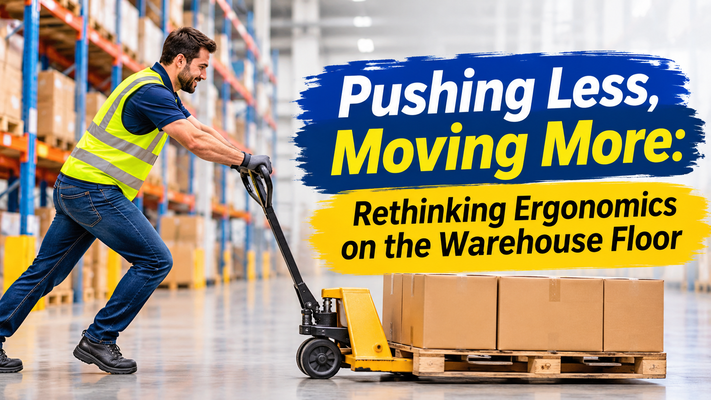
Pushing Less, Moving More: Rethinking Ergonomics on the Warehouse Floor
In many workplaces, moving heavy carts and trolleys is treated as just part of the job. Hospital orderlies push laundry cages, retail staff drag roll cages loaded with stock, and factory workers haul parts between production lines. These tasks look simple, but over time they take a significant toll on the body. Manual handling remains one of the leading causes of workplace injury in Australia, accounting for a large share of serious compensation claims every year.
Reducing that risk does not always require a massive capital investment. Often, the answer lies in rethinking how loads move from one point to another.
The Real Cost of Manual Pushing and Pulling
Pushing and pulling heavy loads places strain on the lower back, shoulders and wrists. The effort required to start a loaded trolley moving is particularly high, and uneven floors, ramps and tight corners make it worse. Injuries rarely happen in one dramatic moment. They build up through thousands of repetitions until a worker can no longer do the job.
For employers, the costs go beyond compensation premiums. Injured staff mean lost productivity, overtime for colleagues, recruitment and training for replacements, and a potential drop in morale across the team.
Applying the Hierarchy of Controls
Work health and safety guidance encourages businesses to address hazards using a hierarchy of controls. The most effective approach is to eliminate the hazard entirely, followed by substituting a safer method, then using engineering controls, and finally relying on administrative measures and protective equipment.
For manual pushing tasks, elimination might mean redesigning a layout so loads do not need to travel as far. Substitution and engineering controls often involve powered equipment that takes the physical effort away from the worker.
Where Powered Towing Fits
Compact powered units designed to tow or push trolleys, carts and wheeled bins have become common in hospitals, airports, distribution centres and manufacturing plants. An operator walks alongside or behind the unit and guides it, while the motor provides the force.
Electric tugs are particularly useful in environments where forklifts would be too large, too noisy or simply unnecessary. They can move multiple trolleys in a train, handle loads well beyond what a person could safely push and navigate corridors and lifts with ease.
Assessing Your Material Flow
Before purchasing equipment, map how materials actually move through your site. Note the weight of typical loads, the distances travelled, the number of trips per shift and any obstacles like ramps, thresholds or doorways. Talk to the people doing the work, as they often know exactly which routes cause the most strain.
This assessment helps identify where powered assistance will make the biggest difference and what specifications the equipment needs, such as towing capacity, battery life and turning radius.
Choosing Equipment That Suits the Environment
Different settings have different demands. Hospitals need quiet, easily cleaned units that can navigate busy corridors safely. Warehouses may need higher capacity and longer battery life for continuous operation. Outdoor sites require units that cope with rougher surfaces and changing weather.
Look for features such as variable speed control, automatic braking on slopes, emergency stop buttons and intuitive controls that require minimal training. Coupling systems should be compatible with your existing trolleys, or adaptable with simple modifications.
Training and Change Management
Introducing new equipment works best when staff are involved early. Explain the purpose, invite feedback and run hands-on training sessions. Some workers may be sceptical at first, especially if they have pushed trolleys manually for years. Once they experience the reduced effort, most become strong advocates.
Training should cover safe operation, speed limits in shared spaces, charging procedures and what to do if something goes wrong. Clear signage and marked pathways help pedestrians and operators share space safely.
Maintenance and Battery Care
Battery-powered equipment needs a simple maintenance routine. Charge units according to the manufacturer’s guidance, avoid letting batteries run completely flat, and keep charging areas clean and well ventilated. Regular inspections of wheels, brakes and couplings prevent small issues from becoming breakdowns.
Keeping a log of maintenance and any faults helps track reliability and plan replacements.
Measuring the Benefits
After introducing powered towing, track key indicators: manual handling incidents, time taken per task, staff feedback and absenteeism. Many organisations find that the equipment pays for itself through fewer injuries and faster material movement. Workers also report less fatigue at the end of shifts, which can improve focus and reduce errors in other tasks.
A Healthier, More Efficient Workplace
Reducing physical strain is not only about compliance. It reflects a culture that values people and recognises that efficient operations depend on a healthy workforce. By assessing material flow, choosing suitable equipment and supporting staff through the change, businesses can move more with less effort and protect their teams for the long term.