
ABS Testauslösung: Causes, Process and Diagnosis Explained
ABS Testauslösung is a term that often appears in automotive diagnostics, especially when dealing with Anti-lock Braking Systems (ABS) in modern vehicles. At first glance, it may sound highly technical—almost intimidating—but in reality, it represents a critical function designed to keep drivers safe under challenging braking conditions.
Understanding ABS Testauslösung is not just for mechanics or engineers. If you’re a car owner, fleet manager, or someone involved in automotive maintenance, grasping this concept can help you identify potential issues early, reduce repair costs, and ensure maximum road safety.
Let’s break it down in detail—step by step—so you walk away with a clear, practical understanding.
Table of Content
- What is ABS Testauslösung?
- Why ABS Testauslösung is Important
- How the ABS System Works
- Working Principle of ABS Testauslösung
- When Does ABS Testauslösung Occur?
- Common Causes of ABS Testauslösung
- Symptoms Associated with ABS Testauslösung
- ABS Testauslösung Process Explained
- Diagnostic Methods for ABS Testauslösung
- Common ABS Fault Codes Related to ABS Testauslösung
- How to Fix Issues Detected During ABS Testauslösung
- Preventive Maintenance for ABS Systems
- ABS Testauslösung in Modern Vehicles
- Real-World Scenario of ABS Testauslösung
- ABS Testauslösung vs ABS Activation
- Tools Used for ABS Testauslösung Diagnostics
- Cost of Fixing ABS Issues
- Safety Risks of Ignoring ABS Testauslösung
- Future of ABS and Testing Systems
- Conclusion
- FAQs About ABS Testauslösung
What is ABS Testauslösung?
ABS Testauslösung refers to the activation or triggering of the ABS test function within a vehicle’s braking system. In simpler terms, it’s when the Anti-lock Braking System performs a self-check or is manually tested to verify that all components are functioning correctly.
This process can occur:
- Automatically during vehicle startup
- During diagnostic scans using OBD tools
- When a fault is detected in the braking system
- During servicing or maintenance checks
Unlike regular braking, ABS involves rapid modulation of brake pressure to prevent wheel lock-up. The test ensures this modulation capability is intact.
Why ABS Testauslösung is Important
Without proper ABS functionality, braking performance can degrade significantly—especially on wet, icy, or uneven roads.
Here’s why ABS Testauslösung matters:
- Safety Assurance: Confirms that the system can prevent wheel lock
- Fault Detection: Identifies sensor or module failures early
- Regulatory Compliance: Ensures the vehicle meets safety standards
- Performance Validation: Verifies real-time braking response
Think of it like a heartbeat check for your vehicle’s braking intelligence.
How the ABS System Works
Before diving deeper into ABS Testauslösung, you need to understand how ABS operates.
Core Components of ABS
- Wheel Speed Sensors
Monitor rotational speed of each wheel - ABS Control Module (ECU)
Processes sensor data and decides when to intervene - Hydraulic Control Unit (HCU)
Regulates brake pressure - Valves and Pump
Adjust pressure dynamically during braking
Working Principle of ABS Testauslösung
When you apply brakes hard:
- Wheels may lock up
- Sensors detect sudden deceleration
- ECU triggers ABS
- Brake pressure is rapidly pulsed
- Wheels regain traction
This entire process happens in milliseconds.
When Does ABS Testauslösung Occur?
ABS Testauslösung can happen under multiple scenarios:
1. Ignition Start Test
When you start your vehicle:
- ABS system performs a self-check
- Warning lights may briefly illuminate
2. Driving Self-Test
At low speeds (usually 10–20 km/h):
- System performs a rolling diagnostic
- You might feel a slight vibration
3. Manual Diagnostic Trigger
Using scan tools:
- Technicians initiate ABS test sequences
- Used during servicing
4. Fault-Induced Trigger
If an error is detected:
- System activates diagnostic routines
- ABS warning light stays on
Common Causes of ABS Testauslösung
Understanding the causes behind ABS Testauslösung is essential for accurate troubleshooting.
1. Faulty Wheel Speed Sensors
One of the most common reasons:
- Dirt or debris buildup
- Wiring damage
- Sensor misalignment
2. Damaged ABS Ring (Tone Ring)
- Cracks or corrosion
- Missing teeth
- Irregular signal generation
3. Electrical Issues
- Loose connections
- Short circuits
- Battery voltage fluctuations
4. ABS Control Module Failure
- Software errors
- Internal circuitry damage
5. Hydraulic System Problems
- Brake fluid contamination
- Pump malfunction
- Valve blockages
Symptoms Associated with ABS Testauslösung
If ABS Testauslösung is happening due to a fault, you may notice:
- ABS warning light stays ON
- Pulsation during braking
- Increased stopping distance
- Unusual noises (grinding or clicking)
- Loss of traction control functionality
These signs should never be ignored.
ABS Testauslösung Process Explained
Let’s go deeper into how the testing process actually works.
Step 1: System Initialization
- ECU activates during ignition
- Checks internal circuits
Step 2: Sensor Verification
- Wheel speed sensors send signals
- ECU verifies signal consistency
Step 3: Hydraulic Check
- Valves and pump are tested
- Pressure response is evaluated
Step 4: Error Logging
- Any irregularities are stored as fault codes
- Dashboard warning lights may activate
Diagnostic Methods for ABS Testauslösung
Accurate diagnosis is crucial. Here are the most effective methods:
1. OBD-II Scanner Diagnosis
Using a diagnostic tool:
- Retrieve ABS fault codes
- Identify specific component issues
2. Visual Inspection
Check:
- Sensor wiring
- Brake components
- Fluid levels
3. Live Data Monitoring
Advanced scanners show:
- Real-time wheel speed
- Pressure readings
4. Resistance Testing
Using a multimeter:
- Check sensor resistance
- Verify electrical continuity
Common ABS Fault Codes Related to ABS Testauslösung
Some frequently encountered codes include:
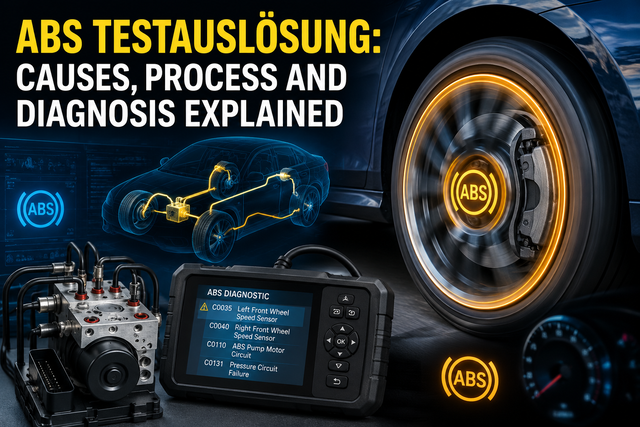
- C0035 – Left Front Wheel Speed Sensor
- C0040 – Right Front Wheel Speed Sensor
- C0110 – ABS Pump Motor Circuit
- C0131 – Pressure Circuit Failure
Each code points to a specific issue requiring targeted repair.
How to Fix Issues Detected During ABS Testauslösung
Fixing ABS-related problems depends on the root cause.
Sensor Replacement
- Clean or replace faulty sensors
- Ensure proper alignment
Wiring Repair
- Fix broken or corroded wires
- Secure loose connections
Control Module Repair
- Reprogram or replace ECU
- Update software if needed
Hydraulic System Maintenance
- Flush brake fluid
- Replace faulty pump or valves
Preventive Maintenance for ABS Systems
Prevention is always better—and cheaper—than repair.
Regular Checks Include:
- Brake fluid replacement
- Sensor cleaning
- Periodic diagnostics
- Battery health monitoring
Keeping your ABS system in top condition reduces unexpected ABS Testauslösung events.
ABS Testauslösung in Modern Vehicles
Modern vehicles have far more advanced ABS systems compared to older models.
Advanced Features Include:
- Electronic Stability Control (ESC)
- Traction Control Integration
- Adaptive Braking Systems
- Autonomous Emergency Braking (AEB)
In these systems, ABS Testauslösung is even more critical because multiple safety systems rely on accurate data.
Real-World Scenario of ABS Testauslösung
Imagine driving on a rainy highway:
You brake suddenly—hard.
Without ABS:
- Wheels lock
- Car skids
- Loss of control
With ABS:
- System activates
- Brakes pulse rapidly
- You maintain steering control
Now imagine if ABS Testauslösung had failed earlier—you wouldn’t even know your system was compromised.
ABS Testauslösung vs ABS Activation
It’s important not to confuse the two.
Feature |
ABS Testauslösung |
ABS Activation |
| Purpose | System testing | Real-time braking control |
| Timing | Startup or diagnostic | Emergency braking |
| Driver Input | Not required | Triggered by braking |
| Outcome | Fault detection | Prevent wheel lock |
Tools Used for ABS Testauslösung Diagnostics
Professional mechanics use:
- OBD-II scanners
- Oscilloscopes
- Multimeters
- Brake pressure gauges
Advanced workshops may also use manufacturer-specific diagnostic tools for deeper analysis.
Cost of Fixing ABS Issues
Costs vary depending on the problem:
- Sensor replacement: Low to moderate
- Wiring repair: Low
- ABS module replacement: High
- Hydraulic unit repair: Moderate to high
Ignoring ABS Testauslösung warnings can lead to more expensive repairs later.
Safety Risks of Ignoring ABS Testauslösung
Neglecting ABS issues can result in:
- Increased accident risk
- Reduced braking efficiency
- Loss of vehicle stability
- Legal compliance issues
In critical situations, a non-functional ABS system can be the difference between a close call and a serious accident.
Future of ABS and Testing Systems
Automotive technology is evolving rapidly.
Future ABS systems may include:
- AI-driven diagnostics
- Predictive maintenance alerts
- Cloud-based monitoring
- Integration with autonomous driving systems
In such systems, ABS Testauslösung will become even more intelligent and proactive.
Conclusion
ABS Testauslösung is far more than just a technical term—it’s a vital diagnostic mechanism that ensures your vehicle’s braking system operates safely and efficiently.
From detecting sensor failures to validating hydraulic performance, it plays a critical role in modern automotive safety. Ignoring it is not an option. Whether you’re a car owner or an automotive professional, understanding and responding to ABS Testauslösung can save lives, reduce costs, and improve overall vehicle reliability.
Stay proactive. Monitor your system. And never ignore the signals your vehicle gives you.
FAQs About ABS Testauslösung
What does ABS Testauslösung mean?
It refers to the activation of a test or diagnostic function in the ABS system to ensure proper operation.
Is ABS Testauslösung normal?
Yes, during startup or diagnostics. However, frequent or unexpected triggers may indicate a problem.
Can I drive with ABS warning light on?
You can, but it’s unsafe. Your braking system will work, but without ABS protection.
What causes repeated ABS Testauslösung?
Common causes include faulty sensors, wiring issues, or control module failures.
How do I reset ABS after a fault?
Use an OBD-II scanner to clear codes after fixing the issue.
Does ABS Testauslösung affect braking?
Not directly, but if it reveals faults, braking performance may be compromised.
How often should ABS be tested?
During regular servicing or when warning signs appear.